Blackfoot, American Falls reservoirs offer great flat-water angling opportunities in East Idaho

You might be getting the feeling that the winter season has dragged on long enough. While the winter season offers some outstanding hard-water angling opportunities, the open-water season offers abundant opportunities as well. Especially notable are the great trout fishing opportunities in the Southeast Region’s two largest reservoirs: Blackfoot and American Falls.

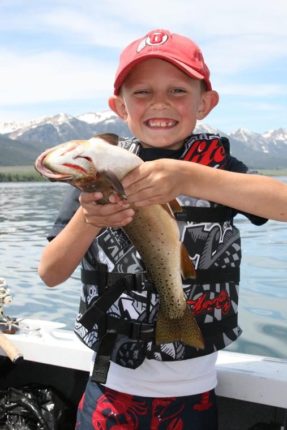
The open water season typically begins around the first week of May at Blackfoot Reservoir; however, the trout fishing usually doesn’t pick up until around the first week of June. Catch rates of both rainbow and cutthroat trout during this period can easily reach double digits per day. The average size of fish caught in the spring is around 18 inches, but trout weighing upwards of 5 pounds are not uncommon. The Idaho Department of Fish and Game stocks about 300,000 rainbow trout annually for anglers to harvest, which pairs well with the general harvest rule of six trout per day; but remember, no cutthroat trout can be harvested from this reservoir.

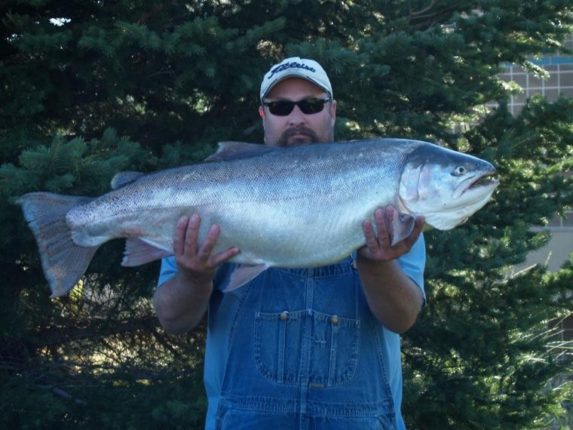
Angling opportunities at American Falls Reservoir typically begin earlier than in its eastern, high elevation neighbor, Blackfoot Reservoir. Catch rates for rainbow trout can also reach double digits during the months of May and June. In addition to rainbow trout, American Falls also boasts a decent population of rainbow-cutthroat trout hybrids. In fact, the state record for this hybrid was harvested from the reservoir in 2011 and weighed nearly 35 pounds. The high spring catch rates experienced by anglers are tied to the large number of rainbow trout stocked there annually — over a half a million! At American Falls, anglers can harvest a total of six trout per day, all species combined.

To target trout in Blackfoot and American Falls reservoirs, try trolling close to the surface and near the shoreline with some traditional pop gear or a flasher, trailed by a wedding ring spinner tipped with a little night crawler. Additionally, trolling a variety of spoons and crank baits near the surface can also be quite productive. Having a fishing boat at your disposal does make access to these fisheries a bit easier; however, both reservoirs have several access areas that provide bank fishing opportunities. The best way to find these access points is to consult Fish and Game’s Fishing Planner.

Southeast Idaho has experienced average to above average snowpack levels over the past several years, and consecutive good waters years are paying dividends for fish populations in the upper Snake River drainage. What this means to anglers is there will be plenty of fish to catch this open water season. Your fish of a lifetime could be swimming somewhere in the Southeast Region, waiting for you.

Sailfish in Mexico beat ice fishing in Idaho

While fishing through an 8-inch round hole cut in ice on Chesterfield Reservoir, I decided Mexico and sailfish were calling. Two weeks later, my fishing partner and I were bobbing in the Pacific along a pristine section of Southern Mexico’s Pacific coast, 100 miles south of Ixtapa-Zihuatanejo, Mexico, in 80-degree weather.

We were on a low-cost fishing trip to a top-rated sailfish destination. Rustic is the best way to describe the area. Puerto Vicente has solitude, no fishing pressure and a reputation for good sailfish in April. It was ranked No. 2 in the world for sailfish by Salt Water Magazine. It features a fishing village with mud streets, no high-rise hotels, chickens walking the roads and no other gringos.

This area is named Costa Grande, Mexico, a 150-mile stretch of pristine coastline. It is remote and too far from Zihuatanejo and Puerto Vallarta for the big cruisers to make day trips; thus it is under fished. We seldom saw another boat. The only small harbor there is Puerto Vicente, where fishing guides pick you up in a well-used 1980 Ford F150 and you climb in, sit on a wooden bench seat for a rough ride over a potholed dirt road to the marina and an ocean adventure.

My fishing partner John Jennings and I fished out of a 20-foot fiberglass boat called a ponga with a 60 horse power Mercury outboard motor. We hooked up with a guiding outfit named El Bandidio Del Mar. Yes, that translates to Bandit of the Sea. They have a package deal of room, board, guide and boat. A no-frills boat with a bench seat for each of us and a canvass top to keep the sunburn down. This little craft would take us up to 15 miles off shore to find marlin and sailfish. Skeptical of the fishing gear we might encounter we brought our own rods, reels and lures. The guides caught or bought fresh bait before sunrise and out we went.

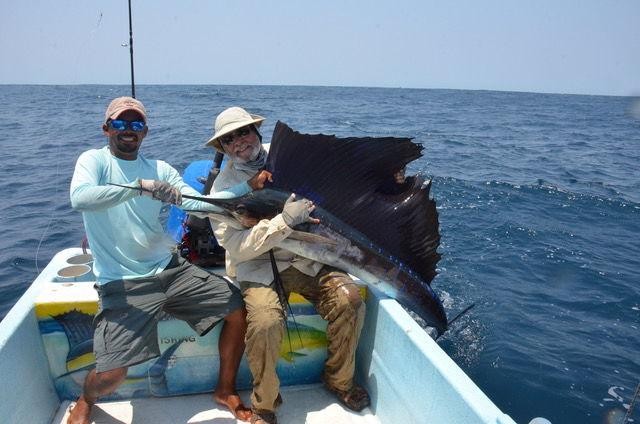
Three miles off shore, our guide Manuel spotted a sailfish on top of the water and the hunt was on. We trolled two giant lures and a live flying fish in the sailfish’s direction. The sailfish turned and raced toward John’s live bait. It batted the bait with its long sword-like bill before inhaling it. The guide hit the throttle gunning the boat forward and flipped John’s reel into free spool. Seconds later, he said “hang on” and engaged the drag on the reel setting the hook firmly into the jaw of the sailfish and nearly jerking John’s arms out of their sockets.

The lined ripped out as the 100-pound fish bolted away. Tucking the butt of his fishing rod into the plastic holder he had strapped to his waist he let the fish run until it jumped. Then he started pumping the rod up and down trying to gain back the line he lost to the fish’s initially run. No luck; it took off again, this time going airborne three different times. Thirty minutes, later it came to the boat its colors shimmered beneath the waters.

With a skilled hand, our guide grabbed the 200-pound shock leader and hauled the fish forward until he could grab the sailfish’s bill. It looked like a life-and-death struggle between the guide and the sailfish until the sail stopped thrashing and shaking stopped and could be lifted out of the water for a picture and released. No extra deck hand to help; just one guide and us.

For the picture, the guide seated John next to him on the back bench seat and hoisted the sailfish up on to John’s lap as he held the bill. A good shake and the fish could have knocked both of them back and into the water. I took a quick picture and the sail went back into the Pacific.

Pods of dolphins delighted us as they played under our boat. When we sped up to 20 to 25 mph, the dolphins kept pace gracefully leaping out of the water in front of us. The number of sea turtles was astounding; we saw 50 to 100 a day. Most were small — the size of garbage can lid — but we saw some big ones that weighed over 100 pounds.

That night at the waterfront diner and hotel, we toasted John’s sailfish and three other marlin caught and released by other anglers at the small lodge. All of us had strikes and bill fish on. We ate fresh dorado served by our host/guide’s wife and looked out over the small bay. The accommodations were Motel 6-style, but the beds were comfortable, no bugs and area quiet. Except for the rooster that crowed from 2 to 5 a.m.

Fresh-squeezed orange juice, scrambled eggs and a homemade roll got us going, and we loaded up the Ford and rode to the dock in the dark. Morning dragged by without a strike; then we had a double hook up. A pair of marlin came out of nowhere smashing our lures. Mine leaped and came off almost immediately; meanwhile John’s headed to the bottom of the ocean. The battle would last nearly an hour, tiring John out and bring a beautiful fish to the boat.

The marlin was not a big one by “Old Man and The Sea” standards — around 120 pounds — but it was a magnificent fighter. And you could not see land, only ocean.

Over the next two days, luck was with me. I landed two sailfish and a marlin each similar in size to John’s. Then the seas turned rough with 6- to 8-foot waves and whitecaps. We stayed inland and fished for crevalle jack, rooster fish and dorado in the lee of the peninsula. Schools of jacks stretching the length of a football field were migrating north next to shore and provided constant action.

The last night we had a lobster, a dinner to remember. It was Easter Day and bands play off in the distance, the sun sank into the pacific and we feasted. Good memories to savor especially since all of us in Idaho are sheltering in place, dreaming of favorite adventures.

For information on Bandito Del Mar Fishing, look it up on Facebook or visit bandidodelmar.com.

The best flight we found to Ixtapa-Zihuatanejo, Mexico, was with Alaska Airlines.

Salt Water Magazine featured this area several years back and describes the fishing and area.

Harry Morse is currently a freelance writer living in Pocatello. His articles have appeared in national hunting and fishing magazines. The majority of his career he worked for Washington, Idaho and California Departments of Fish and Wildlife as an information officer. He has travel broadly an enjoys photography, fishing and hunting.

So you’ve got cabin fever

It seems like 90% of the people spend their life in a quandary. The ones that have the money to go hunting or fishing as much as they want are always working. And the people that have all the free time in the world, don’t have enough money to go.

I’m afraid with the current situation that we’re in with so many businesses shutting down, that a lot of people are hurting more than ever since probably the days of the Great Depression. So right now most people are in the latter boat, plenty of free time but no money.

But I’m a big believer in making the most of whatever situation that you find yourself in instead of wishing for something else. So with that said, let’s list out some low-cost outdoor options to entertain ourselves.

First, let me dispel one myth. You don’t have to go first class. I had the best parents in the world but we weren’t rich. So I learned to get by with nothing. In high school Richard Jaco and I would go to the lake for the weekend hunting and trapping. We’d be lucky to have $2.00 between us for gas. We’d have a coke and a piece of candy to eat for Friday night and Saturday. We didn’t have a tent and my sleeping bag had a broke zipper. We survived. And actually had a blast.

I used to rodeo a lot. A lot of guys may have enough to go to one rodeo every week or two. They’d stay in decent motels, eat out and live high on the hog. I learned if I went and slept in back of my car or in a room with four other cowboys, I could hit three rodeos/wk.

I’d rather go a lot than to have one Taj Mahal vacation per year. You can do a lot if you learn how to scrimp. So the morale to the above story is, tighten your belt and get outdoors and have fun.

So what are some low-cost outdoor activities that we can do and still stay within the guidelines of social distancing?

WHISTLE PIG HUNTING

Ok, ok, I’m simple minded but I love whistle pig hunting. It’s low key and non-stressful. If you miss one it’s not like you’ve hunted for 10 days and missed the bull of your life time. .22 ammo is back down in price where it is affordable and if that is still too expensive for you then use an air rifle. Like alluded to in my earlier articles a few weeks ago they’re a blast to hunt with.

https://www.idahostatejournal.com/outdoors/xtreme_idaho/whats-the-fuss-about-airguns-part-1/article_29c668ce-cd45-5680-a92d-6973c2c7ed51.html

https://www.idahostatejournal.com/outdoors/northwest/whats-the-fuss-about-airguns-part-ii/article_78c81e59-16d0-5b55-9f49-06ece88755eb.html

CRAPPIE FISHING

Any second crappie fishing is going to turn on. That is one of the highlights of the Idaho outdoor world. We’re blessed. We have great crappie fishing here. Sure, it’s nice to have a boat but don’t feel handicapped if you don’t. You can still load up on them.

PLAIN OLE CAMPING

Why is camping so much fun? Just go up in the mountains, throw up a tent and build a campfire, cook dinner and later on roast marshmallows. When the kids were small, we’d go camping nearly every weekend.

I have all daughters. We’d set up at night around the campfire and have a ball. The little rascals would have talked all night if I would have let them! I’d get up early the next morning and fire up a pot of coffee and read my newspapers until they woke up.

Katy told me if I was going take the girls camping I’d have to learn how to fix their hair. So they’d wake up, I’d fix hair and then we’d cook breakfast. Then we’d go exploring. They’d pick flowers and put in a bottle to later carry home to mom. We had a great time and it only cost a few dollars for gas.

HIKING

There are 50,000,000 trails in Idaho. Do a big day hike on a Saturday. Or used to a lot of times we’d go up in the mountains after work on Friday and take a can of tamales, build a little fire and heat them up. We’d spread out a sheet and look at the stars and then hike back to the truck.

By the time we headed down they’d be riding on our shoulders fast asleep. The little terds would pick up a 100 lbs. of rocks and put in their pockets. I’d be throwing them out on the way down to lighten the load. Those were fun times.

BOWFISHING

No doubt, you can do better if you have a boat but I have shot truckloads of carp while wading. And don’t feel like you have to have a $750 setup. If things are tight grab an old recurve at a pawn shop or on eBay, slap on a reel, grab a few arrows and hit a lake or river. I used to go carp hunting nearly every afternoon after work.

SUMMARY:

You get my drift. There’s a million things to do outdoors so get out and have fun. We don’t like to be around other people when outdoors anyway so just stay away from anyone you happen to see. There’s a big outdoors out there waiting to be discovered. Use this free time and go have some fun.

Tom Claycomb lives in Idaho and has outdoors columns in newspapers in Alaska, Idaho, Utah, Nevada, Colorado and Louisiana.He also writes for various outdoors magazines and teaches outdoors seminars at stores like Cabela’s, Sportsman’s Warehouse and Bass Pro Shop.

Stuck inside? Go outside with these national park virtual offerings

You’re stuck at home, the national parks are closed, and cabin fever is setting in.

If you don’t mind a bit of computer clicking, Yellowstone National Park and Grand Teton National Park can be brought into your home with stunning photos and cute videos of bison jams or eagles soaring.

For real-time images, both parks offer webcams of fixed scenes of iconic views such as Old Faithful or the Teton Range. Some are less exciting, such as entrance gates. But while fairly static, webcams can offer useful information on weather conditions or how busy the traffic is. For example, Friday’s webcam at the West Entrance at West Yellowstone, Montana, showed a blocked gate and snow-covered road.

“Webcams are always popular, and lately we’ve been doing some Facebook Live events,” said Yellowstone park spokesman Linda Veress. “There is so much information on the park’s webpage, too. I am learning something new every time I’m on there.”

A good place to start online exploring in Yellowstone is at nps.gov/yell/learn.

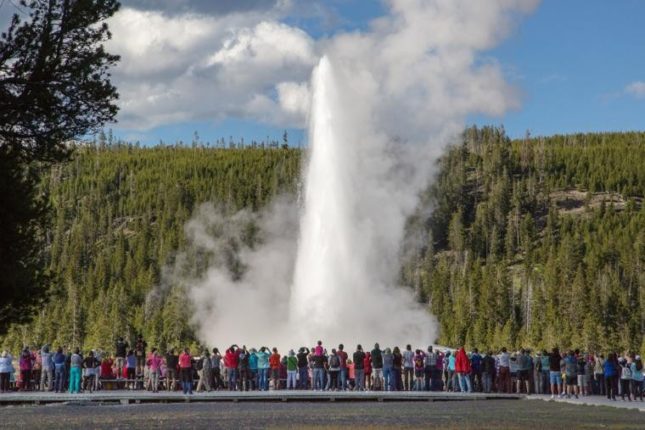
For something a bit fancier than webcams, Yellowstone National Park has a 12-minute video, “Experience Yellowstone,” that shows nice images of many of the park’s iconic animals and beautiful scenic spaces. Although you’ll see crowds gathered around Old Faithful, you won’t have to jostle for a view to see over that 6-foot 5-inch tourist from New York City.

Yellowstone also has a series of a dozen “in depth” videos about five to 10 minutes long on a variety of subjects dear to park lovers. Learn about bears, wolves, geysers, invasive species, bison and goats. Other park video series include “Minute Out In It,” “Q&A,” “Inside Yellowstone,” “Visiting Yellowstone” and “Wildlife Safety.” Each series includes several short videos on a variety of topics. Enough to burn up a couple of hours.

To find Grand Teton National Park videos, go to the “Learn About the Park” section on the park’s official website and spend some time with all the offerings (nps.gov/grte/learn).

A couple of popular connections include “Podcasts and Cell Tours” and “Dispatches from the Field” which is Grand Teton’s own YouTube channel.

Grand Teton also offers “distance learning programs” available on YouTube, Flickr, Facebook, Instagram and Twitter. The program is a ready-made lesson for children (and adults) to learn about a variety of subjects that affect the park. Current topics include how snow impacts everything about the park. The programs are meant to augment school instruction.

There’s also a “Kids & Youth” section with an online activity book to occupy youngsters with a goal of achieving a Junior Park Ranger badge. It’s fun homework for sequestered families wondering what to do next.

Grand Teton also has a “Photo Gallery” that is divided up into mini-galleries with nice images of landscapes, animals, plants, history, visitors and education.

Of course, one can always search YouTube (a dangerous proposition) for interesting videos on Bison vs. Tourists or climbing the Grand Teton, but beware of quickly being lured away into cute cat videos or stupid human antics.

EVEREST CLOSED: Coronavirus hits mountaineering crews hard

Apa Sherpa knows firsthand all the risks of climbing Mount Everest. He’s been to the summit 21 times.

The potential for a COVID-19 outbreak at base camp had him just as fearful as a blizzard or cracking ice.

The 60-year-old mountaineer from Nepal who now lives in Salt Lake City applauded the decision to shut down the routes to the top of the famed Himalayan mountain over concerns about the new coronavirus.

That meant Sherpa didn’t have to worry about the health of anyone on the mountain, including his niece, nephew and cousin as they follow in his Everest-climbing footsteps.

Now, he has another fear: How will those who work in the shadow of Everest make ends meet?

“I just feel bad,” said Apa Sherpa, who established a foundation to help Nepalese students with their education. “For everyone.”

Phurba Ongel was all set for spring work guiding western climbers to the 29,035-foot Everest summit when he heard the news. He has already scaled Everest nine times and makes about $7,000 per season.

That was money he desperately needs for his two sons’ school, rent and groceries.

“Now,” Ongel said, “I don’t have much.”

Also losing money are clients, who dole out anywhere between $35,000 to $85,000 to be led up the mountain, and expedition operators who have expenses to pay despite the closure.

“It is devastating for the tourism industry in Nepal and abroad,” said Lukas Furtenbach, a mountaineering guide and founder of Furtenbach Adventures. “Many businesses will not survive this.”

China shut down the northern route through Tibet due to the COVID-19 pandemic on March 12. A day later, expeditions to the Nepal side were closed, too. Everest straddles the border between Nepal and China and can be climbed from both sides.

By shutting down the passage through the south route of Everest, the Nepal government stands to lose some $4 million in permits alone. There are thousands of people who depend on the money spent by climbers in Nepal.

“They have no income right now. Nothing,” Apa Sherpa said. “But the government made the right decision. The lives are more important.”

According to Ang Tshering, a mountaineering expert in Nepal, the mountaineering industry in the region brings in about $300 million annually — and most of it during the spring climbing season that begins in March and ends in May.

“The closure of the mountains has made thousands of people jobless in the mountaineering community,” Tshering said.

It’s setting up a potentially risky proposition in 2021 — overcrowding on the mountain. There will be a backlog of clients eager to make the trek, along with a new batch of climbers.

Last May, a climber snapped a memorable photo from a line with dozens of hikers in colorful winter gear that snaked into the sky. Climbers were crammed along a sharp-edged ridge above South Col, with a 7,000-foot drop on either side, all clipped onto a single line of rope, trudging toward the top of the world.

“It would be very important that Nepal puts reasonable regulations in place for operators and climbers,” said Furtenbach, who resides in Austria and spends time at Lake Tahoe. “Otherwise, I see that risk for a total mess next year.”

For the Sherpas, it’s about finding a way to hang on after their source of income was halted. They’re the backbone of an expedition — the first to reach Everest each climbing season and the last to leave. They set up the camps, carry the equipment and cook the food for climbing parties. They fix the ropes and ladders over the crevasses and ice-falls that enable mountaineers to scale the peak.

Generally, a Sherpa can earn $10,000 or more should they summit. Porters or cooks at the mountaineers’ camps average between $3,000 and $5,000 during their three months of work. That’s a significant amount compared with Nepal’s $1,035 annual per capita income.

But it’s treacherous work.

That’s why Apa Sherpa started his foundation — to give young kids another route.

Born into poverty and with a modest education, he had no choice but to climb. By the age of 12, he was working on climbing expeditions. At age 30, he summited Everest for the first time. He had earned the nickname “Super Sherpa” before retiring in 2011.

His organization — the Apa Sherpa Foundation — attempts to provide hot meals to students at the Ghat School in the Khumbu region. It also pays the salary of six teachers in Thame and provides school supplies such as computers. He’s hoping to expand the foundation’s reach into other schools in Nepal.

“If I’m still in Nepal, I have no choice. I would have to climb,” said Sherpa, who moved to the U.S. in 2006. “I have a choice here in America. I don’t have to take a risk. I’m just trying to help.”

The climbing community has seen an interruption on Everest before: An earthquake-triggered avalanche killed 19 at the base camp in 2015 and another avalanche over the dreaded Khumbu Icefall in 2014 killed 16 Nepali workers.

Apa Sherpa shuddered at the thought of anyone being at base camp in the midst of the coronavirus. He has plenty of family who still serve as mountain guides.

For most people, COVID-19 causes only mild or moderate symptoms, such as fever and cough, with the vast majority recovering in about two weeks. But anything respiratory can have dire consequence at base camp, where there are climbers scattered around in tents as they acclimate.

“At high altitude our respiratory systems are incredibly distressed and challenged,” said Adrian Ballinger, the founder of Alpenglow Expeditions. “We do know the coronavirus, which affects the respiratory system and can lead to pneumonia, would absolutely be much more serious and lead to potentially serious consequences and fatalities much more quickly at altitude.”

Ballinger had 11 clients scheduled for the summit team to the Tibet side of Everest, along with seven foreign mountain guides and 18 Sherpas.

He’s trying to lessen their financial hardships as best he can. Same with Garrett Madison, a guide based out of Seattle who was scheduled to lead his 14th Everest expedition.

“This is a tough time for sure. Thankfully we’ve saved up a rainy day fund to weather the storm,” Madison said. “With Everest canceled (our largest program of the year), as well as all other programs in jeopardy because of travel bans, we don’t know when we can resume normal operations of our programs.”

To celebrate recently turning 50, Graham Cooper of Piedmont, California, planned to summit Everest from the Tibet side with Ballinger. It was a bucket-list item for Cooper.

To prepare, he slept in an oxygen tent to simulate the thin air. He also ventured to Lake Tahoe, where he trained by hiking up the snow-packed slopes and skiing down.

Then, he received the text he was fearing: No trip. The mountain was closed.

Sure, he was disappointed. But he also understood.

“It’s not the end of the world,” Cooper said. “There’s always next year.”
Yes, you can hunt and, yes, you can fish

Idaho Fish and Game has not closed any fishing or hunting seasons in response to COVID-19, and the department is providing guidelines in accordance with the governor’s orders for social distancing at least 6 feet apart, including while fishing and at access sites and boat ramps.

“Fishing lends itself to social distancing,” Fish and Game State Fisheries Manager Jim Fredericks said. “In fact, for most types of fishing, general etiquette says if you’re fishing within 6 feet of the next person, you’re way too close.”

Lakes, reservoirs and streams are vast places where anglers can easily put space between themselves. During the statewide COVID-19 order, it’s extremely important that people recreating on the water make extra efforts to maintain social distancing at the access sites, boat ramps and in the parking lots.

Anglers are advised to launch boats quickly, minimize dock time, maintain space between people and don’t gather in crowds.

“Please help ensure our boat ramps and other public access sites remain open,” Fredericks said. “Maintaining opportunities to enjoy outdoor recreation will depend on people doing it safely. Enjoy your time outdoors — responsibly.”

Travel guidelines for hunters and anglers

Because hunting and fishing may require some travel, the Governor’s Office has provided some additional guidelines for all recreationists:

  • Minimize your travel distance from your home and spread out. If a trailhead or other access site is congested, consider finding another one, or go during off-peak hours.
  • Check before you go. Many campgrounds and trails may be closed.
  • Bring all supplies you will need from home to avoid putting unnecessary strain on local grocery stores or convenient stores that serve the local population. Make sure you pack out all your trash and leave your space clean.

For more information about COVID-19 related to Fish and Game, see F&G’s COVID-19 information page on the website: idfg.idaho.gov.

Go fishing — pre-spawn crappie fishing, that is

It happens every year. One warm, sunny day and I think it’s full-blown spring. Time to load up the boat, wife and kids and go crappie fishing. But, as an old boss used to say, one robin doesn’t mean it’s spring.

But the above happens every year, the first warm day of pre-spring (and more so the longer the winter has been) so I guess I will die starting my crappie fishing too early. But you actually do want to start a week or two early. You don’t want to doodle around and miss being on the lake when the spawn actually does start. It is too big of an event to miss.

As I type this article, it is March 21. By the time it prints on April 2, depending on how the weather is between now and then, the spawn should be within a week of starting.

If you are wondering why I am being such a drama queen and panicking about being late to hit the crappie spawn, then that means that you have never eaten a crappie. We are super blessed to live in Idaho. Most people think of crappie as a southern fish, but here in Idaho and Oregon we have better crappie fishing than a lot of the southern states. Maybe not as big but more prolific. For instance, I think the limit in Texas is only 25 per day. Here, we don’t have limits.

But to be wise conservationists I think we ought to throw back the smaller ones for breeding stock. It seems like the supply is limitless, but I’m sure the early settlers thought the same about passenger pigeons and bison.

So you’re successful, here will be the format. The experts tell us that crappie start moving out of their deeper wintering holes when the water hits something like 45 to 50 degrees. Then, when it hits 55, they’ll stage outside of their spawning areas. Then, near 60 degrees, the males will move in and fan out a bed.

Crappie will be on a pre-spawn feeding binge during this time. And then when the water temp gets up to 60 to 65, they move in and start spawning.

When they’re spawning, they’ll be literally 1 to 2 feet from the shore. There are lots of ways to catch them at this time, but here is the method I like. I tie on a small jig head and slip on a tube jig. About 12 to 18 inches above the jig, I put on a pencil bobber. I don’t know why it matters but I catch a lot more fish with a pencil bobber as opposed to the ol’ red/white round bobber. When the bobber stands up, let him pull it under or start running with it and then lift up your rod tip and start reeling.

Don’t jerk the rod tip and set the hook or you’ll rip their lips off. They are called paper mouths for a reason. In fact, any keeper fish, I net. The bigger they are the more likely it is that they will rip off when boating them.

But we’re getting ahead of ourselves. They aren’t in the spawning mode yet. More than likely right now they are staged out about 20 yards from the bank. I will use the same jig but put a small split shot about four to six inches above the jig so it will sink down. The windier it is the bigger, or more, split shots I use.

To fish the above set-up, I’ll cast out the jig and let it drop down. Then I’ll slowly lift my rod tip and reel in the slack as I’m dropping the tip back down. If the line goes slack when the jig is sinking, a fish has hit it. Again, lift the rod tip and start reeling to set the hook. I’ll get a lot of hits while bouncing along the bottom, especially if perch are present.

I’ll fish the jig like this all the way back up to the boat. I get a lot of hits up higher in the water column.

At first I thought they had followed it up from the bottom but now I say I am catching ones that are suspended up higher.

So the moral to the article is just because crappie haven’t moved in and started spawning yet doesn’t mean that you can’t catch them. Just move out deeper and catch them pre-spawn.

Tom Claycomb lives in Idaho and has outdoors columns in newspapers in Alaska, Idaho, Utah, Nevada, Colorado and Louisiana. He also writes for various outdoors magazines and teaches outdoors seminars at stores like Cabela’s, Sportsman’s Warehouse and Bass Pro Shop.

Pennsylvania Gunsmith School offers alternative career option

At the 2020 SHOT Show, Ron Spomer introduced me to Robert Thacker and Jamey Wojtaszek. Robert owns the Pennsylvania Gunsmith School and Jayme works there. PGS is doing fine but they’re concerned about the dropping numbers of students across the country in the majority of the gunsmithing schools.

Due to this concern they’re encouraging young people to choose gunsmithing as a career. I hear similar concerns among the gun experts that the numbers of hunters/shooters are dropping and the current ones are an aging group.

So as not to start off as a Negative Nancy, here’s some encouraging news. I attended a seminar at the SHOT Show put on by Safe Shoot, which is an Israeli company. One of the speakers said that actually, shooting is the No. 2 sport in America, even ahead of golf. That surprised me.

If that is the case, then it’s alarming that the number of kids going to gunsmithing schools is dropping because there will obviously be a need for more, not fewer gunsmiths on the not too distant horizon.

I’m about to say something that up until the last few years I was on the opposite side of the aisle. In the past, I encouraged kids if at all possible to go to college. If they couldn’t afford that then at least work and attend a junior college and get an associate’s degree. I no longer hold that stance. Let me explain.

Higher learning institutions have lost their compass. Their goal is no longer to teach kids to graduate work ready. They now have too many hidden social changing agendas. Kids go off to college conservatives and return as socialists. The colleges spend way too much time teaching/pushing these agendas. Many kids no longer graduate with useful skills.

I used to hire a lot of college kids when I was the director of quality control for Con Agra. I had five large beef plants and a cooked plant under me so I had a large QC staff and hired a lot of college kids. Even back then the colleges thought that they knew more what the kids needed to be taught than the industry did. I only had one professor inquire what skills their graduates were lacking in. Is that not bizarre? Would any business survive if it didn’t do customer service audits? Investigate open markets?

Due to my ignorance, I thought trade schools were for kids like in my high school that would have dropped out but due to shop classes they hung in and graduated (Yes, this was all nearly 50 years ago).

Then 15 years ago I started learning what some of the skilled workers were making. Such as linemen, electricians, dental assistants, etc. It costs an arm and a leg to hire a good maintenance man — if you can even find one. So now, if a kid can’t afford college, I recommend they go to a reputable trade school. They may graduate right off the bat $200,000 ahead of the normal college graduate because of no student loans and have an extra two and a half years of wages already in the bank by the time their college buddies graduate.

So, let’s play this out. They could work for an established gunsmith after school and learn the ropes.

After four or five years they could then open their own shop while their college graduate counterpart is still in some menial job barely getting by with no hope in sight and a huge student loan hanging over their head.

So what I’m saying is, if a kid is a hustler but for whatever the reason doesn’t have the option of going to college, I don’t see him/her as being handicapped. There are a million options. Go to beauty school. Same scenario. Work for someone else, learn the ropes and then in a few years open your own shop. When you have a few employees then you are making money off of them as well as your own labors.

Before you think I’m nuts, think about it for a minute. A high percentage of kids go to a four-year school and graduate with a degree that is not in demand and come out with huge debt. On the other hand, a kid could go to somewhere like the PGS and graduate in 16 months. With a part time job, they may be lucky enough to graduate with no/low debt.

It takes four semesters to graduate. Students of any skill level can expect to complete the program. Every student starts at the same spot and being a course hour program, they typically finish at the same time. They have graduates in all 50 states and 18 countries.

I’ve never been to the school but here’s what I’d loosely suggest if you attend the PGS school or another trade school. Get a part-time job so you’re not racking up loans. After you graduate, get a job with a reputable gunsmith that you can learn from. Work for him a few years and learn the ropes instead of opening your own business right off and making costly mistakes at your expense. Then in a few years when you’re comfortable open your own shop.

I stand to gain nothing if you go to the Pennsylvania Gunsmith School or not. If gunsmithing isn’t for you, find what you like to do and be the best you can at it. The moral to the story is don’t feel like a second-class citizen if you can’t afford or have no desire to go to college. Be a hustler and sharpen your skills and you may actually end up better off.

Tom Claycomb lives in Idaho and has outdoors columns in newspapers in Alaska, Idaho, Utah, Nevada, Colorado and Louisiana. He also writes for various outdoors magazines and teaches outdoors seminars at stores like Cabela’s, Sportsman’s Warehouse and Bass Pro Shop.

Raptor rehab: Fish and Game helps rescue, rehab injured raptors

It often starts with a phone call from a concerned person to Idaho Department of Fish and Game. A large raptor is suffering along the side of the road.

Eagles, hawks and owls are attracted to the roadside. The living can be easy — and dangerous. Fish and Game estimates several are hit each month.

Matt Proett, diversity biologist with Fish and Game, said they have had as many as 20 or more reported in a month. Fish and Game partners with the Teton Raptor Center in Wilson, Wyoming, to nurse the birds back to health and release them back into the wild. As of March 13, the center had taken in 14 birds this year.

“I just picked one up yesterday,” said James Brower, regional communications manager for the Upper Snake Region. “It was another rough-legged hawk in the Rigby area. It looked like it had been hit by a car. It had also been sprayed by a skunk. Insult to injury, absolutely.”

Eagles are attracted by an easy meal of roadkill. Owls and hawks perch on roadside fenceposts or power poles and target rodents bolting across borrow pits or open roads. Then a car comes and hits the distracted bird.

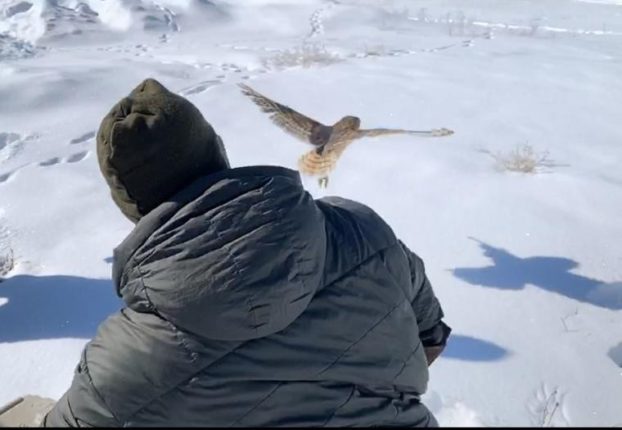
Fish and Game recently released three rehabilitated raptors back into East Idaho wildlife management areas — a bald eagle, a barn owl and a rough-legged hawk.

The bald eagle had recovered from a mild case of lead poisoning.

“The barn owl had some head and eye trauma from a car strike,” Brower said. “The rough-legged hawk had some soft tissue trauma and a sore wing, likely from a vehicle collision.”

You can find a short video of the birds being released at tinyurl.com/pr-raptor.

Fish and Game volunteers and Teton Raptor Center volunteers play the role of bird ambulance, delivering the sick or wounded to the center.

“The bird species vary depending on the season and which ones are migrating through the area,” Brower said. “Right now it’s a lot of rough-legged hawks.”

He said saving the birds is not necessarily a matter of protecting the population, “but there are some birds such as great gray owls and golden eagles that are of great conservation need which puts them higher on the priority list. Their numbers are fairly low. This is one way we can make sure they persist on the landscape.”

Once the ill or injured birds arrive at the Teton Raptor Center, experts swing into action.

“They really have state-of-the-art facilities over at the Teton Raptor Center which is the reason we take all our birds over there,” Brower said. “They have X-ray machines and a top-notch vet that works for them. They are second to none when it comes to rehabin’ these raptors.”

Because of donations, the price is also right.

“They do all of it free of charge for us,” Brower said. “They do all their own fundraising.”

To learn more about the Teton Raptor Center and to donate to the rehabilitation of raptors, go to tetonraptorcenter.org.

Fish and Game offers these tips should you find an injured raptor:

• Give it space. Keep your distance to avoid undue stress.

• Get an accurate location and description of what you have observed.

• Call the nearest Fish and Game office.

Scooter’s Youth Hunting Camp always a blast

In 2005, my wife Katy, who is a school teacher, came home from school one day and told me that there were two kids in her school and their dad had been put in prison. She told me that she’d signed them up for some youth hunting camp named the Scooter’s Youth Hunting Camp, and she wanted me to take them to the camp and then take them both deer hunting.

What? I don’t want to sound self-centered, but the camp is held the first Saturday in May. Spring in Idaho is a flurry of outdoor activities. It’s the ultimate for the outdoorsman. Bear hunting is hot, turkey hunting is on, crappie are going ballistic, whistle pigs are coming out in the droves and the morels are popping up. I about died.

Well, I was stuck. The day came and we headed up to the little mountain town of Emmett, Idaho, where the camp was being held. Whoa, this was going to be a big event. The kids were divided into six groups and rotate to the six different stations. In between stations, seminars are conducted. This camp was awesome. I had to help with this deal.

Fast forward 15 years. The camp has grown and we had to go to an online registration. Last year, it filled up with 260 kids in 47 seconds. In a nutshell, here’s how it runs. The kids show up and even though they’re preregistered, they still sign in. They’re given a bracelet that signifies which one of the six groups that they’re in and given a bag filled with goodies donated by various companies. For instance, Swab-ITS gives them some gun cleaning swabs, MyTopoMaps gives them coupons for maps and Blue Lizard gives them a package of sun screen.

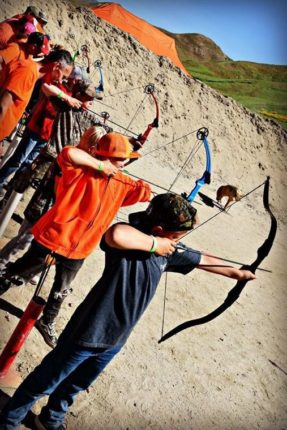
The Pledge of Allegiance is said, many times led by an enlisted serviceman about to head out for duty. A prayer is then given by a local pastor and it’s off to the races. Group one starts at the shotgun station, group two at the .22 range, group three at the blackpowder range, group four at the archery range, group five at the knife-sharpening/gun-cleaning station and group six at the survival station.

After the allotted time for that session is over, they gather in the commons area for a seminar put on by a pro-staff member. The seminars are excellent. There are some top-notch presenters like Rockie Jacobsen the owner of Rocky Mountain Game Calls who puts on the elk & turkeys calling seminars and Fowl Weather Custom Calls puts on a waterfowl calling seminar.

After the seminar they rotate to their next station. At noon, volunteers serve lunch to the kids. Due to local donations and volunteer help the kids eat free and have snacks throughout the day. A local donut shop, HeBrews Coffee sets up a donut trailer. I love their sugar/cinnamon donuts.

There’s a raffle table set up that helps fund the camp. At the end of the day is the kid’s drawing. Every kid wins a prize. And I don’t mean a rinky dink Chinese finger pulling gizmo. Last year there were 25 guns, 10 bows, backpacks, knives, etc., given away.

I hesitate to list the generous sponsors since there is no way that I can include them all. Riton Optics, Knives of Alaska, Smith’s Consumer Products, Spyderco, Otis, Swab-It’s, Birchwood Casey, Adventure Medical Kits, MyTopoMaps, Buck Knives, Sportsman’s Warehouse, Blue Lizard and the list goes on and on.

I know it’s business and companies do it for advertisement, but I’m touched by the generosity of the outdoor world. The kids get to attend this all-day camp for free due to the generosity of all the volunteers and sponsors.

Some of the lucky kids draw a hunt. Volunteers take them elk, deer and duck hunting. Where was SYHC when I was a kid?

I finally figured out why Scott McGann aka Scooter is so passionate and developed this camp. If it hadn’t of been for his grandad, him and his brother probably would have never ended up being the sportsmen that they are today. He originally drew up the camp to help single mom’s but couldn’t very well disallow kids with two parents to attend.

I do 50 to 60 seminars and shows per year from Texas to Vegas on up to Alaska. This is the coolest event I participate in all year.

It might be a five-hour drive but you ought to think about enrolling your kid in the camp. Registration is April 1, and you can register here: scootersyouthhunting.camp. Your kid would love it!

Tom Claycomb lives in Idaho and has outdoors columns in newspapers in Alaska, Idaho, Utah, Nevada, Colorado and Louisiana. He also writes for various outdoors magazines and teaches outdoors seminars at stores like Cabela’s, Sportsman’s Warehouse and Bass Pro Shop.