Time to fish: Several East Idaho spots primed for Memorial Day weekend

Memorial Day weekend is coming and for many East Idaho families, that means fishing and camping.

Idaho Department of Fish and Game says it is stocking the region’s waters in preparation for the coming holiday weekend, often seen as the historic kickoff for the fishing season.

While many campgrounds and developed sites remain closed until June 1, many day-use attractions and dispersed camping sites will be open. One popular state park campground, Henry’s Lake, won’t open until May 30. Caribou-Targhee National Forest campgrounds will open June 1.

“It may be confusing planning your trips, and the simple, but the not-so-simple answer is to do some homework before you go to avoid disappointment, especially if you plan to use developed facilities, such as campgrounds, boat launches, picnic areas, etc.,” said Fish and Game’s Roger Phillips in a news release.

But even without camping, Henry’s Lake is expected to be popular.

“Access is open, you can put a boat on the water (at Henry’s Lake),” said James Brower, regional communications manager for Fish and Game. “Camping is going to be closed, so that’s going to be different for people. That’s a big draw during Memorial Day weekend.”

Brower said “every spot that can be filled” will be filled on opening day at Henry’s Lake. “It’s definitely an event. It’s a big one.”

One of the reasons people flock to Henry’s Lake is the fishing is usually great.

“Not only are they big, trophy size fish … but in the spring, they’re hungry,” Brower said.

Other areas worth taking the family to include the Henry’s Fork River, Ririe Reservoir, the South Fork of the Snake River, American Falls Reservoir, Birch Creek, Stoddard Mill Pond (Island Park), Becker Pond, Blackfoot Reservoir and area lakes and ponds. Fish and Game reports that many of the places will be freshly stocked before the holiday weekend arrives.

In the Salmon area, Fish and Game says rivers and streams are expected to be in spring run-off mode (high and murky), but several kid-friendly ponds are stocked and ready to fish. Kids Creek Pond, Hyde Creek Pond, Hayden Creek Pond, Williams Lake, Blue Mountain Meadow Pond, Mosquito Flat Reservoir and Squaw Creek Pond are all worth a visit.

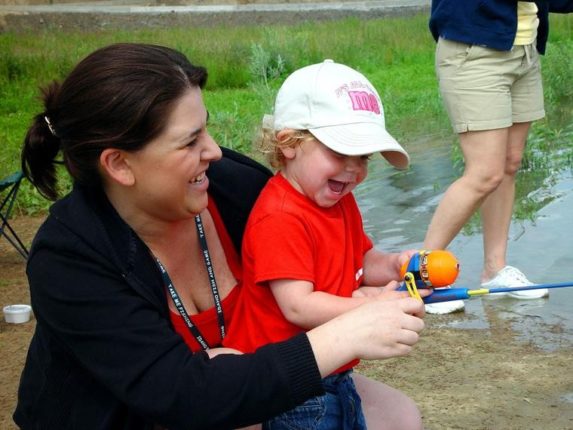
“Parents can watch their youngster’s eyes light up as they hook a feisty rainbow trout at many close to home and kid-friendly fishing spots,” Fish and Game biologist Mike Demick said in a news release. “Remember to keep it simple when fishing with kids. Using simple set-ups like worm/marshmallow combinations or Power Bait near the bottom or below a bobber will usually work well.”

Reports on waters closer to Idaho Falls are looking positive.

“There’s several hatches that have been going on the Henry’s Fork,” Brower said. “The big one is the salmon fly hatch coming soon.”

Ririe Reservoir is expected to produce smallmouth bass “especially around the willows around the edges and in the coves,” Brower said. Yellow perch have also been doing well at Ririe Reservoir.

Fish and Game is also reporting stocking fish at Pole Bridge on Willow Creek and at a new spot.

“We also have a new access agreement on Camas Creek with a landowner right where the Red Road crosses Camas Creek,” Brower said. He said that area will be stocked with fish.

One area that is fishing well right now is the South Fork of the Snake River just below the Palisades Dam and downstream to Irwin. Rainbow trout (there’s no limit on the South Fork) are spawning and gathering on their redds.

“People are fishing egg patterns and bouncing them off the bottom,” Brower said. “If you find the right spot … you’ll keep pulling them out of there and they’re pretty good size.”

Because the South Fork is running high this time of year, families are advised to be cautious near the water.

To get more information about specific recreation sites and where Fish and Game is stocking fish, go to these online links: idfg.idaho.gov/ifwis/fishingPlanner/stocking, parksandrecreation.idaho.gov and www.idahopower.com/community-recreation/recreation.
Baking homemade bread

I’m about recouped from the coronavirus, and after nearly three weeks food is starting to sound good. Out of the blue it hit me that some homemade bread would really be good.

When Katy and I first got married we’d make sourdough bread every Sunday afternoon after church. Back in 1972, Sports Afield ran a long article on making sourdough. They listed out numerous ways to make your own starter. I still have that article but now I mainly use a yeast package.

I’ve made loaves of bread in the artisan-looking lump (like a cow patty) on a baking sheet. You can add in fresh chopped garlic, olives and all kinds of herbs or vegetables.

But my favorite bread is just a plain loaf of bread. I’ll mix my flour (4-5 cups) with a ½ cup of sugar and a package of yeast. Then mix in your water and work it until it is of the right consistency. Then put the dough aside and let it rise. Katy will cover the pan with a damp rag and place it in a warm oven, which will speed up the rising process. But don’t have the oven hot or it will kill the yeast. Or you can set it up on top of the fridge and let it rise.

In an hour or two it should be working. When it has almost double in size break off enough to fill a bread pan about three-quarters of the way. Work the dough just slightly and put it in the bread pan and let it rise again.

OK, I don’t know why but one twist that will make the bread taste 10 times better is to bake it in a Lodge cast iron bread pan. It’s to die for. Cook at 350 until it is almost a slight golden brown on top. Right before it starts browning, I’ll cut a few slices of butter and grease up the top and then finish baking.

When done, pull it out. Usually with a butter knife you can run it around the edge of the pan and it will literally fall out. We eat it hot right out of the oven.

One other item you’ll want is a serrated bread knife. If you try to use a regular butcher knife it will smash the loaf. I got a Spyderco bread knife and love it. Cut slices and smear with butter and get ready to gorge. We’ll eat this alone for a meal a lot of times. It is amazing how awesome just a plain slice of bread smeared with butter is.

And use real butter. Katy read somewhere that margarine is bad for you but butter is good. I’m all for that theory and will not investigate the validity at all.

And yes, if you have a sweet tooth you can use the same dough to make cinnamon rolls. Just roll out the dough on the counter. Sprinkle on brown sugar and white sugar and cinnamon. Roll it up and let it rise. When it has risen slice into rolls. Lay the rolls on a lightly greased cookie sheet. Let them rise again. Sprinkle more brown sugar and white sugar on top and place in the oven preset for 350. Pull out when done and lather butter on top.

Now I’m hungry for some homemade bread. Happy eating!

Tom Claycomb lives in Idaho and has outdoors columns in newspapers in Alaska, Idaho, Utah, Nevada, Colorado and Louisiana.He also writes for various outdoors magazines and teaches outdoors seminars at stores like Cabela’s, Sportsman’s Warehouse and Bass Pro Shop.

Tight times for small local operators in Idaho’s river rafting industry

The Middle Fork of the Salmon River roared with spring flows as rafting outfitter Willis McAleese dissected the currents for his guides and showed them the best way to maneuver their rafts safely through the high water. White water rafting is an exhilarating sport and those manning the oars have to be highly skilled. This training trip is just one way outfitters throughout the west are getting ready for the spring and summer season.

But will there be enough clients to keep rafting companies afloat? Are white water and wilderness river rafting headed down the river-of-no-return or is it going to be the go-to vacation?

“This could be one of our toughest seasons on record,” said McAleese of Pocatello. “All of us in the industry are going to have to be creative and adapt to a new reality, highlighting that the rafting experience is the safe, clean, healthy adventure people love.”

From Idaho to Maine, rafting companies are working to make rafting safe and secure for families in light of COVID-19. There are an estimated 700,000 white water rafters and millions of leisure rafters enjoying the water each year in the U.S. It is one of the fastest growing outdoor sports.

Idaho’s outfitters and guides are monitoring government policy changes, Centers for Disease Control and Prevention guidelines and following state and federal mandates regarding COVID-19 and will utilize industry-approved testing. Their survival and success means keeping customers safe and confident that they can enjoy their rafting experience.

Rafting Middle Fork Salmon River Wilderness

The friends and family concept

Middle Fork Wilderness Outfitters is trying a friends and family concept on some of their raft trips to see if it gets potential rafters out of the house and on the river. The friends and family model involves setting up certain trips with a discount for families and friends. Knowing who you are traveling with is most important to some rafters despite the fact that most of their rafting trips consist of less than 20 guests scattered between four of five boats allowing for social distancing.

Middle Fork Wilderness Outfitters is implementing strategies to prevent any spread and outbreak of COVID-19. Health screening will still be required but an intangible level of security comes from of knowing who is on your trip in advance.

Good health practices key to success

COVID-19 has hit Idaho’s commercial rafting companies hard. Trips that normally fill by May have openings. Travel bans linger, putting families on lockdown reassessing spring and summer travel plans and recreational spending. That can mean more cancellations for outfitters.

The airline industry that transports many of Idaho’s aspiring white water rafters from across the U.S is struggling to survive. Some people are averse to the idea of traveling through airports and sitting in airline cabins is not appealing when their is concern that COVID-19 could make a comeback.

Mark Singleton, executive director of American Whitewater, says, “The COVID-19 pandemic is serious stuff. Make the health of others your No. 1 priority. Be part of the solution to keep the delicate balance that ensures river access.“

Good advice for Idaho’s multi-million dollar river rafting industry. Over 12,000 rafters went down the highly regulated Middle Fork of the Salmon River last year. Rafting clients come from all over the U.S. and world seeking the thrill of a trip down the massive white water of the Snake and Salmon Rivers or simply a day trip on the Payette River.

So how does a small family-owned rafting company like Middle Fork Wilderness Outfitters with roots to Pocatello survive the COVID-19 crisis? Provide a great product and think regionally.

McAleese believes there is a robust and untapped market in Idaho and neighboring states. An example is the family from Boise that recently booked a trip with him when their international rafting trip to Chile was canceled. Another big plus is that most of Idaho’s rivers are less than a two-day drive from all of the neighboring states. Riding in the family car is far less threatening than airports and airplanes in terms of disease contact.

The biggest plus for rafting

Rafting biggest plus is the outdoor experience and limited number of people contacted. Once on the river, contacts are minimal and the air is fresh. Compared to the potential exposure on a seven-day cruise filled with 2,000 people or a trip to Disney World with thousands of children, a raft trip is a boat ride in the woods.

Harry Morse is currently a freelance writer living in Pocatello. His articles have appeared in national hunting and fishing magazines. The majority of his career he worked for Washington, Idaho and California Departments of Fish and Wildlife as an information officer. He has travel broadly an enjoys photography, fishing and hunting.

Morel mushrooms: Manna from heaven

In the midst of the COVID-19 scare there is one spring highlight that didn’t fail to occur. Morel mushrooms! Morels are the best food that nature has to offer and now is the primo season. I have been out of state and dying to get back home to go mushroom picking. Katy had to teach the first day back but she was off Friday so we took off for my secret spot.

We didn’t find as many as we would have wished but still got enough for a good mess. They were all nice and firm and in good shape. So if you are reading this article you need to hurry up, finish reading this article and jump in the truck and head for the mountains. It is primo time.

To prepare the mushrooms gently rinse and then slice in half lengthwise. Put in a bowl with salt water to kill any bugs and refrigerate overnight.

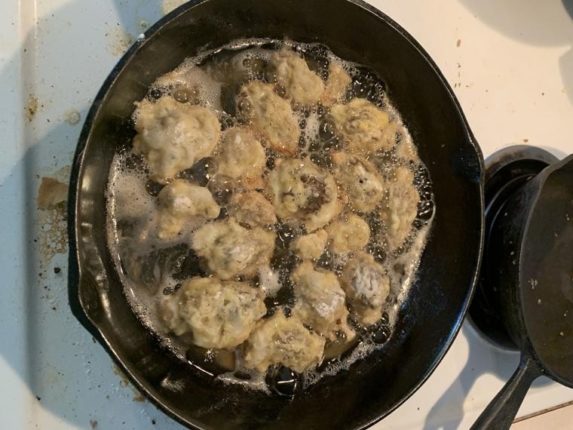
The other day I covered how to hunt them; today let’s go over my favorite recipe. You can make mushroom gravy, scramble with eggs, etc. but frying them is the ultimate. Beat two to three eggs with about ½ cup of milk in a bowl. Drain the water off of the rinsed mushrooms an hour beforehand. Throw the drained/sliced mushrooms in the egg batter and cover with batter. Pour some flour on a plate. Roll the mushrooms in the flour.

On the stove be preheating a skillet with about a half-inch of grease to medium heat. When hot (sizzles a drop of water) lay mushrooms cut side down in the skillet. Fry to a golden brown and flip.

OK, I have to digress for a minute. If you have a thin-walled skillet anywhere in your kitchen gingerly pick it up with two fingers so as not to defile yourself. Walk out to the trash can and throw it away. Buy a cast iron Lodge skillet. They are the best for frying and evenly disperse heat while cooking.

When golden brown (not too brown) remove and lay on a paper towel-lined plate. I lightly sprinkle with salt and pepper when frying but not too much. Let everyone season to their tastes. I use Tony Chachere’s original seasoning.

ENJOY!

Tom Claycomb lives in Idaho and has outdoors columns in newspapers in Alaska, Idaho, Utah, Nevada, Colorado and Louisiana.He also writes for various outdoors magazines and teaches outdoors seminars at stores like Cabela’s, Sportsman’s Warehouse and Bass Pro Shop.

Discovering a new salmon fishing experience with famous anglers

Fishing with famous anglers and guides can be a bit intimating. I was along with Gary Loomis of G.Loomis fishing rod fame and expert salmon fishing guide Clancy Holt. They were opening up salmon fishing on a new hemisphere with amazing results, catching Chinook salmon weighing between 40 and 70 pounds. I was on the trip to write about them pioneering an untapped salmon fishery and to take photos. Luckily, long-time friend Clancy Holt put a fishing rod in my hand. Yes!

While fighting a big salmon, Gary Loomis commented on how amazing the fishing was and how untapped. Coming from one of the most experienced salmon anglers in the world, it was a tribute to the fishery. Where is it? Alaska, Russia, New Zealand?

No, it is in Patagonia, Chile, an hour and a half by air south of Santiago on the Petrohue River. The Petrohue River is a pristine river winding it way down from the Andes Mountains to the Pacific Ocean.

Chilean salmon fishing

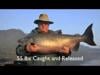
The first morning, Clancy Holt, Gary Loomis and I caught 11 Chinook salmon in five hours of trolling at the mouth of the river. Only two fish weighed less than 40 pounds. Loomis caught the biggest, which tipped the scale at 61 pounds, six were over 50 pounds and rest were between 40 and 50. It was the first day of five incredible days of fishing guided by Clancy as we explored the fishery for Southern Chile Expeditions.

Why this fishery now?

This fishery was in the making since the early 1980s when Chinook salmon eggs were imported from Pacific Northwest Hatcheries to start massive commercial salmon net pen operations in Chile. Chinook salmon escaped the net pens and over three decades began spawning in a number of rivers along the southern coastline of Chile and a new fishery was born.

The lack of access to major rivers is the major hurdle to fishing salmon in Chile. The second challenge is finding experienced guides with updated equipment. Fortunately, the number of guides — ranging from Orvis-endorsed guides, to independent outfitters and individuals advertising on the internet — have grown. Each year, the number of salmon fishing options continues to expand, providing anglers looking for an adventure salmon fishing trip the opportunity.

Southern Chile Expeditions pioneered the current fishery, hiring Holt and Loomis to help put them at the forefront starting in 2015. Yan Kee Way Lodge provided the infrastructure of lodging, guides and boats. The lodge’s trout fly fishing clients were already incidentally hooking Chinook salmon in the 40-pound range.

Chilean salmon fishing secondary

A salmon is netted in Southern Chile’s Petrohue River.

Holt was hired to guide anglers, train Chilean guides, find new fisheries and consult on equipment. That meant getting four new 17.8 Smoker Craft sleds with 60 horsepower Yamaha jet-drives set up.

Loomis was brought in to test the fishery and perfect the equipment needed. He is first and foremost a fisherman that designs and builds rods. Working with his new company, Edge Rods, he designed a new fly rod and conventional salmon rod that could handle salmon over 50 pounds. His new rods handled the abuse doled out by 50-pound Chinooks easily.

Great salmon fishing

My first salmon ripped out over 200 feet of line and was still going threatening to spoon my reel when Holt spun the boat around and followed the fish. It ran along the surface of the glassy bay waters then sounded going deep and circled back at us. I reeled, frantically loosing tension as the salmon passed under the boat and streaked away. Ten minutes, later the salmon was netted and released.

Loomis designed new rods for this fishery, which are probably the best made. Loomis’ Edge 9’11” rods handled the big fish with grace. Over the next five days of estuary fishing, we caught and released over 100 Chinook salmon.

Since I needed pictures for the magazine article, several fish had to come on board for photos. We were doing catch and release, which made bringing the fish on board for a photo and releasing them unharmed more difficult than expected. Getting 60 pounds of thrashing salmon into Loomis’ hands for a photo and then releasing it was a challenge. The best photo came when Clancy and I hoisted a 60 pounder on to Loomis’ lap soaking him. He smiled for the picture and swore to get even with us later.

It was a pleasure fishing with the best of the best. Holt easily switched from one technique to another to keep us catching salmon. Loomis told me more about rod making than I could absorb. Did I know it all started from his designing and making tank aerials?

For more information or to book your own trip, visit southernchilexp.com.

Harry Morse is currently a freelance writer living in Pocatello. His articles have appeared in national hunting and fishing magazines. The majority of his career he worked for Washington, Idaho and California Departments of Fish and Wildlife as an information officer. He has travel broadly an enjoys photography, fishing and hunting.

Discovering a new salmon fishing experience with famous anglers

Fishing with famous anglers and guides can be a bit intimating. I was along with Gary Loomis of G.Loomis fishing rod fame and expert salmon fishing guide Clancy Holt. They were opening up salmon fishing on a new hemisphere with amazing results, catching Chinook salmon weighing between 40 and 70 pounds. I was on the trip to write about them pioneering an untapped salmon fishery and to take photos. Luckily, long-time friend Clancy Holt put a fishing rod in my hand. Yes!

While fighting a big salmon, Gary Loomis commented on how amazing the fishing was and how untapped. Coming from one of the most experienced salmon anglers in the world, it was a tribute to the fishery. Where is it? Alaska, Russia, New Zealand?

No, it is in Patagonia, Chile, an hour and a half by air south of Santiago on the Petrohue River. The Petrohue River is a pristine river winding it way down from the Andes Mountains to the Pacific Ocean.

Chilean salmon fishing

The first morning, Clancy Holt, Gary Loomis and I caught 11 Chinook salmon in five hours of trolling at the mouth of the river. Only two fish weighed less than 40 pounds. Loomis caught the biggest, which tipped the scale at 61 pounds, six were over 50 pounds and rest were between 40 and 50. It was the first day of five incredible days of fishing guided by Clancy as we explored the fishery for Southern Chile Expeditions.

Why this fishery now?

This fishery was in the making since the early 1980s when Chinook salmon eggs were imported from Pacific Northwest Hatcheries to start massive commercial salmon net pen operations in Chile. Chinook salmon escaped the net pens and over three decades began spawning in a number of rivers along the southern coastline of Chile and a new fishery was born.

The lack of access to major rivers is the major hurdle to fishing salmon in Chile. The second challenge is finding experienced guides with updated equipment. Fortunately, the number of guides — ranging from Orvis-endorsed guides, to independent outfitters and individuals advertising on the internet — have grown. Each year, the number of salmon fishing options continues to expand, providing anglers looking for an adventure salmon fishing trip the opportunity.

Southern Chile Expeditions pioneered the current fishery, hiring Holt and Loomis to help put them at the forefront starting in 2015. Yan Kee Way Lodge provided the infrastructure of lodging, guides and boats. The lodge’s trout fly fishing clients were already incidentally hooking Chinook salmon in the 40-pound range.

Chilean salmon fishing secondary

A salmon is netted in Southern Chile’s Petrohue River.

Holt was hired to guide anglers, train Chilean guides, find new fisheries and consult on equipment. That meant getting four new 17.8 Smoker Craft sleds with 60 horsepower Yamaha jet-drives set up.

Loomis was brought in to test the fishery and perfect the equipment needed. He is first and foremost a fisherman that designs and builds rods. Working with his new company, Edge Rods, he designed a new fly rod and conventional salmon rod that could handle salmon over 50 pounds. His new rods handled the abuse doled out by 50-pound Chinooks easily.

Great salmon fishing

My first salmon ripped out over 200 feet of line and was still going threatening to spoon my reel when Holt spun the boat around and followed the fish. It ran along the surface of the glassy bay waters then sounded going deep and circled back at us. I reeled, frantically loosing tension as the salmon passed under the boat and streaked away. Ten minutes, later the salmon was netted and released.

Loomis designed new rods for this fishery, which are probably the best made. Loomis’ Edge 9’11” rods handled the big fish with grace. Over the next five days of estuary fishing, we caught and released over 100 Chinook salmon.

Since I needed pictures for the magazine article, several fish had to come on board for photos. We were doing catch and release, which made bringing the fish on board for a photo and releasing them unharmed more difficult than expected. Getting 60 pounds of thrashing salmon into Loomis’ hands for a photo and then releasing it was a challenge. The best photo came when Clancy and I hoisted a 60 pounder on to Loomis’ lap soaking him. He smiled for the picture and swore to get even with us later.

It was a pleasure fishing with the best of the best. Holt easily switched from one technique to another to keep us catching salmon. Loomis told me more about rod making than I could absorb. Did I know it all started from his designing and making tank aerials?

For more information or to book your own trip, visit southernchilexp.com.

Harry Morse is currently a freelance writer living in Pocatello. His articles have appeared in national hunting and fishing magazines. The majority of his career he worked for Washington, Idaho and California Departments of Fish and Wildlife as an information officer. He has travel broadly an enjoys photography, fishing and hunting.

Choose an exotic fishing adventure

What kind of fishing adventure are you interested in? Given a choice, would you choose a high-cost lodge where you are catered to at $1,000 a day or a remote backwoods adventure where you cook on a wood stove for $75 a day? Take a look at the video and make a choice.

Trout Fishing: Chile Two Lodge

$1,000 a day: Yan Kee Way Lodge in Southern Chile

This place is amazing. Individual chalets, 4-star cooks, guides equipped with the best gear and the world-famous Rio Petrohue river to fish for rainbow and brown trout in an exotic location. Unfortunately, I was not fishing but on a writing assignment for Salmon Trout Steelheader magazine out of Seattle to chronicle the fishing adventures of expert steelhead guide and angler Jack Mitchell of eastern Washington.

The Rio Petrohue is famous. Flanked by snow-capped volcanoes and deep woods, it produces rainbows to 10 pounds, sea run browns to 20 pounds and Chinook salmon to 70 pounds. When we arrived, the river was high due to heavy rains, a volcanic eruption trickled silt into the river and the Chinook salmon run was late. Even a $1,000 a day can’t guarantee good fishing.

Jack Mitchell is an expert fly fisherman, and he drew on years of experience fishing the Snake, Columbia, Klickitat rivers for trout and steelhead. After a day of pulling streamers in eddies and casting dry flies to small pockets of water, it was apparent catching fish was going to be a challenge. His wife, Jennifer, also an accomplished angler, suggested fishing yarn under a strike indicator. It worked and instead of catching five to 10 rainbows a day between them, they caught 27 rainbows the next morning.

Where were the giant salmon and brown trout? Out in the bay, lodge salmon guide Clancy Holt and his client Gary Loomis trolled deep the river mouth and caught salmon to 70 pounds, but the salmon and browns had not yet entered the river where we could get a crack at them.

Chile fishing secondary

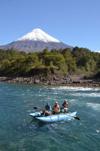
A group is seen fishing the Rio Potrohue in Chile.

$75 a day: Backwoods fishing adventure in Chile

Leaving luxury, I boarded an ancient plane for a two-hour flight 300 miles south to a backwoods lodge that promised excellent rainbow trout fishing. The manager of Yan Kee Way owned the low-cost fledgling Rio Paloma Lodge and was exuberant about the fishing. All I had to do was pay my airfare, cost of food and pitch in. All for $75 a day and the cost of a horse back ride to see a rare deer in the Andes Mountains.

The catch? The only the cook was at the lodge, he didn’t speak English and I would have to pitch in on the chores.

The plane landed in a defunct military airport, miles from nowhere and the cook/guide was not there to pick me up. An hour late, he rumbled up in an old pickup truck, hopped out and let out a burst of rapid-fire Spanish and motioned like he was casting a fly. Yep, this was my man.

The lodge was two hours over dirt roads and one temporary road block consisting of 100 sheep away. It is an old wood frame house with three tiny bedrooms, kitchen and a wood fired stove. He would guide and cook, and I would clean dishes, chop wood and fetch water.

The next morning, we were casting on a river out of a picture book. Tall pines, rippling water and trout breaking the surface. But the fish were not biting our flies. Late in the day, I broke out my little spinning rod and a No. 2 gold Mepps spinner. Three casts later, I landed a nice 2-pound rainbow. The cook was delighted. No catch and release here. This was dinner. The spinner worked magic on fish after fish.

Delighted at the great day of fishing, the cook arranged for a horseback ride into the mountains to see a rare and endangered deer. The year before, I spent nine days in the Andes Mountains in a pup-tent with a scientific team trying to locate and photograph one of these rare deer with no success.

Chile fishing secondary

An endangered Huemul deer is seen in Chile’s Andes Mountains.

As my horse swam the swift river to start the steep ascent into the mountains, I realized this was clearly not a tourist horseback ride. Four hours later, I swore I would never ride a horse again.

The endangered Huemul deer stood in a small ravine 100 yards away. A nice buck with forked horns. I snapped shots with my 600 telephoto lens. Not great shots but rare ones. We continued up the mountains for several hours looking for more deer then returned to an old sheepherders hut. Sore, hungry and tired, I dreaded the four hours more of trail riding to reach the road.

At the hut, to my amazement, the sheepherder pulled from his saddle bags a rack of lamb, started a fire and stuck the ribs on a T bar over the fire to roast. Once they were done, he rustled in his other saddle bag producing a loaf of bread and a six pack of beer. He handed me his knife to cut off a slab of roasting ribs, hunk of bread and a beer. Best mountain meal ever!

Chopping wood and washing dishes was a small price to pay for excellent rainbow fishing day and a horseback ride to see the endangered Huemul deer.

Choices

So which adventures would you choose? Luxury lodge or wilderness house with cook for a guide and a trail ride?

Harry Morse is currently a freelance writer living in Pocatello. His articles have appeared in national hunting and fishing magazines. The majority of his career he worked for Washington, Idaho and California Departments of Fish and Wildlife as an information officer. He has travel broadly an enjoys photography, fishing and hunting.

Hunting wild mushrooms

Right now is one of the best times of the year: morel mushroom picking time! It is a short season, so you want to make sure that you don’t miss it. In Nebraska and Iowa, it is somewhere around the middle of April. Up in the mountains, I do good around the first or second week of May, and they start popping up after that as you go up in elevation.

There are a lot of edible wild mushrooms, but I only can identify a couple. A few years ago, I thought, “It’s crazy to spend all that time walking around and only be able to identify a few varieties. Why not take a class so I could come back down from the mountains with more?”

I attended a mushroom hunting class. They told me that after I had completed the class that I’d feel comfortable picking at least 10 different varieties. By the time I completed the class, I still only felt comfortable picking the same couple.

Here’s the deal. Morel mushrooms are the best tasting food in the world, but if you screw up and pick the angel of death, well, let’s just say that you and God had better be pretty good friends. In a nutshell, one little snack is not worth dying over, so the first few times go with an old timer. Today I’m going to cover how to find morel mushrooms. I’m not going into how to identify them; find a trusty old timer and have them coach you.

Where do you find them? A lot of writers confidently say something like, “Go to the woods and look around dead logs.” I’ve got news for them. The woods are full of dead logs and you don’t find a morel at every one. While you can find some around logs, not every log has morels. I’ve hunted morels for more than 40 years. By now, you’d think I’d have it down pat and could give you the “Five Steps to be a Morel Mushroom Hunter.” The problem is I can’t.

But let’s go over a few things that I have learned. In Nebraska and Kansas, I find them on sandy river banks. I’ve made hauls out on islands and in the woods along the river. Again, not in wet turf but kinda sloping drained areas.

In the mountains, I’ll find them on the uphill side of old logging roads and in slight drainages that have some spread out vegetation but not thick grass. I’ll find them in brush piles. My old hunting buddy Roger Ross says he likes to look around Tamarack trees.

Sometimes they’ll be found around fresh (from last fall) caterpillar tracks. It seems like torn up soil promotes their growth. If you find some, look downhill. The spores get washed downhill. One year after a fire, I found a bunch like this washed down a draw on a mountainside.

If you found some last year, go back there this year. It’s not a guarantee every year but almost. I have one spot that I find them at almost every year, but not last year.

They are really temperature and moisture dependent. When the weather finally turns warm, if you get a rain and a warm night it seems like they pop up overnight. A few years ago, I was talking to a Forest Service employee, and we were talking about mushrooms. She brought up the thought of taking the temperature of the soil when you find them. Then just this week I read an article and the writer said when the soil hits 50 degrees, they start growing. Maybe so.

The absolute best place to hunt them is in places where there was a forest fire the previous year. There was one place where I could fill two 5-gallon buckets. Under a lodgepole pine that was laid down, I found 17. In one area I could have covered with a 10- by 12-foot tarp, I picked 162.

Real pickers use a mesh bag so the spores can drop out. They also use a knife to cut them off at the ground.

When you get home, slice them lengthwise and gently rinse and put in a bowl of water with salt to kill the bugs and set over night in your fridge. Dip in beat eggs and roll in flour. Sprinkle with salt and pepper or my favorite is Tony Chachere’s seasoning and fry to a golden brown.

Morels are the best food in the world!

Tom Claycomb lives in Idaho and has outdoors columns in newspapers in Alaska, Idaho, Utah, Nevada, Colorado and Louisiana.

On sighting in your turkey shotgun and choosing the proper ammo

There are some turkey hunting fanatics out there. In fact, you may be one of them. Here are a few symptoms/signs:

1. You like turkey hunting almost as much as you do elk hunting.

2. You get the DT’s when you hear a gobble reverberating through the woods.

3. You have or almost have lost a job over turkey hunting.

As you know, spring is the big time to hunt turkeys. The Toms are strutting and trying to impress the hens and calling one can almost be as cool as calling in a bull.

BUT … before you actually go hunting you have some important tasks to complete and a few choices to make. First, you need to decide which ammo to use. When I was a kid pretty much all we had was lead No. 2 shot. 30 to 40 yards was about the max for range.

A lot has changed since then. No longer do a lot of people use their trusty ole dove or duck shotgun. Many hunters have a turkey hunting shotgun. One big reason is, with the shells we now have, you can roll a turkey out to 50 to 60 yards. So, you have to aim at an actual body part (head/neck) just like when hunting with a rifle.

It no longer suffices to use your bead sights on your regular shotgun. A lot of Turkey Hunters (TH) now use a scope or red dot sight. Riton Optics has a cool Red Dot Scope and a 3x magnifier that you ought to use.

The next thing you need to do is to choose your ammo. There are a lot of options on the market nowadays, and a lot of them work ok but of all the ammo that I’ve tested HEVI-Shot is hands down the best. I did a comparison once for Bass Pro Shop and some of the competitors had 17-34 BBs in the kill zone if I remember correctly. HEVI-Shot had 119! The kill zone looked like Swiss cheese.

After choosing your ammo you need to sight in your shotgun just like you do when sighting in your rifle so the main pattern hits where you want it to. But whoa, before you shoot you need to get a good choke to maximize your shotguns performance. I use Trulock chokes. You’ll want to use a tight choke.

Turkey loads kick so I use a Caldwell Lead Sled or a Caldwell Hydrosled to do my sighting in, especially if you’re dumb enough to use some HEVI-Shot 3 ½-inch magnums. They’re a killer (on both ends). And also, I like to use the Birchwood Casey turkey targets (Their Shoot NC targets). That way I can easily count how many BB’s hit in the kill zone.

You’ll want to sight in your shotgun right below the head. You don’t want to shoot at the head and half of the BB’s go flying harmlessly overhead. Shoot at the neck so the turkey gets the main brunt of the pattern.

Now you’re ready to go turkey hunting. Good luck.

Tom Claycomb lives in Idaho and has outdoors columns in newspapers in Alaska, Idaho, Utah, Nevada, Colorado and Louisiana.He also writes for various outdoors magazines and teaches outdoors seminars at stores like Cabela’s, Sportsman’s Warehouse and Bass Pro Shop.

Catch a tiger fish, hunt a Kudu and find a geocache in Africa

Geoff Hogander’s dream was to visit Africa; catch a tiger fish, hunt a kudu and find a geocache. When the opportunity came to join me on a hunt to South Africa with Harloo Safaris in Zululand and visit Tembe Elephant Park next to the Mozambique boarder he was all in.

Zululand in South Africa is tropical jungle country with rolling mountains, deep draws and rivers. The safari area bordered Lake Jozini, known for its superb tiger fishing. Our hunt was the first part of the trip, fishing second and Geoff’s geocache hunt and wildlife viewing in Tembe Elephant Park the wrap-up.

We booked the hunt for the end of May when kudu are in rut. Kudu are called the gray ghosts of Africa for their ability to elude hunters. Similar in size to our rocky mountain elk they are wary. The best time to hunt them one time is when breeding season is in full swing.

Geoff’s chance at a kudu came on day four of the hunt. Glassing a ridgeline a mile away he saw a single bull slowly working his way through the woods. It would cross an open area a half mile ahead where we could intercept it. Thirty minutes later our professional hunter, Niel Uys, had us in place and Geoff glimpsed the kudu moving along the edge of the clearing.

The massive bull crossed the opening 100 yards away and dropped with Geoff’s shot. We marveled at the long spiraling horns and it beautiful grey coat. It is truly one of Africa’s iconic antelope. Two days later we were enjoying Kudu tenderloin over an open fire at camp. They reminded me of mild, tender elk steaks.

Next door the Phinda Game Reserve was culling nyala. They are mule deer size antelope, sporting a shaggy dark gray coat, white strips and black spiraling horns they are exotic. Phinda’s game manager asked if were interested in hunting nyala.? You bet!

In Africa when antelope start to overgraze an area, game managers use hunting as a tool to save the habitat and provide meat for local tribes. The one drawback was lions. We needed to be very careful since this conservancy had a thriving lion population along with cape buffalo and rhinos.

Parking our Landrover in the early morning light the adventure began. Nyala live in dense cover along the edge of grasslands. The local game manager lead the way along trails weaving through dense cover. Luckily, lions do not like hunting in this type of cover. We were very cautious since we had seen a pride of lions when driving into the area.

The game manager knew exactly where nyala crossed the opening in the dense cover. Each of us made good shots and nyala and the animals were on the way to the butcher by noon. We enjoyed several prime cuts of meat for dinner. It was delicious.

Tiger Fishing Lake Jozini

Sprawling Lake Jozini bordered our hunting area and is a tiger fishing mecca. Tiger fish are fierce predators with razor sharp teeth and are sought after by anglers for their fighting ability. A member of the piranha family, their canine-like teeth can inflect serious wounds.

Fishing with sardines was the most effective way to catch the toothy fish this time of year. Niel, our professional hunter, had a supply in his freezer. An avid angler, he supplied the boat, bait and tackle, and took us to his favorite fishing spot. The 8-pound to 15-pound tiger fish were not biting now, but we would catch plenty in the 3-pound to 5-pound range. Only he would handle the fish. He didn’t want us going home minus fingers!

Geoff got the first strike and the line ripped off his reel as the tiger fish headed toward the other end of the lake. It turned out to be the best fish of the day. We took pictures and released it.

Our only problem came at the boat launch. A 4,000 pound white rhino, measuring 10 to 12 feet long and 5 feet tall at the shoulder, grazed at the waters edge. Geoff and I did a double take. A rhino grazing next to the boat launch ramp? Welcome to Africa.

Geoff’s Geocache

We traveled 150 miles north to the Mozambique border to Tembe Elephant Park. No trip to Africa is complete without getting a look at some truly wild country and elephants. Plus, Tembe held Geoff’s geocache.

The Tembe Tribe run the only concession in the 115-square-mile massive transnational Tembe Wildlife Park. Part of the legendary Ivory Route where the greatest tuskers roam, the park was set up in 1983 to protect migrating elephants between South Africa and Mozambique. It’s a wild and unique place. It’s on the low end of the luxury scale, on the high end of wild and one of the lowest-priced lodge experiences in Africa.

Each morning at 6 a.m. we loaded into a converted Landrover to slowly drive through thick sand-forest. Twice elephants materialized out of the impenetrable foliage halting our vehicle. They gave us a brief look and walked right by us disappearing into the jungle.

Geoff’s geocache was located under the step of one of the Tembe wildlife observation blinds. Geocaching is an international activity in which participants use their GPS to find a hidden container and it’s one of Geoff’s favorite sports. Once he found it, he carefully removed the ledger and inscribed his name and the date on it, completing a life-long dream of visiting and achieving a series of goals in Africa. Harry Morse

Find a video with this story at xtremeidaho.com

Harry Morse is currently a freelance writer living in Pocatello. His articles have appeared in national hunting and fishing magazines. The majority of his career he worked for Washington, Idaho and California Departments of Fish and Wildlife as an information officer. He has travel broadly an enjoys photography, fishing and hunting.