Climate change, booming population threaten Yellowstone area

The Greater Yellowstone area is facing two great threats — a rapidly warming climate and rapid population growth, says one of Montana State University’s leading scientists.

Cathy Whitlock, one of the state’s top experts on climate change, said this region also offers unique opportunities for learning and research that MSU should focus on in a serious way to earn the nickname it trademarked in 2006 — the University of Yellowstone.

Whitlock, a regents professor and the first scientist from a Montana university elected into the National Academy of Sciences, spoke recently to a crowd of about 100 at Reynolds Recital Hall. Her talk was part of the university’s spring convocation events to welcome back faculty and staff at the start of the new semester.

MSU puts out three times more studies and publications on the Yellowstone region and spends twice as much researching this area as campuses like Stanford, Oregon and the University of Montana, Whitlock said. Yet no one knows it.

Years ago MSU trademarked the phrase University of Yellowstone, mainly as an idea for branding the Bozeman campus and attracting students.

Now Whitlock said she’s working with a campus committee on the University of Yellowstone Initiative, to put out a plan this spring and “put some meat on the bones” of the idea. It’s much more than branding, she said.

“Every student should have a meaningful experience in Yellowstone,” Whitlock said. “Yellowstone should help them be better global citizens. This is where they can learn, become critical thinkers.”

And given the drastic changes coming from a warming climate and an exploding population, there’s a lot for students and professors to think about.

Whitlock, lead author of the 2017 Montana Climate Assessment, is working now with a large team on the Greater Yellowstone Climate Assessment, expected to come out in 2021.

Average temperatures have risen dramatically in recent years, she said, and by the end of this century this area could be 10 degrees hotter.

“We’re moving into uncharted territory,” Whitlock said. She added she agrees with young people who see climate change as “an existential crisis.”

Whitlock has been studying Yellowstone’s ecology since the fires of 1988, when 40% of the national park burned. As the climate gets hotter, fires become more likely. White bark pine, a key grizzly bear food, is becoming scarcer. Already wolverines, amphibians and cold water fish like trout are suffering. And by the end of this century, she said, “we’re simply going to lose our snowpack.”

Yet lots of people are leaving worse places to move to the Yellowstone area. Since 1970 our population has doubled, Whitlock said. Some have predicted that by 2060 Bozeman’s population could grow to the size of Minneapolis today.

She quoted Mike Clark, former executive director of the Greater Yellowstone Coalition, who received an honorary doctorate at December’s graduation ceremony.

“’MSU is poised to be the essential academic institution that will help to determine if Greater Yellowstone can survive both climate change and the coming wave of humanity moving into this region,’” Clark said.

Asked by an audience member about the fires raging in Australia, Whitlock said the country is so dry, she doesn’t think people there can simply solve the problem through better management.
Skiing’s slippery slope: Ski resorts work to attract millennials to stick with the recreation

People get old, even die.

That holds true for skiers. You may have heard that old skiers never die, they just go downhill.

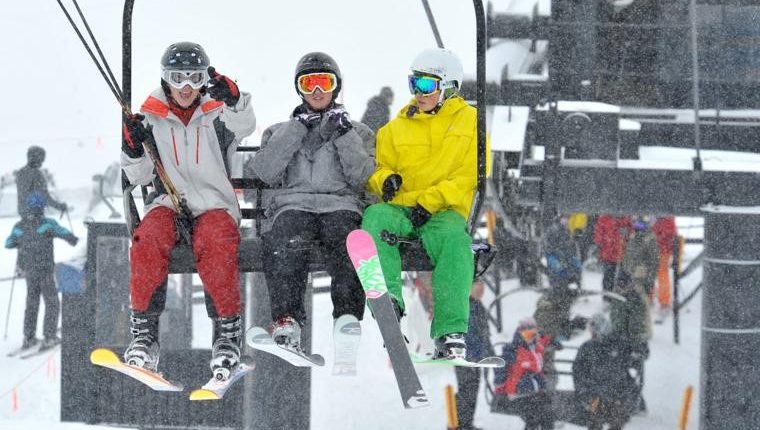
That age thing is catching up with baby boomer skiers who statistically are often the bread and butter of ski resort clientele. The demographic is aging out of the ski hill, and the younger generation is taking up the slack in different ways.

Age 53 and older folk log more skier days on the slopes in North America than other demographics.

Jim Powell, vice president of marketing for the Park City Chamber/Bureau in Utah, recently told the Park City Record that it takes two millennials (age 20 to 36) to equal the spending of one baby boomer at ski resorts. Not to say that ski resorts are hurting for clientele, it’s that the demographics are shifting to a more affluent group.

But some Idaho ski resorts are bucking the trend with innovative marketing and strategies geared toward hooking people in their youth, this is particularly true at the state’s smaller community resorts.

“It’s not a trend that I’m unfamiliar with,” said Tony Harrison, publicist for Idaho Ski Areas Association. “One of the things that a number of mountains in Idaho and nationwide are doing to appeal to the (millennial) audience is to create a young adult pass product. For Bogus Basin, the pass is $349 versus $549 for an adult pass. So a huge difference there.”

Don’t condemn millennials too harshly. They’ve got student loans, wedding plans, babies, first homes, new careers, new cars, Netflix and video games to distract them from the ski slopes.

The first thing skiing millennials in East Idaho mention is cost as a deterrent when it comes to skiing and snowboarding.

“Money is a big factor why millennials aren’t going to ski resorts,” said Katy Shilling, 24, of Idaho Falls and a master’s graduate from Arizona State University. “They’re freakin’ expensive. I go skiing at least three times a month and money is definitely a factor. I don’t have $50 every weekend to go, and that would be considered cheap.”

“Cost and time are huge. It’s more expensive than ever,” said Jacob Howell, 26, an Idaho Falls carpenter who loves to ski.

Susan Saad, director of community and customer relations at Bogus Basin Mountain Recreation Area, said her ski resort saw the problem emerging and hired the experts — they put millennials to work to hack the challenge.

“We just promoted our marketing manager to marketing director this week,” Saad said. “He is 25 and has done a remarkable job reaching out to that particular demographic.”

Bogus Basin reached out to the younger crowd using a “relentless social media push” working to make people feel they are part of what’s going on at the resort. Each week, the audience sees new stories on Facebook and Instagram of younger people playing on the slopes.

“In fact, just this morning I saw a text from our general manager that the number of our Instagram followers, which has been climbing, pegged at 30,000,” Saad said last week. “I think the energy has really changed.”

Saad said a few years ago, Bogus Basin approached a Boise State University marketing class and gave it the challenge of marketing the ski resort to college students and similarly aged people.

“We did not at that time have many college-age students on the mountain,” she said, despite the resort being only an hour from 20,000 students. “As part of a semester-long project, one of the marketing classes broke down into groups and put together proposals on what we should do to grow our college-age audience. We (followed) a lot of what they did.”

One thing Bogus Basin created was new discounted season passes aimed at students.

“We started with just a few hundred college-age students on the mountain and, last year, at our college-age pass sale we sold 2,700 college-age passes,” Saad said.

Smaller, community ski resorts also have found continued success with tapping into area schools. The trick is to hook kids on outdoor snow activities before video games turn them into wintertime couch potatoes.

“One of the factors that we think makes a difference is younger people get involved in school programs during their youth, and get skiing and outdoor winter activities in their blood, and it stays with them,” said Dave Stoddard co-owner of Kelly Canyon Ski Resort. “We have 60 to 70 schools in our program that brings busloads and busloads of kids who get meaningful lessons and learn how to do it, and they can do it on a mountain like ours that is a good place to learn. … It’s a very common thing around the lodge or the base of the mountain or up the lifts, people are saying, ‘Yeah, I learned to ski here when I was a kid.’ ”

Pebble Creek Ski Area south of Pocatello has been doing its school program for 30 years.

“There’s even, at this point, where we have a couple of generations of kids whose parents came through the school program and their kids come to the school program,” said Dana Kmetz, guest services director at Pebble Creek. “We do see them returning.”

Pebble Creek also taps into the local college scene to build younger clientele. Idaho State University students can get college credits for taking a ski or snowboard class.

“That’s a really fun way to earn a college credit, but it makes it really affordable as far as lift ticket prices and lessons,” Kmetz said.

With big destination ski resorts such as Sun Valley or Jackson Hole Ski Resort continuing to raise prices and give millennials second thoughts, Kmetz and Stoddard see more people coming back to smaller hills.

“The tier 1 destination resorts like Park City, Jackson Hole or Sun Valley can be more than four times as much as our prices,” Stoddard said. “People look at those prices and say, ‘Maybe I’ll ski locally.’ ”

Stoddard said for the most part his resort hasn’t noticed fewer millennials skiing.

“We see their numbers, and they’ve been pretty good for the last several years,” he said. “It’s often more dependent on the snow we get.”

Skiing’s slippery slope: Ski resorts work to attract millennials to stick with the recreation

People get old, even die.

That holds true for skiers. You may have heard that old skiers never die, they just go downhill.

That age thing is catching up with baby boomer skiers who statistically are often the bread and butter of ski resort clientele. The demographic is aging out of the ski hill, and the younger generation is taking up the slack in different ways.

Age 53 and older folk log more skier days on the slopes in North America than other demographics.

Jim Powell, vice president of marketing for the Park City Chamber/Bureau in Utah, recently told the Park City Record that it takes two millennials (age 20 to 36) to equal the spending of one baby boomer at ski resorts. Not to say that ski resorts are hurting for clientele, it’s that the demographics are shifting to a more affluent group.

But some Idaho ski resorts are bucking the trend with innovative marketing and strategies geared toward hooking people in their youth, this is particularly true at the state’s smaller community resorts.

“It’s not a trend that I’m unfamiliar with,” said Tony Harrison, publicist for Idaho Ski Areas Association. “One of the things that a number of mountains in Idaho and nationwide are doing to appeal to the (millennial) audience is to create a young adult pass product. For Bogus Basin, the pass is $349 versus $549 for an adult pass. So a huge difference there.”

Don’t condemn millennials too harshly. They’ve got student loans, wedding plans, babies, first homes, new careers, new cars, Netflix and video games to distract them from the ski slopes.

The first thing skiing millennials in East Idaho mention is cost as a deterrent when it comes to skiing and snowboarding.

“Money is a big factor why millennials aren’t going to ski resorts,” said Katy Shilling, 24, of Idaho Falls and a master’s graduate from Arizona State University. “They’re freakin’ expensive. I go skiing at least three times a month and money is definitely a factor. I don’t have $50 every weekend to go, and that would be considered cheap.”

“Cost and time are huge. It’s more expensive than ever,” said Jacob Howell, 26, an Idaho Falls carpenter who loves to ski.

Susan Saad, director of community and customer relations at Bogus Basin Mountain Recreation Area, said her ski resort saw the problem emerging and hired the experts — they put millennials to work to hack the challenge.

“We just promoted our marketing manager to marketing director this week,” Saad said. “He is 25 and has done a remarkable job reaching out to that particular demographic.”

Bogus Basin reached out to the younger crowd using a “relentless social media push” working to make people feel they are part of what’s going on at the resort. Each week, the audience sees new stories on Facebook and Instagram of younger people playing on the slopes.

“In fact, just this morning I saw a text from our general manager that the number of our Instagram followers, which has been climbing, pegged at 30,000,” Saad said last week. “I think the energy has really changed.”

Saad said a few years ago, Bogus Basin approached a Boise State University marketing class and gave it the challenge of marketing the ski resort to college students and similarly aged people.

“We did not at that time have many college-age students on the mountain,” she said, despite the resort being only an hour from 20,000 students. “As part of a semester-long project, one of the marketing classes broke down into groups and put together proposals on what we should do to grow our college-age audience. We (followed) a lot of what they did.”

One thing Bogus Basin created was new discounted season passes aimed at students.

“We started with just a few hundred college-age students on the mountain and, last year, at our college-age pass sale we sold 2,700 college-age passes,” Saad said.

Smaller, community ski resorts also have found continued success with tapping into area schools. The trick is to hook kids on outdoor snow activities before video games turn them into wintertime couch potatoes.

“One of the factors that we think makes a difference is younger people get involved in school programs during their youth, and get skiing and outdoor winter activities in their blood, and it stays with them,” said Dave Stoddard co-owner of Kelly Canyon Ski Resort. “We have 60 to 70 schools in our program that brings busloads and busloads of kids who get meaningful lessons and learn how to do it, and they can do it on a mountain like ours that is a good place to learn. … It’s a very common thing around the lodge or the base of the mountain or up the lifts, people are saying, ‘Yeah, I learned to ski here when I was a kid.’ ”

Pebble Creek Ski Area south of Pocatello has been doing its school program for 30 years.

“There’s even, at this point, where we have a couple of generations of kids whose parents came through the school program and their kids come to the school program,” said Dana Kmetz, guest services director at Pebble Creek. “We do see them returning.”

Pebble Creek also taps into the local college scene to build younger clientele. Idaho State University students can get college credits for taking a ski or snowboard class.

“That’s a really fun way to earn a college credit, but it makes it really affordable as far as lift ticket prices and lessons,” Kmetz said.

With big destination ski resorts such as Sun Valley or Jackson Hole Ski Resort continuing to raise prices and give millennials second thoughts, Kmetz and Stoddard see more people coming back to smaller hills.

“The tier 1 destination resorts like Park City, Jackson Hole or Sun Valley can be more than four times as much as our prices,” Stoddard said. “People look at those prices and say, ‘Maybe I’ll ski locally.’ ”

Stoddard said for the most part his resort hasn’t noticed fewer millennials skiing.

“We see their numbers, and they’ve been pretty good for the last several years,” he said. “It’s often more dependent on the snow we get.”

ShockStraps are the ultimate strap

While conducting seminars at the Dallas Safari Club Expo last year, between seminars I was walking the aisles at the show and noticed a booth that had some stout looking straps called ShockStraps. Everyone in the outdoor world uses straps, don’t they? Whether it’s strapping down our four-wheelers, snowmobiles, boats or a load of firewood.

My wife calls me the eternal tightwad. I tell her I’m not tight, I’m just thrifty, but I learned a long time ago that you don’t want to scrimp on the quality of your straps. Too much bad stuff can happen if they malfunction. What if a load of firewood or a four-wheeler flipped out of the back of your truck into oncoming traffic? Someone is going to get hurt or die. You don’t want that. So don’t buy cheap straps.

When I saw the ShockStrap booth and looked at their product, I knew that I had found the ultimate strap. Over the years, I’ve gravitated from buying cheap gear to better/more durable gear. Not only does cheap gear not last, it will also malfunction and leave you stranded.

I don’t know how many times I’ve lost a strap while hauling my four-wheeler. I always strap it down with four straps but nearly always lose one so I got in the habit of tying the tail off to the trailer.

ShockStrap incorporated what they call a safety strap, which helps tie your load down tight. It has two purposes:

  • If an accident happens and the ShockStrap breaks, the Safety Strap will keep the tie in place.
  • The Safety Strap acts as a limiter so you don’t over tighten and warp what you’re securing.

The breaking strength is over 3,000 pounds. The military-grade ratchet has an outside release for ease of use even with gloves on. It is bolted on so you can replace it in the future if you wear out your straps. I like this feature. On many of the cheaper straps, it is a race to see if the straps or the ratchet part wears out first. It also has a two-year warranty, which is higher than any other tie downs that I have ever purchased.

On the end of the tail of the strap past the hook is a loop. This lets you use the soft loop when the hook won’t fit around your desired tie off point so that you can wrap the strap around a corner post or piece of equipment and place the loop in the hook to tie it off. Ingenious idea. The hooks also have retention clips to keep the hooks from coming off.

The ShockStrap maintains constant pressure on the strap so when hitting bumps or having side pressure applied to it. You won’t be pulling over every 50 miles to retighten your straps.

Amazingly for a heavy-duty tie down made in America, the MSRP is only $45.99.

For more information, visit shockstrap.com.

Tom Claycomb lives in Idaho and has outdoors columns in newspapers in Alaska, Idaho, Utah, Nevada, Colorado and Louisiana.

Fly gals: Women’s fly-fishing group ties flies, fosters friendships

BOZEMAN, Montana — A small group of women gathered around Patty Gnuse at her kitchen table recently, watching intently as she pulled thread through a fly-tying bobbin.

“See, then just zip it through,” Gnuse said.

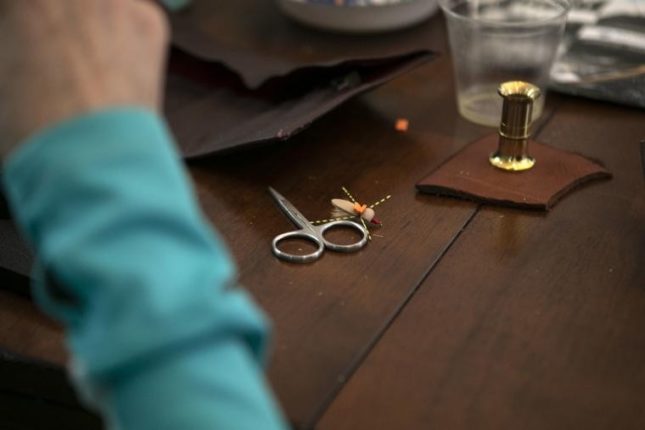
The women returned to their stations where a variety of tools and materials were laid out and followed Gnuse’s instructions. They were tying Pink Pookies, a dry fly that resembles a grasshopper.

It was all part of a fly-tying clinic organized by local group MT Fly Gals. The clinic was open to anyone interested, and the group consisted of all ages and experience levels.

Gnuse has been tying flies for about 15 years and teaches a workshop at the Fly Fishers International expo each year. She told the group that tying flies at home isn’t always cheaper than buying them in a store.

“If you catch the bug like I did, you’re always going to be wanting to try something different,” Gnuse said.

Sandra Erickson started MT Fly Gals two years ago when she moved to Bozeman. She had been part of a similar group in Colorado.

“I learned how to fly fish in that group and I ended up building a huge group of friends,” Erickson said.

Erickson said around 70 women showed up to first meeting. Since then, the MT Fly Gals private Facebook group has grown to more than 550 members. They periodically plan fishing trips, camping trips and workshops like Saturday’s fly-tying clinic.

Erickson said the women are encouraging and share their knowledge. Sometimes they’re competitive, but in a fun way.

“It’s a social event as much as it is about fishing,” Erickson said.

That was certainly true Saturday.

The women listened to instructions and focused on the intricate craft at hand. They chatted happily in between. Some of the women had been a part of MT Fly Gals since it was started. For others, it was their first event.

Grace Phillips, 22, moved to Bozeman in September. She came to the workshop for both the social aspect and to learn how to tie flies, although she’s skilled at fly-fishing and plans to guide out of Livingston this summer.

Deb Gay and Heidi Palmer sat across from one another and talked about how much they enjoyed being in an all-women group. They agreed that it’s a completely different experience than when they’ve gone fishing with men.

Gay said women tend to be more patient and don’t underestimate each other’s abilities.

Palmer said it’s important that MT Fly Gals introduces women to fishing partners so they don’t have to go alone. Palmer showed the others a scar stretching from her wrist to her elbow she got when she fell while fishing by herself. Luckily, she was able to call for help.

Stories like that flowed easily among the small group as they assembled their hoppers. They trimmed the foam and attached elk hair and completed the fly with a whip finish, which Gnuse said takes the most practice.

Some flies looked more symmetrical than others. But Gay, who’s been tying flies for three years, told the group to forget appearance — the fish will bite.

“There’s nothing quite like catching that first fish with a fly you’ve tied,” Gay said.

Fly gals: Women’s fly-fishing group ties flies, fosters friendships

BOZEMAN, Montana — A small group of women gathered around Patty Gnuse at her kitchen table recently, watching intently as she pulled thread through a fly-tying bobbin.

“See, then just zip it through,” Gnuse said.

The women returned to their stations where a variety of tools and materials were laid out and followed Gnuse’s instructions. They were tying Pink Pookies, a dry fly that resembles a grasshopper.

It was all part of a fly-tying clinic organized by local group MT Fly Gals. The clinic was open to anyone interested, and the group consisted of all ages and experience levels.

Gnuse has been tying flies for about 15 years and teaches a workshop at the Fly Fishers International expo each year. She told the group that tying flies at home isn’t always cheaper than buying them in a store.

“If you catch the bug like I did, you’re always going to be wanting to try something different,” Gnuse said.

Sandra Erickson started MT Fly Gals two years ago when she moved to Bozeman. She had been part of a similar group in Colorado.

“I learned how to fly fish in that group and I ended up building a huge group of friends,” Erickson said.

Erickson said around 70 women showed up to first meeting. Since then, the MT Fly Gals private Facebook group has grown to more than 550 members. They periodically plan fishing trips, camping trips and workshops like Saturday’s fly-tying clinic.

Erickson said the women are encouraging and share their knowledge. Sometimes they’re competitive, but in a fun way.

“It’s a social event as much as it is about fishing,” Erickson said.

That was certainly true Saturday.

The women listened to instructions and focused on the intricate craft at hand. They chatted happily in between. Some of the women had been a part of MT Fly Gals since it was started. For others, it was their first event.

Grace Phillips, 22, moved to Bozeman in September. She came to the workshop for both the social aspect and to learn how to tie flies, although she’s skilled at fly-fishing and plans to guide out of Livingston this summer.

Deb Gay and Heidi Palmer sat across from one another and talked about how much they enjoyed being in an all-women group. They agreed that it’s a completely different experience than when they’ve gone fishing with men.

Gay said women tend to be more patient and don’t underestimate each other’s abilities.

Palmer said it’s important that MT Fly Gals introduces women to fishing partners so they don’t have to go alone. Palmer showed the others a scar stretching from her wrist to her elbow she got when she fell while fishing by herself. Luckily, she was able to call for help.

Stories like that flowed easily among the small group as they assembled their hoppers. They trimmed the foam and attached elk hair and completed the fly with a whip finish, which Gnuse said takes the most practice.

Some flies looked more symmetrical than others. But Gay, who’s been tying flies for three years, told the group to forget appearance — the fish will bite.

“There’s nothing quite like catching that first fish with a fly you’ve tied,” Gay said.

Trout Unlimited’s Chris Hunt to give fishy presentation at free event hosted by Southeast Idaho Fly Fishers

POCATELLO — Chris Hunt — award-winning journalist, author, angler and national digital director for Trout Unlimited’s Trout Media — will be the featured presenter at Southeast Idaho Fly Fisher’s February meeting. The public is invited to attend this free presentation on Thursday at Goody’s Deli located at 905 South 5th Avenue in Pocatello. The program starts at 6:30 p.m.

Hunt will be sharing fish stories, fly patterns, and information from his latest book, “Catching Yellowstone’s Wild Trout: A Fly-Fishing History and Guide.”

When he is not out fishing his favorite streams or tying flies, he is responsible for in-house content crafted for TU’s blog and for content sent out over social media to TU’s members, supporters and followers. 

Hunt is a former newspaper editor and reporter who joined TU in 2005, where he worked for the organization’s Sportsmen’s Conservation Project. He served several years as the organization’s national communications director and assumed his present duties in late 2016.

Hunt is also an award-winning journalist, having received recognition from the Associated Press, the Society of Professional Journalists, the Pacific Northwest Newspaper Association, the Idaho Press Club and the Outdoor Writers Association of America. He has authored four books, the latest of which — “Catching Yellowstone’s Wild Trout: A Fly-Fishing History and Guide” — was published in June 2019.

This upcoming free event is not just a chance to hear from an expert angler and author from Idaho, it’s also an opportunity to meet and mingle with members of the Southeast Idaho Fly Fishers who have been involved in countless habitat and fish conservation projects in southeast Idaho since 1972.

Trout Unlimited’s Chris Hunt to give fishy presentation at free event hosted by Southeast Idaho Fly Fishers

Chris Hunt — award-winning journalist, author, angler and national digital director for Trout Unlimited’s Trout Media — will be the featured presenter at Southeast Idaho Fly Fisher’s February meeting. The public is invited to attend this free presentation on Feb. 13 at Goody’s Deli located at 905 South 5th Avenue in Pocatello. The program starts at 6:30 p.m.

Hunt will be sharing fish stories, fly patterns, and information from his latest book, “Catching Yellowstone’s Wild Trout: A Fly-Fishing History and Guide.”

When he is not out fishing his favorite streams or tying flies, he is responsible for in-house content crafted for TU’s blog and for content sent out over social media to TU’s members, supporters and followers. 

Hunt is a former newspaper editor and reporter who joined TU in 2005, where he worked for the organization’s Sportsmen’s Conservation Project. He served several years as the organization’s national communications director and assumed his present duties in late 2016.

Hunt is also an award-winning journalist, having received recognition from the Associated Press, the Society of Professional Journalists, the Pacific Northwest Newspaper Association, the Idaho Press Club and the Outdoor Writers Association of America. He has authored four books, the latest of which — “Catching Yellowstone’s Wild Trout: A Fly-Fishing History and Guide” — was published in June 2019.

This upcoming free event is not just a chance to hear from an expert angler and author from Idaho, it’s also an opportunity to meet and mingle with members of the Southeast Idaho Fly Fishers who have been involved in countless habitat and fish conservation projects in southeast Idaho since 1972.

Idaho Master Naturalist open house and introductory meeting set for Feb. 13 in Pocatello

POCATELLO — You may have heard of Master Gardeners, Master Instructors, Master’s Degrees, masterpieces or have a MasterCard in your wallet. But do you know what a Master Naturalist is?

An Idaho Master Naturalist is a person who enjoys nature, outdoor recreation, supporting conservation and is interested in continually learning more about the natural world around them. It is someone who then channels his or her skills, interests and energy to volunteer at nature centers, helps biologists collect data, monitors wildlife, assists at parks and natural areas, helps with fishing or hunting clinics, participates in habitat projects or contributes to many other conservation-related efforts. An Idaho Master Naturalist can be a teacher, farmer, hunter, angler, birdwatcher, retired professional or homemaker — perhaps you!

The High Desert Chapter of the Idaho Master Naturalists is now recruiting new members and will hold an open house and introductory meeting on Feb. 13. The meeting starts at 6 p.m. at the Southeast Regional Fish and Game Office at 1345 Barton Road in Pocatello.

To earn the title of Idaho Master Naturalist, an individual completes 40 hours of hands-on training in areas focused on Idaho’s ecology, plants, animals and natural systems taught by experts in their fields. You don’t need to have an education or background in science, just the desire to learn and the enthusiasm to volunteer.

This first class is free of charge. For interested individuals who desire to become certified Idaho Master Naturalists, additional trainings and classes will be offered. The total cost for the certification process is $80 per person to cover supplies and materials. And, later in the year, much of the training will be spent outside in the great outdoors!

In the US, there are over 30 states with Master Naturalist programs. To date, Idaho has eight Master Naturalist chapters throughout the state, including the High Desert Chapter here in Southeast Idaho, and interest in starting new chapters is growing.

Though Idaho Fish and Game coordinates the state’s Master Naturalist Program, it is not solely a Fish and Game program. It is a program that belongs to the volunteers who drive it and donate their services to various agencies, organizations, and communities throughout Idaho.

So what does this program mean for Idaho?

Idaho Master Naturalist Program aims to develop a corps of well-informed volunteers to actively work toward stewardship of Idaho’s natural environment. Furthermore, agencies like Idaho Fish and Game benefit from having skilled volunteers like Master Naturalists in the community. Volunteers are not only critical to completing important projects and tasks, their donated hours often serve as match for securing grants and other funding sources. Simply put, volunteerism helps Idaho Fish and Game and other agencies stretch their dollars further and do their jobs better.

If you would like more information on the Idaho Master Naturalists Program, the upcoming training in Pocatello, or if you have a need for these specialized volunteers, contact Tessa Atwood at the Southeast Regional Fish and Game Office in Pocatello at 208-232-4703 or visit idfg.idaho.gov/master-naturalist.

What to expect at a gun show

I have attended numerous gun shows and never seen a hint of all of the mayhem and wickedness that some claim is happening at them. I just see a lot of older people, young kids, etc., having a good time. So, from my naive perspective, let’s look at what to expect when you go to a local gun show. But realize every gun show will have its own flavor.

I never thought about it until just now, but I don’t think that I’ve ever actually bought a gun at a gun show. I’ve sold some guns but never bought one so I guess, really, I just go to buy accessories and cool stuff. As I’m typing this article, I’m visiting South Dakota. I noticed that there was a gun show going on in the town that I am staying in so me and a buddy decided to hit it. It was not unlike most shows.

FORMAT

Vendors will rent tables to set up their wares. They can rent from one table on up to I guess as many as they want, but usually it will be one to three with a handful of the bigger vendors renting four to maybe six.

There will be a handful of vendors selling new guns. More than likely these will be a local gun dealer.

Then there will be quite a few tables with used guns. These are set up by guys that appear to hit all of the local gun shows. If you talk to them it sounds like they hit the Nampa, Caldwell, Marshing, Ontario, La Grande and Pendleton shows. To me, it seems like a lot of this group do gun shows almost as a hobby.

I don’t really see them selling too much. I think they like to hang around that group of people and hope to make enough to support their lifestyle.

Then there will be a few that specialize in brass. Most of these guys are into shooting and not really hunting. They just love to shoot, tweak their rifles and spend a lot of time at the gun range. This explains why gun shows can have a semi-high attendance even during hunting season when normal people ought to be up in the mountains hunting!

I couldn’t believe it but at a meeting at the SHOT Show last week, one of the speakers said that shooting is the No. 2 sport in America, ahead of golf.

KNIVES

And of course knives are always a big item. I write a weekly knife product review for AmmolandShootingSportsNews, which is the largest Outdoor website in America so as you can imagine, I love knives. Yes, half of the knife tables will have cheap imports but there will also usually be a few quality knives at every show.

And there will be a few tables with some old-school knives. I never tire at looking at them — like the old Case leather handle knives, etc. I met a guy last year in La Grande and he had a table full of knives made in Finland. The sheaths were made of reindeer leather and some of the handles out of their antlers. It’s always cool to find some new twist like this. I got a few and am testing them and will do some product reviews on them sometime in the future. It’s fun to find something new like that.

Then something that is cool to the old timers is that there is always two to three tables that have some World War II knives, bayonets (If you’re young and don’t know what a bayonet is, it is a knife that can be attached to the muzzle of your rifle for hand-to-hand combat in the trenches), rifles and pistols.

Some guy here today had a whole table of German Lugers which was cool. I’d love to own one of them. And while on old military gear, there will be one to two guys that has some old military clothing for sale.

AMMO

There will be a lot of ammo for sale. At every gun show I can find at least a few vendors that have a good deal on ammo. So, I always end up buying a few boxes to go plink with. If you’re looking to buy in bulk, a gun show is a good place to check out.

So, as we wrap up, if you’re in town when one of the (semi) local gun shows is going on, you might want to check one out. Who knows, you might become a gun show groupie!

Tom Claycomb lives in Idaho and has outdoors columns in newspapers in Alaska, Idaho, Utah, Nevada, Colorado and Louisiana.