New state records set for cutthroat and golden trout

Two Idaho fishing records were recently broken by anglers fishing central and eastern Idaho waters.

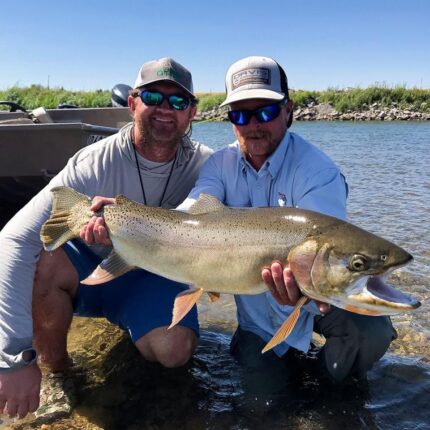
On Aug. 7, Sam Hix of Bellaire, Texas, set a new catch-and-release state record for Yellowstone cutthroat trout after landing a 30.5-inch monster while fishing the Snake River in Bingham County.

“After measuring the fish and taking a quick photograph, Hix released it to swim another day,” Idaho Fish and Game said in a news release. “His fish tops the long-standing record set by Nate Ivy in 2016 (28.5 inches) and will set a very high bar for future Yellowstone cutthroat trout records.”

The other new record fish was a 19.7-inch golden trout caught by Joseph Putnam Evans in Pass Lake high in the backcountry near Leatherman Peak in the Lost River Range. Putnam and his wife Huan Zhou were backpacking in Idaho from North Carolina.

“Joseph caught the remarkable trout on July 20 using a wet fly (rigged on spinning tackle),” Fish and Game said. “After a quick measurement and photo, he released the 19.7-inch golden trout to claim a new catch/release record.”

Golden trout are native to high elevation streams and lakes of the southern Sierra Nevada mountains in California and have been planted in several Idaho alpine lakes to provide more fishing opportunities, according to Fish and Game.

Yellowstone cutthroat trout are mainly found in eastern Idaho and are native to the Snake River from Shoshone Falls upstream to its headwaters, and they are one of four subspecies found in Idaho. Idaho Fish and Game keeps state records for all game fish including Yellowstone, Bonneville, Westslope and Lahontan cutthroat subspecies.

Fish and Game started keeping catch-and-release fish records in 2016. To learn more about the program and see records on various fish caught in the state, go to idfg.idaho.gov/fish/record.

New state records set for cutthroat and golden trout

Two Idaho fishing records were recently broken by anglers fishing central and eastern Idaho waters.

On Aug. 7, Sam Hix of Bellaire, Texas, set a new catch-and-release state record for Yellowstone cutthroat trout after landing a 30.5-inch monster while fishing the Snake River in Bingham County.

“After measuring the fish and taking a quick photograph, Hix released it to swim another day,” Idaho Fish and Game said in a news release. “His fish tops the long-standing record set by Nate Ivy in 2016 (28.5 inches) and will set a very high bar for future Yellowstone cutthroat trout records.”

The other new record fish was a 19.7-inch golden trout caught by Joseph Putnam Evans in Pass Lake high in the backcountry near Leatherman Peak in the Lost River Range. Putnam and his wife Huan Zhou were backpacking in Idaho from North Carolina.

“Joseph caught the remarkable trout on July 20 using a wet fly (rigged on spinning tackle),” Fish and Game said. “After a quick measurement and photo, he released the 19.7-inch golden trout to claim a new catch/release record.”

Golden trout are native to high elevation streams and lakes of the southern Sierra Nevada mountains in California and have been planted in several Idaho alpine lakes to provide more fishing opportunities, according to Fish and Game.

Yellowstone cutthroat trout are mainly found in eastern Idaho and are native to the Snake River from Shoshone Falls upstream to its headwaters, and they are one of four subspecies found in Idaho. Idaho Fish and Game keeps state records for all game fish including Yellowstone, Bonneville, Westslope and Lahontan cutthroat subspecies.

Fish and Game started keeping catch-and-release fish records in 2016. To learn more about the program and see records on various fish caught in the state, go to idfg.idaho.gov/fish/record.

Fall hunting fun is just around the corner — are you ready?

Hunting seasons are upon us in Idaho with opening day for general archery season starting on Aug. 30. Here are some things to keep in mind as you get ready for your fall hunting adventures.

— New this fall, the pheasant stocking program has been expanded in Southeast Idaho to include the Portneuf Wildlife Management Area south of Pocatello near Inkom. This makes two WMAs in the Southeast Region at which pheasant hunters will be able to pursue their quarry, the other being Sterling WMA near Aberdeen which has been traditionally stocked for years. More information about this expanded stocking program will be coming soon.

— Also new this fall is an opportunity for 50 hunters to pursue tundra swans in Benewah, Bonner, Boundary and Kootenai counties. The season runs from Oct. 19 through Dec. 31. Tags went on sale on Aug. 1 and are sold out. If you were successful in buying a swan tag, check out Fish and Game’s swan hunting orientation course, which can be found online at idfg.idaho.gov/hunt/swan/course. This experimental hunt will provide a hunting opportunity for swans for at least three years. After that period, the hunt could become a continued opportunity for swan hunters upon approval by the Pacific Flyway Council and the U.S. Fish and Wildlife Service.

— The big game hunting outlook in the Southeast Region should be similar to last fall. A detailed hunting forecast will be coming out in the next couple of weeks.

— The results for the second controlled hunt application period are not out yet, but will be soon. Any tags leftover from the second drawing will be sold first-come, first-served on Aug. 25 at 10 a.m. Leftover tags can be purchased online, at any license vendor, or at any Idaho Fish and Game regional office.

— Remember, if you have a tag you wish to exchange, don’t wait too long. Once a season has started for the hunt for which you have your tag, exchanging that tag is not possible.

— Figuring out where to hunt is one of the biggest hurdles new hunters face, and Idaho Fish and Game has produced a three-part video tutorial to help guide hunters through the process of finding a place to hunt big game. The series will be featured on Fish and Game’s recently-launched website, gohuntidaho.org, which contains a wealth of information for hunters.

— Hunter education will continue to be offered online through the end of the year without the in-person field day requirement. Bowhunter education is also offered online. For access to online courses, visit idfg.idaho.gov/hunt/education. No regular in-person hunter or bowhunter education classes are being offered at this time, however, the Southeast Region is preparing to offer an in-person trapper education class this fall.

— Those who like to hunt wild turkey should take note that Unit 71 has been added to the list of units in the Southeast Region for either-sex general turkey season, and the season has been extended. This general turkey season is for units 71, 73, 74, 75, 77, and 78 and runs Sept. 15 through Nov. 30.

— Ever wonder what the most common hunting violations are? Check out this list, and make sure you don’t make one of these mistakes in the field this year.

Wrong class license: It is unlawful for any person to purchase and possess a license of the wrong class. This is commonly individuals who are not residents of Idaho purchasing Idaho resident licenses.

Possession/transportation of big game without evidence of sex: Failure to leave evidence of sex naturally attached to the carcass, largest portion of meat if boned or hide for mountain lion, black bear and wolf.

Unlawful take: It is the hunter’s responsibility to know the season open and close dates, hunt area boundaries, which species and sex may be taken, authorized methods of take such as archery, muzzleloader and any weapon hunt, and what license, tag and/or permit is required.

Violate Forest Service road/area closures: The US Forest Service and Bureau of Land Management establish designated routes in Idaho’s National Forests and BLM lands. Please pay attention to the current Motorized Vehicle Use Maps for the areas you hunt.

Hunt without a tag or with an invalid tag: It is the hunter’s responsibility to know the species and sex their tag is valid for, whether the tag is for a controlled hunt or a general hunt, which zone and dates the elk tag is valid for and hunt area boundaries.

Hopefully this information helps gets you both prepared and excited for your upcoming fall adventures. Don’t forget to check out the current Idaho seasons and rules brochures for your hunts this fall and winter. Brochures are available at license vendors and online at idfg.idaho.gov.

Into the wild: Backpacking into the Frank Church River of No Return Wilderness Area

I know that I’m totally blessed and get to do a lot of cool stuff, but my most favorite trip every year is backpacking with my daughter, Kolby. It’s the best daddy-daughter time in the world. No TV, no cellphones, no internet, no nada. Just me and her. We get to talk about everything under the sun with no interruptions. When I take time to hear her insights, it amazes me as to how smart and perceptive she is. I’d never have a chance to see this side of her if we didn’t withdraw from the busyness of the world.

I live a busy life. Right now, I’m 30,000 feet above the earth headed home. I’ve been out of state for two weeks and have two to three in-state trips this week while home and then I fly out again for two more weeks.

While going through TSA, I got a call from an editor wanting me to fly down to Texas in a few weeks for a dove hunt. And working on a deal with Knives of Alaska to develop a professional boning knife for the outdoorsman. It will soon be hitting the market. I’ve got to run down for a few days to bone out a steer, deer and a hog and do some filming on processing and do a couple of TV shows.

There is always something going on or being planned. So to get away, just me and my daughter by ourselves in the wilderness backpacking and fly fishing is precious. If you don’t do this with your kids, you really should. It’s the highlight of my year.

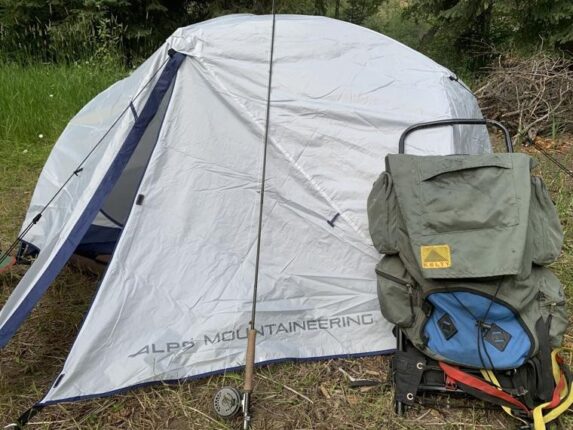
After your initial set-up cost, it is a cheap outing. We covered backpacking gear a couple of weeks ago, but I’d advise buying good gear. It will last for years to come and not toot out on you while in the backcountry. We tested out an Alps Mountaineering Chaos 2 and an Alps Meramac 2 tent, their Crescent 20 sleeping bags and their Nimble Air Mats. All worked great.

I had a flurry of articles I had to submit so we got off a little later than I wanted. I wanted to get to our camping spot, set up and fish for an hour or two before dark. As is, we got there in time to get set up before dark. We threw up the tents and while Kolby was pumping up the mats, I gathered enough firewood for the duration. I love the Nimble Air Mats. They’re unique in that the storage bag acts as a pump of sorts. It connects to the valve on the mat. Fill the bag with air and then roll it up to force air into the mat. A lot of mats are only 1-inch thick, the Nimble is nearly 4 inches thick so you only need one mat. This will save me from packing two.

We built a fire, ate some snacks and then stumbled to bed. The next morning, I got up early and hit my favorite hole. I caught one nice cutthroat, about 17-18 inches and then went back to camp to get Koko. We built a fire, drank some coffee and ate a quick breakfast.

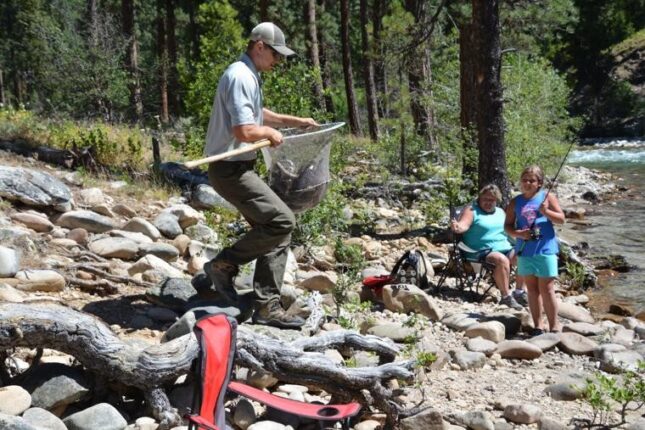
We then hit the river and fly fished all day. I started out using Skull Head black wooly buggers from flydealflies.com. I could not beg a bite. I put on one of their Olive Caddis flies on Koko’s line and right fast she hung a nice native cutthroat. Wow, what a nice fish.

We didn’t catch a ton of fish but got a couple of nice ones and had a great time and as you remember from last week’s article, we got sidetracked picking huckleberries, which isn’t a bad thing at all. That in and of itself would have made it a great trip. I screwed up big time and forgot to pack flavored oatmeal. We love that for breakfast with huckleberries mixed in.

Wow, too many options in the backcountry. Do we pick huckleberries? Thimble berries? Fly fish? Why just do one? So we did all three. Late that afternoon we headed back to camp and built a big roaring fire and dined on Mountain House meals. I love their beef stroganoff dinners and if I don’t pack a MH raspberry crumble dessert … let’s just say that Kolby might go full auto.

As the sun set it started sprinkling lightly. We normally stay up until dark to watch the bats erratically swooping around chasing mosquitoes but due to the sprinkle and being dead tired from hiking all day we crawled to our tents and crashed. The sprinkle turned into a light rain. Nothing is as peaceful as being in a tent warm and toasty while it’s raining outside. Poor animals, they need to buy an Alps tent and sleeping bag.

The next morning the wood was damp. I had some fire-starting material I was testing but it didn’t work so I used some paper towels and soon had a fire going. I dipped a pot of water out of the river and made coffee.

We then hit the river until … we walked by a good huckleberry patch. Kolby put on the brakes and we picked a few more bottles of berries (we pulled the filters out of our Aquimira water bottles and filled them up). I finally got her back to fishing.

Soon the time had come to leave. We reluctantly packed up camp and hit the trail back to the truck.

What a great time.

Kolby and I got home, unloaded and were in bed by 1 a.m. The next day, Katy wanted to go hit the crappie so I unpacked, repacked and we took out and didn’t get home and in bed until 1 a.m. again!

Wow, two girls that are fishing me to death. Now that’s a good problem to have!

Tom Claycomb lives in Idaho and has outdoors columns in newspapers in Alaska, Idaho, Utah, Nevada, Colorado and Louisiana. He also writes for various outdoors magazines and teaches outdoors seminars at stores like Cabela’s, Sportsman’s Warehouse and Bass Pro Shop.

Online download of Fly Fishing Film Fest to benefit local club

The Snake River Cutthroats chapter of Trout Unlimited has a deal for anglers.

The club has teamed up with the once canceled Fly Fishing Film Tour to allowed interested anglers and outdoor enthusiasts to watch the film from an online source.

Since the Fly Tying Expo and Fly Fishing Film Tour was canceled earlier this year because of the coronavirus pandemic, the Snake River Cutthroats haven’t had much in the way of club-wide activities. Offering people a chance to see the 2020 film is its way of engaging people, a club representative said.

“When you see the trailer (to the movie), it’s pretty impressive,” said Rob Knox of the Snake River Cutthroats. “It’s just magnificent cinematography. It’s pretty cool stuff.”

East Idahoans will have access to the film beginning Aug. 27 for a limited time. Cost is $18, which allows people to view the movie at home or a single digital device. All of the money, except for a small percentage, will go to the Snake River Cutthroats for local conservation projects.

“I’m really stoked and the club is really stoked that the Fly Fishing Film Festival went through this effort,” Knox said. “We’re hoping that the funds that come from this will keep us in the game.”

For information on the online film festival, go to snakerivercutthroats.org/how-it-works.

“The Fly Fishing Film Festival is running a raffle nationwide for a bunch of trips and a bunch of gear donated by YETI, Simms, Costa and other stuff, but the Cutthroats are going to do one too,” Knox said.

To see the two-minute trailer to the 2020 Fly Fishing film, go to snakerivercutthroats.org/event/fly-fishing-film-tour.

Visit Idaho’s Great Lakes for some of the ‘best of the best’ fishing

Idaho is world-famous for its quality fishing, which includes not only a wide variety of species, but different types of waters. Those include Idaho’s “Great Lakes,” which are not only large in size, but also provide excellent and unique fishing opportunities for trophy-sized fish. In most cases, they also provide a user-friendly experience because services and accommodations are typically on the lakes or close by. Many also offer guided fishing trips and boat rentals for people who don’t have all the equipment they need.

Lakes also offer a serene summer (or fall) getaway where you can enjoy sparkling waters and gentle lapping of waves against the shore. You have a variety of ways to catch fish ranging from trolling in open water to casting or trolling near the shoreline in a canoe or kayak, to casting bait or a lure from a dock or from the bank.

Not to pit Idaho’s famed rivers against its lakes, but on average, fish tend to grow larger in lakes and reservoirs, and you have the opportunity to catch some of the biggest fish found in the state.

Idaho’s Great Lakes are well distributed around the state, so whether you want a day trip, weekend outing or vacation, there’s likely one fairly close, but they can also provide a good destination for a road trip and a chance to experience someplace new.

This list of destinations is hardly comprehensive. There are many other Idaho lakes worthy of your time and fishing efforts, and you can find more information at Idaho Fish and Game’s Fishing Planner, but here are a few lakes and reservoirs that are among the best:

Lake Pend Oreille

While this list isn’t in order of importance, it’s still fitting to start with Lake Pend Oreille because it’s Idaho’s largest lake, and you couldn’t consider listing the Great Lakes of Idaho without it. Lake Pend Oreille boasts some impressive stats: it’s 43 miles long and 6 miles wide with 111 miles of shoreline, not to mention 1,158 feet at its deepest spot, making it the fifth-deepest lake in the U.S.

The backbone of Lake Pend Oreille’s fishing is its kokanee population, which is thriving after Fish and Game launched one of the largest fishery restoration projects in its history to bring those fish back to abundance.

Fish and Game crews recently surveyed the lake and found more kokanee than they’ve seen in 20 years. That’s great news for kokanee anglers, but many other anglers benefit because kokanee also support the lake’s trophy rainbow trout, bull trout and lake trout populations, allowing them to grow to massive sizes. The lake has produced numerous state record fish, as well as the current world’s record for bull trout (which can no longer be harvested) and the former world-record rainbow trout.

The lake also hosts a variety of other gamefish, including cutthroat trout, brown trout, largemouth and smallmouth bass, black crappie, northern pike, and walleye.

Lake Pend Oreille is also a full-service lake with many marinas, boat rentals, guides, charters and other services, not to mention a multitude of options for lakeside accommodations.

Coeur d’Alene Lake

Being in the shadow of Lake Pend Oreille is a tough spot to be, but Coeur d’Alene Lake still shines with a combination of size, quality and variety. While roughly half the size of Lake Pend Oreille at 26 miles long and about 1 to 3 miles wide, it’s still Idaho’s second largest lake (Bear Lake is larger, but divided between Idaho and Utah).

Its native fish include Westslope cutthroat, bull trout and mountain whitefish, but throughout its history, Coeur d’Alene Lake has had many other fish introduced that now provide good-to-excellent fishing opportunities. Game fish include kokanee and Chinook salmon, largemouth and smallmouth bass, northern pike, yellow perch, black crappie, brown and black bullheads, and more.

Coeur d’Alene Lake also boasts lots of quality fishing nearby, including the Coeur d’Alene River and its chain lakes, and the North Fork of the Coeur d’Alene River and St. Joe River, all of which feature more quality fishing opportunities. The lake has not only its namesake town on its shore, but also several smaller communities, all of which provide accommodations, guides and services for a fishing destination.

Priest Lake

As if Northern Idaho didn’t have enough to brag about, Priest Lake adds another big lake with postcard scenery and quality fishing. Unlike lakes Coeur d’Alene and Pend Oreille that are located near cities, Priest Lake is more rural and less developed, but still has the all the services you need for a day trip, weekend outing or extended vacation with campgrounds, resorts, charters, boat rentals, accommodations, and more.

Priest Lake is about 19 miles long and about 4 miles wide, but it is different from other big lakes and reservoirs because it’s actually two lakes. It’s connected to Upper Priest Lake by a short, narrow channel that’s passable for most boats. The upper lake has no road access and is mostly undeveloped, but it does feature shoreline campsites.

Priest Lake’s main sport fish are lake trout, cutthroat trout, smallmouth bass and kokanee salmon. Lake trout and smallmouth bass offer the best catch rates. 

The lake’s abundant lake trout population has taken its toll on the kokanee population, so catch rates for kokanee are much lower than in Lake Pend Oreille where the population is much larger. If you’re seeking a more backcountry atmosphere, Upper Priest Lake is an excellent opportunity to find it, but don’t expect to be alone because it’s a popular area for anglers, campers and boaters. 

Dworshak Reservoir

If you want a big reservoir with lots of elbow room, Dworshak is a great opportunity to find solitude and good fishing. The reservoir is created by Dworshak Dam and creates a backwater on the North Fork of the Clearwater River and several tributaries stretching about 16,500 acres across miles in the heart of the Clearwater backcountry.

Anglers can catch kokanee salmon, trout and smallmouth bass. Dworshak is the current state record holder for smallmouth bass and continues to produce trophy-sized fish.

Most people access the reservoir and launch boats via Dworshak State Park at the reservoir’s south end, near the town of Ahsaka and a few miles west of Orofino.

But another option if you want more seclusion is boat-in campsites with no road access that are managed by the U.S. Army Corps of Engineers. There are 96 of them located throughout the reservoir, and all are equipped with vault toilets, picnic tables and fire rings. Use is first-come, first-served, and there are no camping fees.

Services are limited once you’re on the lake, so stock up in nearby communities before you get there.

Lake Cascade

While technically a reservoir, this lake is among the largest in the state at 21-miles long and up to 4.5-miles wide. Despite its size, it’s relatively shallow with a mean depth of 26 feet, but it’s extremely productive and has produced numerous state and world-record fish. Lake Cascade’s perch fishery is a great success story thanks to a multi-year effort by Fish and Game and partners to reduce predatory, nongame fish, transplant perch from other waters and let them naturally spawn and flourish.

While perch may be lake’s current marquee species, it has at least 10 species of game fish and produces trophy sizes for many of them. Other species include trophy-sized rainbow trout and smallmouth bass, as well as kokanee salmon and tiger muskie.

Lake Cascade is a year-round fishery, and summer is an excellent time to visit because its 4,760-feet elevation means temperatures aren’t too hot and the lake is rimmed by numerous developed campgrounds. Lake Cascade State Park offers shore-side camping around the lake, as well as boat ramps and picnic areas. It’s well-suited for RV camping and fishing with numerous paved RV pads around the lake with nearby boat launches.

Trolling is a productive way to fish, but because of its relatively shallow nature, bank fishing with bait, or pitching lures, will likely get you into fish. But beware, the lake has a well-earned reputation for being fickle, so don’t be discouraged if you don’t catch fish immediately. 

American Falls Reservoir

This is another Snake River reservoir that doubles as a “Great Lake” because of its large size and trophy fishing opportunities. It’s the largest of Idaho’s Snake River reservoirs, but unlike others that tend to favor warmwater fish, American Falls is kind of a hybrid because it also supports a trophy trout fishery that includes rainbows, browns and cutthroat.

And hybrid is an apt description in other ways because although it’s a large reservoir at 55,000 acres, its shoreline has a variety of bays, inlets and coves that provide a fishing experience similar to smaller waters, which anglers in small craft can enjoy.

The lake has lots of catchable trout thanks to regular stocking by Fish and Game. About 400,000 trout have already been stocked in 2020, which thrive in the productive waters and grow to large sizes. That productivity also applies to naturally spawning smallmouth bass, which are plentiful and also grow large, and there’s also yellow perch.

The town of American Falls is at the southwest end of the reservoir, where there are also several boat launches and fuel available. There’s also services and a boat launch available near Aberdeen, midway up the reservoir on the westside. Camping is available at Massacre Rocks State Park, as well as several private RV parks and campgrounds on or near the reservoir.

Bear Lake

Large and unique are two simple words to describe this Southeast Idaho destination. Large is pretty self explanatory, and to be specific, it’s about 20-miles long and 8-miles wide. The lake is roughly divided in half between Idaho and Utah, and you can fish with a license from either state.

The unique part deserves more details. First, its clear, aquamarine color has earned it the nickname of “Caribbean of the Rockies” and the lake boasts four “endemic” species of fish, which means they exist nowhere else on earth. They include: Bear Lake whitefish, Bonneville cisco, Bonneville whitefish and Bear Lake sculpin.

Anglers are drawn to the lake for its trophy Bonneville cutthroat trout, lake trout and whitefish. In addition, there’s a unique (there’s that word again) cisco fishery where fish are dipnetted through the ice during the fishes’ winter spawning season.

The lake’s size and large fish that favor deeper water mean it’s best fished from a boat, but there are some shore fishing opportunities as well.

The lake is a destination for many people, so there’s a wide range of services available, including full-service camping at Bear Lake State Park, various accommodations from motels to vacation rentals, boat and other recreation rentals, and more.

Brownlee Reservoir

This reservoir is in upper end of Hells Canyon and is predominantly a warmwater reservoir fishery. People travel from far away to catch its abundant bass, crappie, catfish, sturgeon, bluegill and more. But what makes this reservoir fun and exciting for anglers is that regardless of what you’re targeting, there’s a good chance you will catch something else as well.

While most anglers use boats so they can reach areas that are not accessible by road, there are many coves, bays and areas that provide good shore fishing. Rocky points are typically hotspots for smallmouth bass and crappie. Catfishing for channel cats can also be excellent, especially in the upstream end where the river transitions into the reservoir.

Brownlee has a well-deserved reputation for its trophy fish, having produced several state records. 

Unlike other destinations that are located along or near major highways, Brownlee requires a little more effort to reach, and most anglers access it through the small town of Cambridge along U.S. 95 midway between Weiser and Council. Supplies and service are limited at Brownlee, so make sure you bring what you need.

Henry’s Lake

Henry’s Lake is smaller than most of its fellow great lakes, but is still a respectable size at about 8 square miles. It’s also unique among them because it is located at about 6,500-feet elevation, and the panoramic peaks of the Centennial Mountains and Henry’s Lake Range provide a breathtaking backdrop.

Equally breathtaking are the trophy fish the lake produces. Henry’s Lake is a destination for anglers trying (and often succeeding) to catch its large Yellowstone cutthroat trout, sterile rainbow/cutthroat hybrids, and sterile brook trout. Sterile is notable because sterile fish tend to be fast growing and achieve large sizes.

Henry’s Lake produced the state-record brook trout, an 8-pound behemoth by brookie (or any other trout’s) standards. Cutthroats and hybrids semi-regularly top the 10-pound mark, and 20-inchers are so common they barely raise an eyebrow, unless of course, one is on the end of your line.

Due to its high elevation, Henry’s has a fairly short fishing season for open water (non-ice) and summer and early fall are both prime times for anglers. 

Camping is available at Henry’s Lake State Park, and at other developed and dispersed camping areas on public land managed by the Forest Service and Bureau of Land Management. There are various other accommodations around the lake, as well as most services.

C.J. Strike Reservoir

This is another bountiful reservoir created by a dam on the Snake River in southern Idaho. But C.J. Strike is a little different than others because C.J. Strike Dam is a “run of the river” dam, so its levels remain relatively constant. Why is that important? Because it provides a relatively stable environment and a very productive place to grow fish.

Like other Snake River reservoirs in Southern Idaho, warmwater fish are its main attraction, but there are some trout as well. Smallmouth bass, largemouth bass, perch and crappie are among the most common species caught in C.J. Strike, but you can also catch bluegill, sturgeon, channel catfish and bullheads, as well as a variety of nongame fish.

While boats have a clear advantage for reaching prime fishing spots, most of the south shoreline of the reservoir is accessible by roads and offers lots of place for those without a boat to catch fish. It’s also relatively friendly to small, human-powered boats, such as kayaks, canoe and small pontoon boats, but beware the reservoir can get windy, especially in the afternoons.

The reservoir has several developed campgrounds on the south shoreline, and ample places for dispersed/undeveloped camping. You can find supplies at each end of the reservoir in the towns of Grandview and Bruneau.
‘Latrine Queen’ fancies up Henry’s Lake toilets

The self-professed “Latrine Queen” has struck again.

If you’re on the south side of Henry’s Lake on Bureau of Land Management land and nature calls, prepare yourself for an artistic experience.

In an effort to spruce up its property at Henry’s Lake, the BLM improved the dirt road, worked on fences and replaced portable toilets with two new vault toilets. The BLM also plans to eventually upgrade the primitive campsites and work on bank stabilization there.

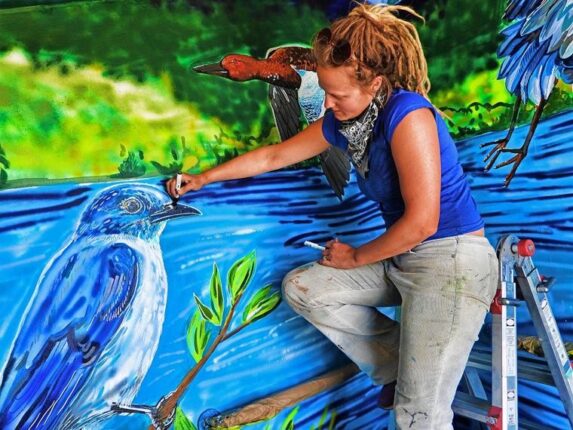
Monica Zimmerman, outdoor recreation planner for the BLM’s Upper Snake Field office saw the blank interior walls of the new vault toilets as empty canvasses. Zimmerman was put in contact with Helen Seay, a Tetonia artist who painted murals on three other vault toilets along the Teton River last summer.

“I wouldn’t say it’s a regular gig, but people hear about it and see it, it gives them an idea to reach out to me,” Seay said. “It’s not something I’m doing every month or that I market myself as, but I’m happy to do art anywhere, anytime.”

Bruce Hallman, a BLM spokesman, said the reaction has been enthusiastic.

“Nothing but wow, that it’s the best bathroom ever,” Hallman said.

“Wish more camp restrooms looked like this!” wrote Nyta Pea on the Bureau of Land Management – Idaho Facebook page.

Seay said each mural is unique and she tries to match the artwork to the surroundings. One restroom she completed at Spring Hallow near Felt east of Ashton on the Teton River had a special request.

“I try to learn about the area and the flora and fauna for every bathroom that I go to,” she said. “The Spring Hallow one I asked if there was anything they wanted to see me paint. One of the ladies of the Friends of the Teton River told me, ‘I really want you to paint a canyon wren,’ because it’s the only place in Idaho she’d ever heard a canyon wren.” Seay also included fishermen, rafters and bighorn sheep because “(Idaho) Fish and Game was saying that it was an old winter range for bighorn sheep.”

At Henry’s Lake, Seay painted one restroom with a variety of birds and the other with a fishing theme. “It’s kind of a fisherman’s paradise and a birder’s paradise.”

Zimmerman said the Henry’s Fork Wildlife Alliance and Henry’s Lake Foundation contributed ideas and funding for the murals.

Seay is a Georgia transplant who said most of her art is on canvas or wood, but also sells artistic hats, T-shirts, postcards and prints. Her business webpage can be found at helenseayart.com.

“I have been doing the annual posters for Grand Targhee Bluegrass Festival and Targhee Festival, but those got canceled this year unfortunately because of COVID,” Seay said.

Picking wild huckleberries

I interrupt this “Backpacking Series” to bring you a time-sensitive article. My daughter and I had an awesome backpacking trip last week and I planned on writing about that trip this week but first we have to talk about picking huckleberries since the season is semi short.

As stated above, we were up backpacking and while hiking down a trail after fishing, we hit one of our old huckleberry patches. Wow! They are thick this year. We picked quite a few but of course since we were backpacking we didn’t have a container. Kolby decided the best that we could do was to store them in our Aquamira filtered water bottles. So we pulled out the filters and used them.

If you wonder why I am so excited about them, my answer? You would only ask that question if you ever hadn’t eaten any. They’re a great tasting berry. They’re unique. A little tart and yet sweet — and a great tasting berry. They grow on a small shrub, barely up to your knees. I pick a lot of mine on steep hillsides. They are a deep blueish/purplish color berry that is about half the size of a green pea.

Normally, I always pack flavored oatmeal for us to eat for breakfast. A big treat every year is to pick huckleberries and mix them in every morning for breakfast. That is a real treat. This year I totally screwed up and forgot to buy oatmeal. Screw up of all screw ups.

I also like to mix some huckleberries into my water bottle. It elevates water from plain ol’ water to a fruit-flavored water drink. Pretty ingenious, huh? The first real natural fruit-flavored drink.

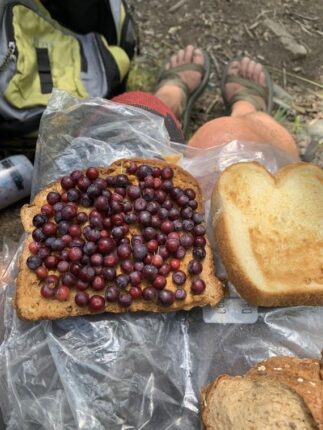
For lunch we always eat PBJ sandwiches but this year we didn’t have any jelly. PB sandwiches by themselves are not exactly a gourmet meal. In fact, it’s kind of a prison diet. So as they say, necessity is the mother of all inventions so we came up with a PBHB (Peanut Butter Huckleberry) sandwich. A little unique … and maybe not necessarily a good unique!

Normally when backpacking I’m mentally keeping note of all of the items that I’m not going to have to pack out. My Mountain House backpacking meals, four at 5 ounces each = 20 ounces; peanut butter, 12 ounces; bread 4 ounces; candy, a couple of pounds — and so the mental list goes. But this time we took out a few pounds of huckleberries and gladly did so. They are one of God’s natural delights second only to the morel mushroom.

And I failed to mention — the best way to eat them is by themselves. You’ve got to have discipline for them to ever make it into your container without eating them all while picking. They are small and you pick them one at a time so it takes a while to gather very many.

Upon making it home we put them in the fridge and stumbled off to bed at 1 a.m. The next day we had a fish fry. I made crappie into fish tacos and grilled a batch of sweet corn on the cob on my Camp Chef pellet smoker.

But then it was time for dessert. Huckleberry homemade ice cream! This is the ultimate way to eat your huckleberries. They freeze solid in the ice cream and I can’t tell you how good they are. This is my most favorite homemade ice cream.

So what are you waiting for? Pick up the phone and call in sick tomorrow. The huckleberries are ripe.

Tom Claycomb lives in Idaho and has outdoors columns in newspapers in Alaska, Idaho, Utah, Nevada, Colorado and Louisiana. He also writes for various outdoors magazines and teaches outdoors seminars at stores like Cabela’s, Sportsman’s Warehouse and Bass Pro Shop.

August fish stocking schedule for Southeast Idaho

Grab your fishing pole, pack the cooler, and don’t forget your fishing license. Personnel from Idaho Fish and Game’s hatcheries in the Southeast Region will be releasing over 6,000 catchable-sized rainbow trout at the following locations during August. Fish on!

  • Cub River at Willow Flat Campground: Aug. 3-7 (500 fish)
  • Kelly Park Pond: Aug. 3-7 (250 fish)
  • Montpelier Creek: Aug. 3-7 (500 fish)
  • Montpelier Rearing Pond: Aug. 3-7 (250 fish)
  • Portneuf River, below Pebble and above Lava Hot Springs: Aug. 3-7 (1,250 fish)
  • East Fork Rock Creek: Aug. 10-14 (1,000 fish)
  • Cub River at Willow Flat Campground: Aug. 17-21 (500 fish)
  • Kelly Park Pond: Aug. 17-21 (250 fish)
  • Montpelier Creek: Aug. 17-21 (500 fish)
  • Montpelier Rearing Pond: Aug. 17-21 (250 fish)
  • Bloomington Creek: Aug. 17-21 (200 fish)
  • East Fork Rock Creek: Aug. 24-28 (750 fish)

The number of trout actually released may be altered by weather, water conditions, equipment problems or schedule changes. If delays occur, trout will be stocked when conditions become favorable.

For maps of these fishing locations and other angling destinations in Idaho, visit the IDFG Idaho Fishing Planner.

How to pack your backpack

When I first started teaching Backpacking 101 seminars, I expected to talk the first 45 minutes and then field questions the last 15 just like I did in all of my other seminars. But I soon found out that the attendees want to hear the instruction the first 10 to 15 minutes and then go over what gear they’ll need. Later on I’m going to run one or two backpacking articles but, today, I’ll list out what I consider some items that you’ll want to pack. When possible, I’ll list which manufacturer(s) has tested out well for me.

I’m going to list out items with a short description. This way we can save space plus I can cram in more items.

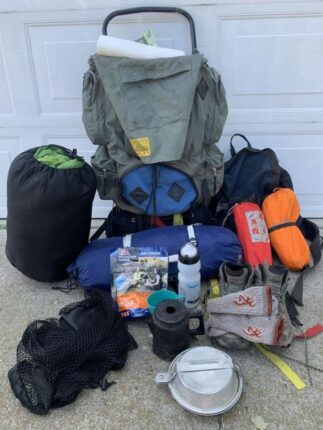
  • Pack — I’m old school. I still use an old external frame Kelty. But the younger crowd likes an internal frame. And they do conform to your body better and not sway like an external frame pack.
  • Tent — I used an Alps Mountaineering Chaos 2 tent this week and my daughter used the Meramac 2 tent. They’re nice. They have two doors AND, two vestibules in which you can leave wet gear.
  • Sleeping bag — According to how cold you get. This week we had the Alps Crescent Lake 20 mummy bags. If that is too warm for where you’re camping, get their Blue Springs 35.
  • Sleeping pads — You’ll want a pad. We live in the Rocky Mountains! The Alps Nimble pad is about 4 inches tall. You’ll only need one pad.
  • Chair — Nice so you don’t have to set in the dirt while eating or setting around the fire. Ten times more relaxing. I found one in the middle of the road called an Alite Mayfly.
  • XGO base wear — Light weight and good for cool mornings and to sleep in.
  • Boots — I like the Irish Setter VaprTrek 5-inch hiking boots. You’ll want a lightweight durable boot.
  • Sandals — I take a pair of Chaco sandals to give my feet a break and to wade in rivers.
  • Socks — Wear good hiking socks and you’ll never regret it.
  • Rain gear — We got rained on two days this week on our backpacking trip. Take something like the Frogg Togg lightweight, easily packable top.
  • Straps — To secure gear to your backpack.
  • Cooking utensils — Small aluminum coffee pot, Army/Boy Scout mess kit, plastic eating utensils sold at sporting stores. I like to take a plastic coffee cup.
  • Paper towels — I always take half a roll. Works for TP, kindling to start a fire and to wash utensils.
  • Fire gear — Take a few cheap Bic lighters, waterproof matches and some Trioxane fire bars.
  • String — Always handy.
  • Mouse trap — The little vermin try to confiscate your food.
  • Food — I eat flavored oatmeal in the morning (add fresh huckleberries), PBJ sandwiches for lunch and splurge and eat Mountain House MREs for supper. For coffee, I use motel packs.
  • Flashlight — I take a good one and a cheap one to read in the tent/change clothes etc. Plus, one may break.
  • Water — I use Aquimira filtered water bottles. That way you don’t have to lug around water.
  • Mesh bag — Use to hang your food in a tree.
  • Camera — You’ll be in cool country and want pics.
  • Adventure medical kits — Moleskin and the small roll of duct tape to patch tents, tent poles etc. Also take some Bactroban for cuts and adhesive wrap and Band-Aids. Uncle Ben’s tick repellent.
  • Knife — You’ll use a knife constantly. I like the Spyderco locking blade folders.
  • Nylon zip-off leg pants or shorts. They dry easy.
  • Blue Lizard sunscreen
  • Maps — MyTopoMaps makes the best maps. You can get one specific for your area, as large/small as you desire.
  • Compass — Always have two.

As you backpack you’ll add/subtract items from this list, but this should get you started. Have fun.

Tom Claycomb lives in Idaho and has outdoors columns in newspapers in Alaska, Idaho, Utah, Nevada, Colorado and Louisiana. He also writes for various outdoors magazines and teaches outdoors seminars at stores like Cabela’s, Sportsman’s Warehouse and Bass Pro Shop.