Regional campgrounds shutting down the next few weeks

October marks a transition time for campgrounds and lodges in the region’s national parks and national forest campgrounds. Many sites are closing or have reduced services starting in October.

For Yellowstone National Park, some campgrounds have already closed. One exception is Madison Campground due to close Oct. 18. Most lodges in Yellowstone close after this weekend, with a few remaining open mid-month or slightly later. Shops, cafeterias and other facilities will generally close after this weekend, with the exception of Mammoth Hot Springs, which closes up later in the month. For specifics on closing times, go to nps.gov/yell/planyourvisit/hours.htm.

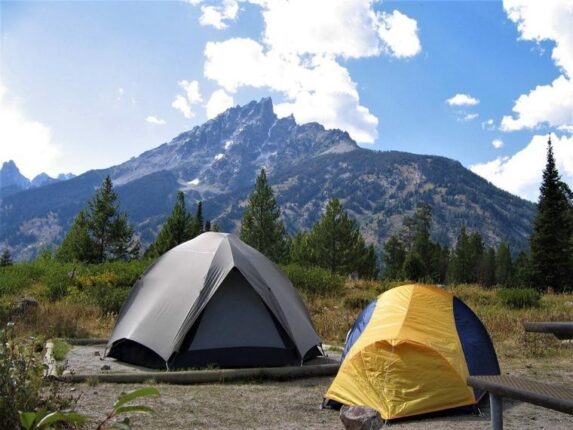
Limited camping options are available in Grand Teton National Park starting this weekend, with most sites either closed or closing in the next few weeks. All campgrounds will be closed after Oct. 18. The park reports that campgrounds continue to fill up each day and surrounding Forest Service campgrounds are also filling up.

“Visitors should come prepared with a plan for finding a campsite and have alternate plans if campsites are not available,” the park said in a news release.

Trails, roads and pathways remain open in both Yellowstone and Grand Teton, and “fall is a great time to explore Grand Teton National Park,” the park said.

Backcountry camping is available year-round in the park with a permit. Permits can be obtained at the Craig Thomas Discovery and Visitor Center in Moose, Wyoming. The Craig Thomas Discovery and Visitor Center closes at the end of Oct. 31, and permits can be obtained online. Go to nps.gov/grte/planyourvisit/back.htm for information.

Henrys Lake State Park campground is scheduled to close after the second Saturday in October. The docks are taken out the day before closing.

Massacre Rocks State Park campground is open year-round.

The houses, shelters and yurts at Harriman State Park have various seasons for availability. Go to parksandrecreation.idaho.gov/parks/harriman for more information.

The Lava Flow Campground at Craters of the Moon National Monument & Preserve closes when the Loop Road closes in late November. Contact the park for specifics.

Campgrounds across the Caribou-Targhee National Forest have begun closing with several in the Island Park area already closed. Some sites remain open without water or garbage services. Bring your own water and pack out your trash. To get specifics on the 50 campgrounds in the Caribou-Targhee, go to bit.ly/34hmUdj.

The more than 50 campgrounds in the Salmon-Challis National Forest are often remain open but run the gamut of services offered. To learn more, go to bit.ly/3itVmq5.

Deer hunters asked to submit samples for chronic wasting disease testing

Idaho Fish and Game is ramping up its efforts at detecting chronic wasting disease, especially in East Idaho, by calling on hunters to provide samples from harvested deer this hunting season.

Although the disease — also called “zombie deer disease” — has not been detected in Idaho, the bordering states of Montana, Utah and Wyoming all have chronic wasting disease in their big game herds. Some animals have been found with the disease within a few miles of the state line in Star Valley, Wyoming.

The contagious disease is fatal to mule deer, white-tailed deer, elk, caribou and moose. Chronic wasting disease is similar to bovine spongiform encephalopathy, or mad cow disease. Infected animal symptoms include “excessive salivation, drooping head or ears, tremors or shaking and extremely low body weight. The animals may also show no fear of humans or lack coordination,” according to Fish and Game.

“There is no known cure for (chronic wasting disease), nor any way of testing live animals, so hunter-harvested animals are a primary way of testing for it in Idaho,” said Roger Phillips, Fish and Game public information supervisor. “(Chronic wasting disease) poses a serious risk to Idaho’s deer, elk, and moose populations, and ultimately, to hunting opportunities.”

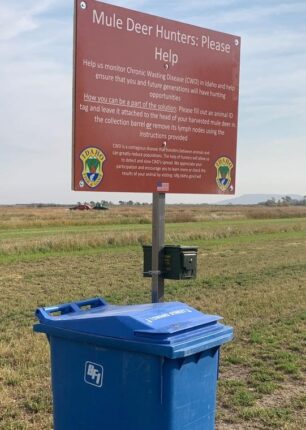
Fish and Game said the main push to obtain samples will begin at the start of the general season Oct. 10.

“We’ve got some (chronic wasting disease) barrels that we’ll be putting out shortly,” said James Brower, Fish and Game regional communications manager. “We’re doing our best efforts to make sure we’re able to detect it if it does come to the state so that we can act accordingly.”

Hunters are being asked to provide deer heads or lymph nodes from harvested animals to help Fish and Game biologists increase the number of animals tested this year. The hunter-supplied samples will add to the data Fish and Game collects from road killed animals.

Besides regular check stations, Fish and Game plans to have barrels at various locations similar to wing barrels used by grouse hunters. Hunters can also take samples to regional offices. Hunters can get detailed information about the disease, including how to provide a sample, online at idfg.idaho.gov/cwd. Drop-off locations are also available online at idfg.idaho.gov/cwd/sampling/locations.

Hunters are also asked to not bring certain parts of deer, elk or moose into the state from other states known to have the disease.

“It’s a pretty scientifically based monitoring effort to be able to detect it in areas where it is mostly likely to cross the border,” said Morgan Pfander, regional wildlife population biologist during last year’s hunting season. “I think we’re just doing everything we can to keep an eye on it. We’re doing everything we can to keep it out of our state. Hunters being really responsible about where they transport game is a big part of that.”

Fish and Game said its current sampling strategy has a 95 percent chance of detecting a 1 percent prevalence of the disease.

“It’s not a mandatory thing, but it is definitely a helpful, useful tool,” Brower said of the hunter sampling request. “People who get their samples tested will be able to know whether their harvested animal is (chronic wasting disease) positive or not. It’s good peace of mind.”

Yes, you do need different boots for different seasons

You hear about women who buy a different pair of shoes every time they get a different outfit. I’ve got buddies whose wives’ closets are full of shoes. Us guys may all roll our eye in disbelief and count our blessings that our wives aren’t like that — but are we outdoorsmen really any different?

I know that this article is going to start a range war and all of the men in the reading public will call me a traitor and tar and feather me. But think about all of the boots that we really believe we can’t live without.

I need Chaco sandals for when I’m unloading the boat and in the boat fishing. I also use them when backpacking and fly fishing so I can wade out into a river, fish and then jump out and hike down the trail and be dried off before I get to the next hole. Then for fishing we actually need some slip-resistant deck shoes don’t we?

And if we’re wearing waders then we need wading boots, right? And felt bottom soles are outlawed in Alaska because you can transport invasive species of bugs or something? So you may have wading boots that have multiple bottoms that you can detach.

Then my buddy up in Alaska wears calf-high rubber boots because of all of the rain/bogs that they hunt in up there. She came to Idaho elk hunting and had a heck of a time scrambling around the mountains in her rubber boots. (But she did get a huge bull).

Then what about cowboy boots? You need cowboy boots to ride horses. Yes, I pack back into the mountains wearing hiking boots, but deep down I’m always worried that if I get thrown that I may hang a boot in the stirrup and get dragged due to the heavy lugs on the sole. Oh yeah, at last count I have seven to nine pairs of cowboy boots.

What if you’re hunting in a snake-infested area? Then we know that we need to wear snake boots. I know the yuppie trend is to sing praises about not killing venomous snakes, but I hate snakes. When I was a kid, a copperhead bit my dog. Since then, I’ve had no use for poisonous snakes. So if you’re hunting in snake country, you can justify wearing snake boots.

And then what about hiking? You have to have a pair of lightweight, canvas-sided hiking boots, don’t you? But what about hunting in colder weather? You’ll need some leather hiking boots. Leather ones are warmer/more waterproof in light snows and rains and cooler weather.

BUT what about hunting in deep snow in subzero weather? You’ve got to have heavy-duty leather high-top boots. Otherwise in deep snow it will come over the tops while hiking and pack into your boots.

Curse of all curses. So then we also have to have gaiters to strap on.

Oh, but what about ice fishing? Not only is it ungoshly cold, we’re also standing on a block of ice. So some Sorel Pac boots are nice aren’t they? Nothing is more miserable than having ice cold feet.

Since we’re on a roll, I might as well slam a few more nails in the coffin! A lot of us work for companies or in environments that require steel toe boots. And it is best not to wear the same pair of boots 12 hours a day, six days a week. My dad always said it is best to have two pairs and alternate every day wearing them and they’ll last a lot longer.

I can only pray that my wife doesn’t read this article and finally put two and two together and figure out how many pairs of boots that I actually own. What are you laughing at? You’d better get to praying, too! get prepared for the upcoming firestorm!

Sidenote: If you’re smart enough to hide this column so your wife doesn’t see it, then here are a few words of advice. For your deer/elk hunts this fall, buy a good pair of hiking boots. I’ve had good luck with Irish Setter VaprTrek boots. They’re lightweight. For heavy-duty snow, I like the leather Irish Setter Elk Hunting boots.

One thing that I now swear by — a good pair of hiking socks. I don’t want to exaggerate and say that it will be like walking on carpet, but it almost is. When you go to buy boots, wear the thicker hiking socks; otherwise if you buy boots while wearing a thin pair of socks then they will be too small and cramp your toes while out hiking hard. I’d rather have my boots a hair big rather than small.

Tom Claycomb lives in Idaho and has outdoors columns in newspapers in Alaska, Idaho, Utah, Nevada, Colorado and Louisiana. He also writes for various outdoors magazines and teaches outdoors seminars at stores like Cabela’s, Sportsman’s Warehouse and Bass Pro Shop.
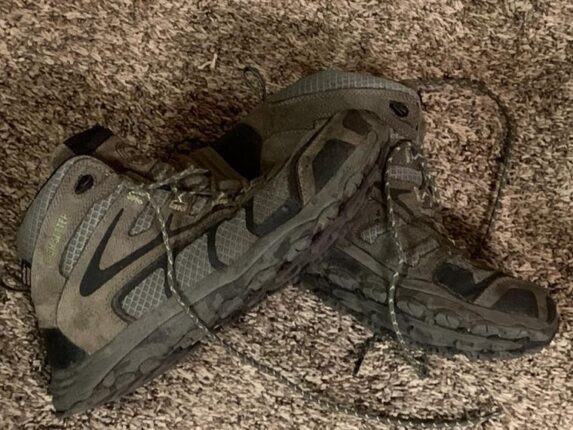
Yes, you do need different boots for different activities

You hear about women who buy a different pair of shoes every time they get a different outfit. I’ve got buddies whose wives’ closets are full of shoes. Us guys may all roll our eye in disbelief and count our blessings that our wives aren’t like that — but are we outdoorsmen really any different?

I know that this article is going to start a range war and all of the men in the reading public will call me a traitor and tar and feather me. But think about all of the boots that we really believe we can’t live without.

I need Chaco sandals for when I’m unloading the boat and in the boat fishing. I also use them when backpacking and fly fishing so I can wade out into a river, fish and then jump out and hike down the trail and be dried off before I get to the next hole. Then for fishing we actually need some slip-resistant deck shoes don’t we?

And if we’re wearing waders then we need wading boots, right? And felt bottom soles are outlawed in Alaska because you can transport invasive species of bugs or something? So you may have wading boots that have multiple bottoms that you can detach.

Then my buddy up in Alaska wears calf-high rubber boots because of all of the rain/bogs that they hunt in up there. She came to Idaho elk hunting and had a heck of a time scrambling around the mountains in her rubber boots. (But she did get a huge bull).

Then what about cowboy boots? You need cowboy boots to ride horses. Yes, I pack back into the mountains wearing hiking boots, but deep down I’m always worried that if I get thrown that I may hang a boot in the stirrup and get dragged due to the heavy lugs on the sole. Oh yeah, at last count I have seven to nine pairs of cowboy boots.

What if you’re hunting in a snake-infested area? Then we know that we need to wear snake boots. I know the yuppie trend is to sing praises about not killing venomous snakes, but I hate snakes. When I was a kid, a copperhead bit my dog. Since then, I’ve had no use for poisonous snakes. So if you’re hunting in snake country, you can justify wearing snake boots.

And then what about hiking? You have to have a pair of lightweight, canvas-sided hiking boots, don’t you? But what about hunting in colder weather? You’ll need some leather hiking boots. Leather ones are warmer/more waterproof in light snows and rains and cooler weather.

BUT what about hunting in deep snow in subzero weather? You’ve got to have heavy-duty leather high-top boots. Otherwise in deep snow it will come over the tops while hiking and pack into your boots.

Curse of all curses. So then we also have to have gaiters to strap on.

Oh, but what about ice fishing? Not only is it ungoshly cold, we’re also standing on a block of ice. So some Sorel Pac boots are nice aren’t they? Nothing is more miserable than having ice cold feet.

Since we’re on a roll, I might as well slam a few more nails in the coffin! A lot of us work for companies or in environments that require steel toe boots. And it is best not to wear the same pair of boots 12 hours a day, six days a week. My dad always said it is best to have two pairs and alternate every day wearing them and they’ll last a lot longer.

I can only pray that my wife doesn’t read this article and finally put two and two together and figure out how many pairs of boots that I actually own. What are you laughing at? You’d better get to praying, too! get prepared for the upcoming firestorm!

Sidenote: If you’re smart enough to hide this column so your wife doesn’t see it, then here are a few words of advice. For your deer/elk hunts this fall, buy a good pair of hiking boots. I’ve had good luck with Irish Setter VaprTrek boots. They’re lightweight. For heavy-duty snow, I like the leather Irish Setter Elk Hunting boots.

One thing that I now swear by — a good pair of hiking socks. I don’t want to exaggerate and say that it will be like walking on carpet, but it almost is. When you go to buy boots, wear the thicker hiking socks; otherwise if you buy boots while wearing a thin pair of socks then they will be too small and cramp your toes while out hiking hard. I’d rather have my boots a hair big rather than small.

Tom Claycomb lives in Idaho and has outdoors columns in newspapers in Alaska, Idaho, Utah, Nevada, Colorado and Louisiana. He also writes for various outdoors magazines and teaches outdoors seminars at stores like Cabela’s, Sportsman’s Warehouse and Bass Pro Shop.
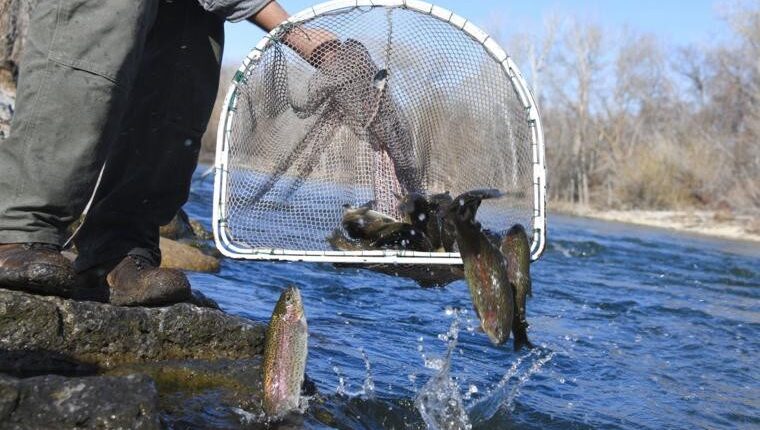
Hatchery highlights for October: Notable fish stockings around the region

With so many fish stocked in so many places, it can be hard for anglers to sift through the stocking forecasts and records to identify noteworthy stocking events. To make it easier, Fish and Game hatchery staff have highlighted some stocking events for the month of October. Here’s what they came up with:

Magic Valley Region

Blair Trail Pond — 2,000 rainbow trout. Located on Little Canyon Creek, this is a remote desert water surrounded by sagebrush solitude.

Burley Pond — 2,000 rainbow trout.

Freedom Park Pond — 700 rainbow trout. This trout pond was built with young kids in mind!

Lake Walcott — 24,000 rainbow trout.

Southeast Region

American Falls Reservoir — 42,000 rainbow trout.

Blackfoot Reservoir — 80,000 rainbow trout.

Edson Fichter Pond — 1,250 rainbow trout. This community pond is located in southwest Pocatello along the Portneuf River at Edson Fichter Nature Area. It features several docks and a trail for access around the pond. Limited development and the Nature Area provide a rural feel. Just minutes from downtown Pocatello, this site offers local anglers a convenient escape close to home.

Snake River — 31,950 rainbow trout. Stocking will occur at Tilden, Blackfoot, Firth and Shelley.

Salmon Region

Hayden Creek Pond — 600 rainbow trout. Here is a family friendly fishing area in the high desert along Hayden Creek. Anglers will find ample bank fishing opportunities and a dock for anglers with limited mobility.

Hyde Creek Pond — 400 rainbow trout. This small pond is surrounded by sagebrush. The open site and level terrain provide ideal bank fishing for beginning anglers and those who want to practice casting techniques.

Tips on knife sharpening

As hunting season is getting into full swing, I hope that you’re prepared. You’re practiced up with your bow, your rifle is sighted in, and if you’re out of shape then you’ve been working out. But one minor detail that most people overlook, which in a very short amount of time will become a big deal, is if your knife is sharp or not. In all actuality, it’s not that most hunters overlook this task; they just flat out don’t know how to sharpen a knife.

I always say that 100 percent of the outdoorsmen use a knife and yet I bet less than 5 percent can sharpen one. That’s why I’ve conducted knife-sharpening seminars from Texas on up to Alaska, at the SHOT in Vegas, SCI Convention in Reno, DSC Convention & Expo in Dallas and everywhere else in between.

While it does take some skill to sharpen a knife, it doesn’t take a Ph.D. It’s somewhat scientific and somewhat touchy feely (artistic). Here’s what I mean by that. You engineers want step 1, 2 and 3. You’re the kind that designed the pre-set systems. And they work but I say learn to do it the old way by hand and then you’ll have a sense of pride at learning your new skill. You’ll even be able to impress your guides.

To master this skill, you do have to learn the basics and adhere to them to be successful, but your artistic flavor is also necessary because it does vary somewhat knife to knife.

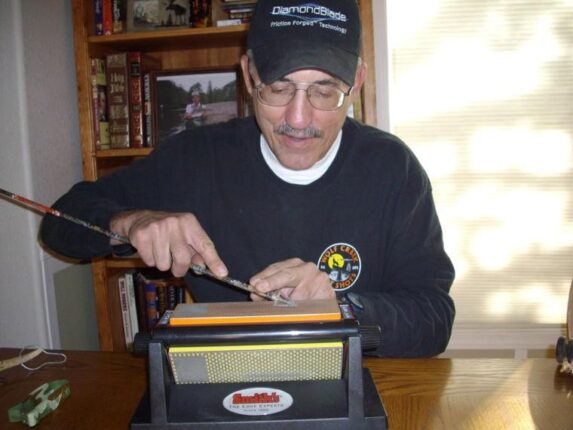
In the old days, the metal in knives was softer so our dads/grandads only used a smooth Arkansas whetstone. Now, the knives are so hard that you’d work forever with one so I recommend using a diamond stone which is a metal plate with impregnated diamond chips. There are cheaper ones on the market but Smith’s Consumer Products makes the best. Their surface has a consistent texture.

Smith’s color codes their stones according to the coarseness of the surface. Yellow (325 grit) is coarse and orange is fine (750 grit). I advise using the orange. I only use the coarse stone in my knife-sharpening seminars when someone comes in with a really dull, chipped or mushroomed edge knife. Don’t let your knife get that bad. Keep it touched up.

If your edge gets too chipped up you may have to regrind the edge or, you can just keep using it and over time you will grind past the chip. But while cutting you will snag on the chip. It’s not that your knife is dull, what you’re cutting is just snagging and stopping. Make sense?

What is the best angle? Just use whatever angle came from the factory. Used to be, edges were around 30 degrees. Then you started seeing 25-, 22-, 20-, then 18-, some 16- and now even 14-degree angles. In the old days, they couldn’t be that steep. The metal was too soft so the edge would have rolled or chipped.

So if you see a knife with a steep angle then you know that the metal is hard. No biggie, use a diamond stone otherwise it’d take all day to sharpen in on an Arkansas stone.

It doesn’t matter if you cut into the stone or push away. The big deal is to do the same number of strokes on each side and keep the same angle all the way down the blade. When it starts getting sharp the strokes will feel smoother. Like the edge is sliding on glass. That tells you it’s sharp.

Before you start, look at the edge. If the light reflects off the edge, that’s a flat (or dull) spot. Really bad edges may be mushroomed or rolled. If so, don’t cut into the stone, push away. Also, if it’s really bad, I lay the knife down flatter the first three or four revolutions and then go back to the correct angle after the metal is lined back up.

Finish up on an Arkansas stone. I had a buddy in college that then progressed to a leather strop and resin and he could get a wicked edge.

The ultimate set-up is the Smith’s 8-inch Tri-hone stone. It’s elevated and has a coarse diamond stone, a fine diamond stone and an Arkansas stone. Everyone has a budget so if you can only afford one stone, I’d recommend the Smith’s 6-inch fine diamond. It’s elevated about 1 inch which aids in being able to comfortably access the stone.

There are a lot of ways to sharpen a knife but I think the way I teach is the easiest method. My brother uses a little 4-inch flat piece of diamond impregnated metal and he can get a knife just as sharp as I can. So if what you’re doing is working, don’t change.

As we come to a close don’t give up if it takes you a minute to master this skill. While it is a simple concept it will take a month or so to get the hang of.

To help speed up your learning process here are a couple of helps. I have a short e-article on Amazon Kindle and a YouTube on Ron Spomer Outdoors.

Tom Claycomb lives in Idaho and has outdoors columns in newspapers in Alaska, Idaho, Utah, Nevada, Colorado and Louisiana. He also writes for various outdoors magazines and teaches outdoors seminars at stores like Cabela’s, Sportsman’s Warehouse and Bass Pro Shop.
Dad and daughter team up to set four state fish records

When avid angler Jon Urban first started thinking about landing a state record fish, he was hoping for a white crappie. After all, beating the current 14.25-inch catch/release record seemed doable. After several trips, he finally landed a big one — but not his original target species. To his surprise, the big fish he landed was actually a black crappie — but no problem — it was still big enough to earn a new catch-and-release state record!

After his initial success, Jon became motivated to chase more state records. Teaming up with his daughter Hayleigh, also an avid angler, the pair have set off on a mission to fill in the blanks in the record fish list. Jon introduced his daughter (and son) to fishing when she was just 5 years old.

“We have been fishing together for 18 years. What we like most is we’re family, so it’s something we both love and can do together,” he said.

Jon and Hayleigh began searching local ponds for green sunfish — a species less common than typical the bluegill and pumpkinseed found in most Idaho ponds. With a little homework and a bit of luck, they not only found an 8-inch green sunfish, but also caught a 6.25-inch green sunfish/bluegill hybrid, clinching two vacant records in the process.

H Urban Hybrid Sunfish

Hayleigh Urban with an 8-inch green sunfish/bluegill hybrid sunfish, big enough to clinch the vacant catch/release release state record for this species.

More recently, Jon noticed the state record list did not have an entry for Lahontan cutthroat trout, one of four sub-species of cutthroat in Idaho. While not native to Idaho, they have been stocked in a few remote high desert lakes in Owyhee County. After researching the fish stocking records, Jon and Hayleigh set off to find the elusive Lahontan cutthroat. In early September, they found success at Grasmere Reservoir, and submitted the first record application for Lahontan cutthroat. The angling duo caught several Lahontans, earning both a 1.17-pound certified weight record, as well as a 15.25-inch catch/release record.

When asked who is the better angler, Jon thinks it’s more about how fishing is a way to make new discoveries.

“We get competitive with each other sometimes, but what we like most is discovering, exploring new waters, and catching new species regardless of size,” he said.

When it comes to getting kids interested in fishing, Jon recommends getting started on panfish.

“I started out by taking Hayleigh to catch bluegills and crappies — fast bites and big numbers to keep them busy. I find it gets them really excited about fishing by giving them a lot of confidence early, and the patience comes later when they get the basic skills down,” he said.

Congratulations to Jon and Hayleigh Urban of Eagle on an outstanding summer of hooking state records!

Taking aim: F&G launches new website to help new hunters find success

Idaho Fish and Game has launched a new website, gohuntidaho.org, to help new hunters learn an Idaho tradition that helps people provide their own food, as well as family recreation.

“For new hunters, getting started in the sport can be intimidating. From firearm safety, seasons and rules, where to find game, and processing meat — it’s a lot to take in,” said Ian Malepeai, marketing manager at Fish and Game. “This website is a sort of one-stop-shop where new hunters can easily find all information they need.”

A large portion of the website is focused on upland hunting, which is a beginner-friendly activity and a gateway to becoming a life-long hunter. The website also includes resources for big game, turkey and waterfowl.

Fish and Game’s research shows that 39 percent of Idaho residents are interested in hunting, and of that group, 34 percent of those interested have never hunted before. Historically, hunting has been a tradition passed down through family mentors, but Malepeai said not all people interested in learning to hunt come from families with hunters.

“While we know we cannot replace family mentors, our hope is to be a surrogate mentor and provide as much information as we can to set new hunters up for success,” he said. “We know that there is a demand, and we are really trying to reach this audience and provide this new resource.”

With a growing population, and with a recent influx of new hunter education graduates, the new website also comes at an opportune time for a group of hunters who will likely be hunting in Idaho for the first time this fall.

Among the resources to get them started is a three-part tutorial to learn how to use Fish and Game’s digital resources, maps, and ways to find new hunting areas. The first video in the Big Game Scouting Series, “Using F&G resources to research and select a hunting unit” was published to the website on Aug. 10.

“Our surveys have shown that the biggest hurdle for new hunters is figuring out where they should go to hunt,” Malepeai said. “These videos will teach new hunters how to use the tools at their disposal to answer that question themselves.”

This is one of many innovative digital resources Fish & Game provides on the website. Another major hurdle for new hunters is what to do with an animal after they have harvested it. The website also provides videos on butchering and field dressing game.

In partnership with Boise State University, Fish and Game developed a virtual reality simulation that provides a “hands-on” tutorial of how to field dress an elk from home, which will be featured on the website, and people can download it.

Additionally, Fish and Game has developed content to inspire current hunters to pass on the traditions of hunting by promoting mentorship programs and experiences. Another three-part video series, dubbed “The Maiden Hunts” is due to hit the website in September.

“Our Maiden Hunt video series really shows the importance of mentoring, and how rewarding mentoring can be,” Malepeai said. “These videos illustrate the diversity of who hunters are. Hunters, and those new to hunting, come from all races, genders, ages, backgrounds, and experiences.”

Yellowstone has second-busiest August, but tourism still down

YELLOWSTONE NATIONAL PARK, Wyoming (AP) — Yellowstone National Park had its second-busiest August on record but tourism is still down substantially this year, park officials said Thursday.

The coronavirus prompted the park’s closure in March and Yellowstone’s five entrances opened for spring automobile traffic a few weeks later than usual. The two Wyoming entrances opened May 18, followed by the three Montana entrances June 1.

Park services including some restaurants and lodges gradually reopened over the summer season and much later than usual.

In August, the park had 881,543 recreation visitors, up 7.5 percent from the year before for the second-busiest August on record. The busiest was August 2017, when tourists flocked to Wyoming to see a solar eclipse, park officials said.

From January through August, Yellowstone had 2.5 million visitors, down 18 percent from the same period in 2019.

Tourism in Yellowstone tapers off in September and October. Most lodges, restaurants, stores and other services close for the year in October, followed by all park roads in early November.

Tom Claycomb: Sighting in your rifle for big game hunting

I titled this article Sighting In Your Rifle For Big Game Hunting but the same concept applies if you’re hunting with a bow or even a spear! Whatever method you choose, you need to sight in your choice of weapon PLUS become proficient. If not, at best you will miss and at worst you will wound an animal.

Nothing kicks you in the stomach like wounding an animal and not finding it. That makes you feel like wrapping your gun/bow around a tree and quitting hunting.

Once I took a buddy black powder hunting to my honey hole. He missed 10 or 11 shots. I finally figured out that he hadn’t even sighted in his rifle. It is crazy to spend all of the money, take vacation, and work so hard to get into the position to take a shot and not be prepared for it. It surprises me how many people don’t really sight in their rifle so let’s cover that today.

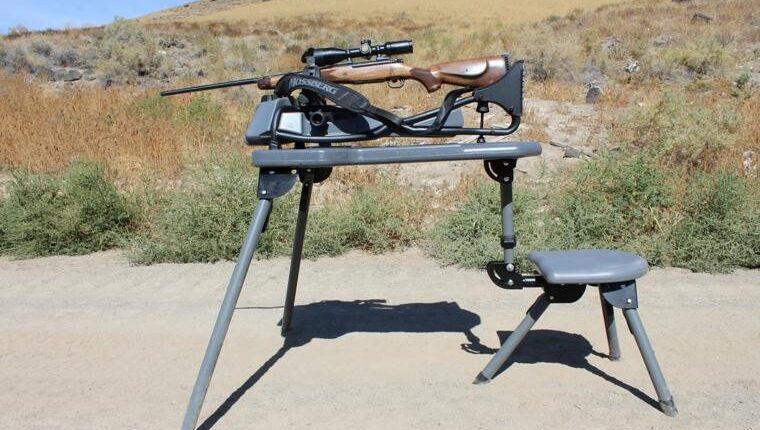
* To begin, you need to have a good rest so you can obtain a good group.Leaning over the hood of the pickup won’t cut it. You may be thinking well, I don’t have a bench while hunting. Duh, no kidding. What we’re talking about right now, though, is getting your rifle sighted in, not how to shoot free handed.

Take a card table, chair and some Caldwell sand bags to shoot off of and go out to the desert and find a good backstop. It’s best to not have any wind but that day will never happen so try to go when there are minimal winds. If you have a rifle that kicks like a mule use a Caldwell Lead Sled or a Caldwell Hydro Sled. That way you won’t flinch. Also wear double ear protection to prevent flinching.

Shoot three shots to determine your group and then adjust the scope/sights. If you’re not getting a good group then you need to determine the cause. This can be caused by multiple things so you have to systematically eliminate each cause.

1. Scope is loose.

2. Scope mounts are loose.

3. Rifle is no good.

4. After multiple shots a thin barrel will heat up and you’ll lose your accuracy.

5. You could be using the wrong brand/grain of ammo.

6. Rifle barrel is dirty. Non gilded metal bullets shoot best out of a clean barrel. Your groups will widen as the barrel gets dirty. Clean the barrel and watch your groups tighten up.

7. You’re a horrible shot (OK, had to throw this one in for humor).

8. May be other causes but this list is pretty inclusive.

Let’s say you’re getting a good group but it is off to one side. Make adjustments and shoot again. Or, to save ammo have someone hold the rifle steady on the rest. Have them hold the crosshairs on the bullseye and you click the adjustments until they are on the bullet hole. It should now be on target.

Ammo can vary greatly between manufacturers. Brand X may be 2 inches low and Brand Y is 2 inches to the left.

You have to sight in your rifle for whatever brand of ammo that you’re going to be shooting. Also, for whatever reason, some rifles like certain ammo. I’ve had good luck with Hornaday and Nosler. For pellets JSB is the best with Sig Sauer & Benjamin right behind them.

Also, you need to figure out which grain bullet shoots best in your rifle. For instance, everyone will tell you that 165 grain is the best size for a 30-06. Sure, 180 or 220 grain is better for moose as far as killing properties but they won’t be as accurate. But is it still accurate enough to shoot in your rifle? Maybe for up to 150 yard shots? Experiment. In your .223/5.56 according to the twist of the rifling certain grain bullets will shoot better.

Don’t be bashful. Call the gun manufacturer and ask them which brand of ammo and what grain is the most accurate in your rifle. This may save buying a lot of different brands of ammo. It constantly amazes me as to how ammo varies. I remember one time I was testing out different ammo performance in a Mossberg Patriot 30-06. I had 15 or so different boxes of ammo to test. It varied widely but a couple were definitely the most accurate.

Next, set up targets at 50, 100, 200, 300 and 400 yards. How long are you comfortable shooting? The rage now is long range shooting but in all actuality, 400 yards is a long shot.

Figure out what you are comfortable at and limit yourself to no further shots. Practice so you know how much to hold over and either carry a range finder of learn to judge distances.

My buddy Ron Spomer teaches a system he calls … I can’t remember the exact terminology but it is something like “Point Blank Shooting.” He teaches to sight in your rifle at 200 yards then if you aim at center mass — anywhere from 50-400 yards — you will have a dead animal.

You have to come to the realization that just because you can see them doesn’t mean you can shoot. Especially when hunting down in the Owyhees. I’ve seen a lot of elk wayyyyyyyyyy out there. There was no cover to sneak closer so I was sunk. That’s life.

Well, there’s a lot more that we could cover but that’s some of the basics to get you started. Good luck.

  • A good rest is a good stable table to shoot off of and sand bags (when sighting in your rifle at the range). If you’re up hunting a good rest can mean you had a strong limb to lay your rifle on or a rock and you laid your backpack on top of the rock and were able to get steady so you could make a good shot.
  • The group means the bullets all are close together. So let’s say you take 3 shots. You don’t want one on the bullseye, the 2nd shot 6 inches high and the 3rd shot 10 inches to the right. Then you’d worry where the bullet was going to actually hit. You want them all w/in 1 inch of each other (or better yet, all bullets touching). Even if the group is 4 inches low, no big deal if it is tight. Just turn your scope 16 clicks and it should now be on the bullseye.

Tom Claycomb lives in Idaho and has outdoors columns in newspapers in Alaska, Idaho, Utah, Nevada, Colorado and Louisiana. He also writes for various outdoors magazines and teaches outdoors seminars at stores like Cabela’s, Sportsman’s Warehouse and Bass Pro Shop.