COVID changes winter: Outdoor retailers anticipate winter rec changes influenced by the pandemic

All summer long the outdoor industry went berserk as people’s normal vacation plans were upset by a pandemic and replaced with camping, hiking, biking and other outside recreations.

Now a pandemic-laced winter is on the horizon, and some questions loom on how people are going to react to the changing recreational landscape and if outdoor gear suppliers will be ready or caught off guard in a similar way that bicycle suppliers were this past spring and summer.

“Particularly we’re seeing already an explosion in anything dealing with backcountry,” said Davin Napier, manager at Idaho Mountain Trading in Idaho Falls about recent winter recreation trends. “I get it, everyone is pretty uncertain about what the resorts are going to do fully. Even though (Grand) Targhee (Resort) says absolutely they are going to open. Kelly (Canyon Ski Resort) is on track. Everyone in the local area is, but a lot of people are taken to the (alpine touring) or backcountry aspect and that’s where we’re seeing a major pinch in available items.”

With the early closure of ski resorts in March because of the pandemic, backcountry ski hotspots such as Teton Pass were slammed with extra visitors.

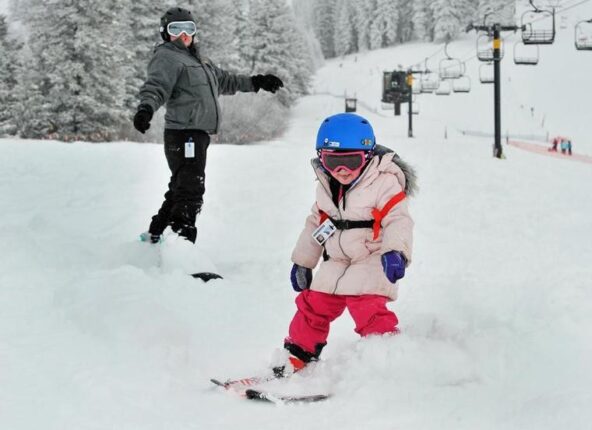
Regional ski resorts plan to open as usual this winter, but with added precautions promising a different experience. Some resorts expect to limit numbers on the ski hill and at lodges. Outdoor retailers say changes at resorts may drive recreators to different activities, such as cross-country skiing and backcountry skiing and snowboarding.

“I think we’ll see a big boom in Nordic this winter,” said Scott Hurst, manager of the Outdoor Resource Center at Brigham Young University-Idaho. “I’ve heard from Rossignol and Alpina that their Nordic is all sold out for the season already as far as from the manufacturers. My Rossignol rep told me they were oversold in some categories for their Nordic. The Alpina rep said they have a feeling that Nordic is going to be like bicycles were this past summer. Because you can do it by yourself and it doesn’t require any special equipment, it’s good for social distancing and it’s a great way to exercise outside of the gym with the COVID still going around.”

Taylor Houck, of Idaho Falls, said via Facebook that the pandemic would be changing her winter recreation plans.

“I chose not to purchase a ski pass this year at (Grand Targhee) partially because they shut down early last year and partially because their social distancing protocols add more challenges that I don’t want to deal with,” Houck said. “I will be replacing that winter activity with others however.”

Yostmark Mountain Equipment in Driggs reports seeing a spike in interest in backcountry skiing and snowboarding recently.

“Equipment, avalanche courses, education has skyrocketed,” said Yostmark co-owner Rich Rinaldi. “With the pandemic that hit in March, lift skiing was closing and the uncertainty of lifts running, etc. People figured, ‘I’ll climb the mountain and ski it.’ Simple as that.”

Both Rinaldi and Napier said certain specialty items needed for backcountry adventures have or will become harder to acquire from manufacturers, such as some specialty bindings and avalanche airbags. Most items are available now, but may not be here later in the winter season. Interest in avalanche courses has also increased.

“We always host an avalanche class — an avy 1 or avy 2 class — here in the store,” Napier said. “We have from six to 12 people. … By this point I would normally have maybe two or three interests in an avy class. They’re not inexpensive – $450 bucks generally. It’s a couple of nights here and then a Saturday and Sunday field training at Teton Pass. … What’s interesting is I’ve already had two dozen interested. There are all these telltale signs of the influx. It’s going to be interesting.”

Barrie’s Ski & Sports in Pocatello notes the same trend.

“Year after year we have been seeing more people interested in that level of skiing,” said Nick DeTore, a bike and ski tech at Barrie’s. “The companies are making more of that style of equipment, too. It used to be a high price point, but now they’re making a lot more entry-level setups just because the market for that has grown so much over the past couple of years. This year seems to be shaping up the same way.”

The new outdoor retailer in Idaho Falls, Al’s Sporting Goods, sees a similar view.

“We’ve seen an increased interest in backcountry skiing as well as cross-country skiing,” said Dustin Peterson in Al’s bike and ski department. “That also includes splitboarding for snowboarders out there. I think as we get into the season, if we see an increased interest as we did with bikes, it’s going to be really hard to get that stuff. Normally by the end of December, we’re pretty scarce on equipment.”

Cross-country skiing is also seeing an upward trend. DeTore said when the snow comes, his shop “will rent out our entire fleet of Nordic skis every weekend. We have 75 sets of cross-country skis; all the adult ones will be rented out.”

For some, the momentum carried over from summer outdoor activities will continue into winter.

“We plan on doing a lot more cross-country skiing, and I would love to learn how to snowshoe,” said Idaho Falls elementary teacher Heidi McJunkin via Facebook.

Joe Hill, co-owner of the Sled Shed shop in Rexburg, said his shop has received increased orders to supply the city with cross-country skis for its operation at Teton Lakes Golf Course. “The popularity just keeps on growing,” he said.

Zoom towns

Another interesting recreational trend affecting eastern Idaho is called “Zoom towns.”

The COVID-19 pandemic has sent many remote workers away from crowded cities, some temporarily, others more permanently. National Public Radio defines Zoom towns as housing markets that are booming as remote work becomes more popular or necessary. Remote workers are leasing out their homes or apartments in cities such as San Francisco and moving to places such as Driggs, Sun Valley, Jackson, Wyo., or even Idaho Falls, to give them access to a nearby ski resort, more space, outdoors, less traffic and nature. They retain their big-city salaries and prosper with a small-town setup.

Forbes magazine said, “Recent trends in the real estate market reflect this shift: Rental vacancies are surging and rental costs are declining in urban areas — as housing prices are increasing and inventory is becoming more scarce in suburbs and rural areas.”

The trend has been noticed in Driggs.

“Driggs definitely has a lot more people moving here this winter. Just because everyone is able to work remotely so why not move to a ski town, kind of vibe,” said Heidi Marquart, a bike and ski tech at Peaked Sports in Driggs. “We’re seeing that. We’re getting more people moving here that would probably have not moved here had COVID not hit.”

Marquart said her shop reported seeing more new faces this summer with people renting mountain bikes and expects to see them again renting skis and snowboards. She wonders how many will last after they get a taste of a real mountain winter.

“I’ve noticed people moving here, and they’re already complaining about how cold it is,” she said. “I’m thinking just you wait. It’s barely been freezing. … The overall vibe with Driggs is that it’s busier than it has ever been as far as people here.”

Lawsuit planned over hunting, fishing at US wildlife refuges

The Trump administration is violating the Endangered Species Act by expanding hunting and fishing by 3,600 square miles on the national wildlife refuge system and national fish hatchery system, an environmental group says.

The Center for Biological Diversity on Tuesday filed a notice of its intent to sue the U.S. Fish and Wildlife Service, which manages the nation’s 550 national wildlife refuges. The formal notice is a precursor to a lawsuit, giving the agency 60 days to respond.

Interior Secretary David L. Bernhardt announced the expansion in August, saying it increases public hunting to 430 refuges and those open to fishing to 360.

“We’re going to court to ensure that our nation’s wildlife refuges can actually provide refuges for wildlife,” said Collette Adkins, the center’s carnivore conservation director. ”We’ve never before seen such a massive expansion of bad hunting practices on these public lands.”

The U.S. Department of Justice defends government entities in lawsuits. Danielle Nichols, a spokeswoman, said the agency had no comment.

President Theodore Roosevelt founded the National Wildlife Refuge system in 1903, signing an executive order to establish the Pelican Island National Wildlife Refuge in Florida to protect several types of birds from ornamental plume hunters.

The expansion of hunting and fishing on the refuges this year followed a similar move in 2019 when the Trump administration expanded hunting and fishing on 2,200 square miles of refuges in 37 states, much of which is considered critical habitat for waterfowl and other birds to rest and refuel during their migration.

Conservation groups have expressed concern that state and federal officials don’t appear to have a monitoring system to see what effect the changes might have.

But hunting groups generally welcomed the expansion, saying it would draw more people to the outdoors.

Tips on how to be successful at elk hunting

Next to sheep hunting, elk hunting is the toughest hunt in Idaho. They live in rough country and they’re tough animals. If you’re hitting it hard by the third day you’re so sore you can’t hardly hunt. So why do people hunt them if it’s so tough? The same reason that makes it tough. Because they live in rough country and they’re cool animals. It gives you a good excuse to get out and hike into areas that you never would.

There’s something cool about being up in elk country. You’re on top of the world in majestic country seeing sights that few people get to see which is all a side benefit.

But how do you be successful, after all, that’s why we elk hunt. We want to get one. I wish that I could give you a five-step plan for guaranteed success. If I had that plan I’d get an elk every year. But I’ll throw out some general rules that should help you be more successful.

SCOUT

The people that are successful year after year scout before season. Even if your family has hunted the same spot for 40 years and you know all of the routes they take when feeding, heading to bed or when spooked, you need to scout. Why? What if a pack of wolves have moved into your drainage and slaughtered everything? Or what if three other camps have decided to hunt in your honey hole this year?

One year a buddy invited me to go hunting with him up by the Rawah Wilderness area. I got there and he said we’ve got to move camp. How come? Unbeknownst to him, the Rainbow Coalition had decided to have a festival there and the day before when he was setting up camp and doing a final scouting, he’d run into some girl in tennis shoes hiking down the trail. And I mean only tennis shoes. Not conducive to a good elk hunting scenario.

While hopefully you may not encounter the above scenario things can change even if you did do due diligence and pre-scout. So the moral to the story is, you need to have at least three spots scouted out to hunt. That way if they aren’t at your first choice — jump. Go to your second choice.

I remember the first elk that I ever got, we moved camp twice before I finally got into the elk at the third camp. If there are no tracks, move. Elk can’t fly so if there’s no tracks, they’re not there. Granted, if you wait long enough some may get moved into your drainage but that’s a big if.

GLASS

I teach “Glassing For Big Game” (glassing = looking around with binoculars) seminars at a number of national sports and hunting conventions and shows and at retail stores and yet every year I’m amazed at how much game I see when I take time to properly glass. Hint: Use good optics. I use Riton Optics 10×42 binoculars and a Lucid Optics spotting scope that I am testing this year. When you take time to glass, it will amaze you as to how much more game you’ll see. But you have to use good optics or you won’t see anything plus bad optics will give you a headache.

SCENT COVER

The more I hunt, the more important I realize that scent cover is important. I like to clip on a couple of the Hunter’s Specialties elk wafers that have cow urine scent on them. They’re strong so let’s just say that you don’t want to be walking downwind of your buddy while he is wearing one.

Also, regardless of how much you cover your scent, always try to stalk in from downwind of your game. Whether it’s elk, deer or bear. And the thermals switch and swirl so it can be confusing. Stalk accordingly.

When setting up to call don’t have brush downwind of you. Set up so they can’t sneak in and scent you and scatter without you even knowing it.

CALLING

With the advent of wolves, most people tell you that elk have gone silent. There’s no use calling anymore. They won’t answer. OK, I agree they have quieted down a good bit but that doesn’t mean that they won’t still come in.

I learned the above by accident. Years ago I took an old buddy elk hunting. He could barely get around even with a walking stick but I’d try to take him out a few days every year. One year near the end before he died, we went to a spot where he’d seen a bull a few days prior. He sat in a spot and I hopped right over the rise 100 yards away. I usually set up and call for 15 to 20 minutes and then move. He said we’d set there about 1½ hours.

Everyone knows the above idea is a dumb idea. Except … the elk. We’d been calling for over an hour. Suddenly I saw a four-point bull sneaking up the mountain. He had not made one peep. I’ve had that happen a lot since then. So yes, elk may not bugle as much as used to when you’re calling but they still come in. Well, good luck!

Tom Claycomb lives in Idaho and has outdoors columns in newspapers in Alaska, Idaho, Utah, Nevada, Colorado and Louisiana. He also writes for various outdoors magazines and teaches outdoors seminars at stores like Cabela’s, Sportsman’s Warehouse and Bass Pro Shop.

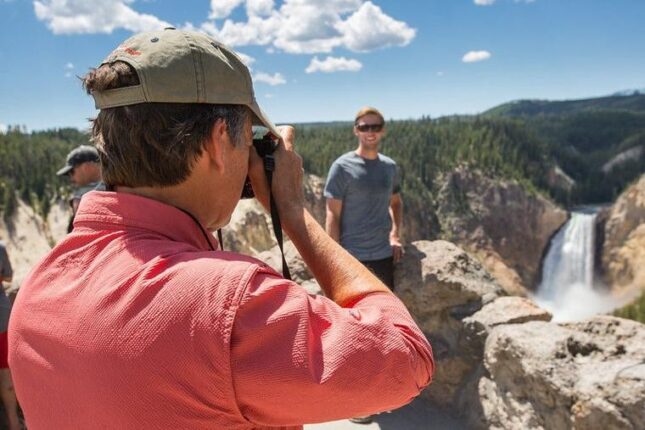
Yellowstone to test automated shuttle system in summer 2021

Yellowstone National Park announced this week that it will begin testing a low-speed automated shuttle system in 2021.

The automated shuttle from vendor Florida-based company Beep, Inc. will serve the Canyon Village campground, visitor services, and the nearby visitor lodging area. Canyon Village is north of Yellowstone Lake and is a popular area, especially during the peak summer months. Specific stops and times for the shuttle have not yet been determined.

The automated shuttle was an idea created in consultation with NPS Park Planning, Facilities and Lands Directorate and the Department of Transportation, according to the release.

“Yellowstone and the NPS are proactively engaging with emerging transportation technologies by looking for ways to test, pilot and learn from these capabilities,” said Yellowstone Superintendent Cam Sholly in the news release announcing the shuttle system. “We will continue exploring possible ways to reduce congestion and to improve visitor experience and access in heavily travelled areas of the park.

The most popular roads in the park are over capacity by about 29% during July, according to the release. Those roads include the West Entrance to Madison Junction, Madison Junction to Old Faithful and to Norris Junction, Old Faithful to West Thumb and Norris Junction to Canyon Village.

The park has tested out a few different ways to help relieve that congestion, like having extra staff stationed in extra-congested parking areas. A 2019 pilot project at Norris Junction stationed staff to help test the efficiency of the overflow parking on the Grand Loop Road. That project showed that staffing can help visitors safely access areas where parking is limited.

Yellowstone also announced Thursday that it will be conducting a transit study in conjunction with the NPS Intermountain Regional Alternative Transportation Program, the NPS Denver Service Center and the DOT Volpe Center.

That study, which is expected to wrap up in 2022, will assess the risks and costs that could be associated with additional shuttles around Old Faithful and Canyon Village. The study’s outcome will help the park decide whether a transit service would work for Yellowstone.

Both the Beep, Inc. shuttle and the transit survey are part of Yellowstone’s Visitor Use Management Program.

Tom Claycomb’s big game recipes

I love eating wild game. I get some of the best ribeyes in the country and yet I still favor fried backstrap with milk gravy and french fries. Or what about a smoked forequarter made into chopped BBQ sandwiches?

I’ve even noticed amongst the young yuppie crowd that there’s an interest in hunting/eating wild game due to it being the undisputed king of organic food. With the dropping number of hunters, I’m surprised that Fish & Game isn’t playing this angle.

The last two weeks I’ve written articles on meat and processing your game. It’s only logical to follow up with an article on recipes. But when cooking wild game remember a few things:

1. Big game doesn’t marble (intermuscular fat) like beef so it is not as juicy. Don’t overcook it or cook it as fast as you do beef. Cook your big game on the medium rare side.

2. Deer/elk haven’t been finished out the last 120 days on corn so it might have a slight off-taste that you need to mask.

3. If tough, use Adolph’s Tenderizer.

BACKSTRAPS/FILETS/CHICKEN FRIED STEAK

Backstraps and the filets are the all-time favorites. Here’s how the Claycombs like to eat them.

The filet mignons, I marinate mine for an hour or two and then apply seasoning. Right now, I’m favoring the coarse ground McCormick’s seasoning. Grill on medium heat. Also great for kabobs.

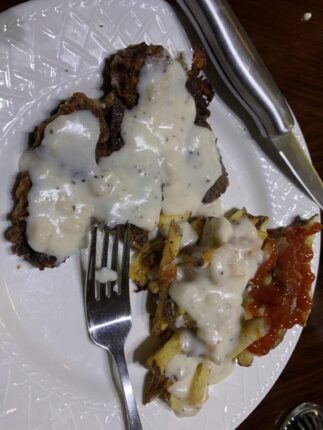
Now for everyone’s all-time favorite. I’m going to lump backstraps and round steaks together because I chicken fry these. My wife beats them with a tenderizer and sprinkles on Adolph’s Tenderizer.

Let sit 15 minutes. Dip in milk, roll in flour and sprinkle with salt and pepper. Fry them in a black skillet until golden brown. I like them cooked medium but my wife cooks them a little crispy and that’s great, too.

I always make milk gravy with my CFS. Another twist is to sauté onions and make onion gravy and garlic toast. Fry up some French fries and drizzle the gravy on the steak, French fries and garlic toast.

A meal fit for kings. I can get the best beef in the country and yet this is my most favorite meat in the world. My family loves fried backstrap.

FLANK STEAKS/ TRI-TIPS

These make great appetizers. Marinate for an hour or two then lay on a pan and heavily sprinkle on McCormick’s coarse ground steak seasoning. Finely chop up some onions and green peppers and lay on the flank. Roll it up and pin it together with toothpicks.

Smoke on low heat for an hour and then turn up the heat. When done, slice paper thin across grain.

These make great hors d’oeuvres. After eating them once you will not believe that for all of these years you haven’t saved them.

KABOBS

Another way to use your steaks is to cut into 1x1x½-inch chunks. Marinate the steak, mushrooms, slices of green peppers, onions and squash for 2-4 hours. Skewer the above ingredients, sprinkle with Tony Chachere’s seasoning and cook on your Camp Chef pellet smoker. These are to die for.

FOREQUARTER

Now for my all-time favorite and after trying it once it will be yours too. The third most tender muscle on the carcass is in the shoulder, if you cook it slowly. Sprinkle the shoulder with your favorite seasoning salt. Smoke it on low heat for 3-4 hours. I used to lay bacon strips over it but haven’t in 30 years. Then put it in a black turkey roasting pan and put in about 2-3 cups of water. Put it in the oven all night at 180 degrees. If you wake up in the middle of the night check on it. If it runs out of water it is ruined. If it is low, add two cups.

When it falls off the bone with a fork, it’s done. If not, turn the heat up to 300 degrees. After cooking all night, it should finish in 30-45 minutes. But to make sure this is clear, if it doesn’t fall off the bone with a fork it is not done.

Pull the meat off of the bone. There will not be enough meat left on the bone for an ant to eat. All of the collagen and gristle has disappeared. Chop into ½-inch chunks. Sprinkle with Tony Chachere’s seasoning salt. Toast buns in a Lodge black skillet on both sides with butter. Throw on a handful of chopped meat and douse with your favorite BBQ sauce and a little Tabasco sauce. I cannot tell you how good these are. Your petite little wife will eat two. It will rival any beef brisket sandwich that you’ve ever eaten.

FAJITAS

Use the skirts to make fajitas. Peel the tough skin off of both sides. Slice ¼-inch slices cross grain.

Marinate the meat, onions and green peppers for 3-4 hours. Cook everything in a black iron skillet. Fill a tortilla and feast.

BBQ RIBS

Trim off what fat cover is easily removed and sprinkle with coarse ground McCormick seasoning.

Place on your smoker for 3-4 hrs. then put in a covered dish in your oven that is preheated to 325 degrees. Cook until the meat falls off of the bones. Douse with BBQ sauce and dig in.

SAUSAGE

Years ago I decided that I like a good hot dog but not the Joe Cheapo $.99/pack hot dogs. So now I make hot dogs out of sausage. Everyone will die for them. Smoke your sausage and then for condiments put out bowls of chopped onions, avocado slices, Wolf Brand chili and spicy mustard. Eat one of these and you’ll fall back in love with the lowly hot dog!

Tom Claycomb lives in Idaho and has outdoors columns in newspapers in Alaska, Idaho, Utah, Nevada, Colorado and Louisiana. He also writes for various outdoors magazines and teaches outdoors seminars at stores like Cabela’s, Sportsman’s Warehouse and Bass Pro Shop.

Aging your game

You hear about aging meat but does anyone really understand what it means to age meat? So first off, what is aging? It is basically controlled rotting. So why do people age their meat?

1. It makes the meat more tender.

2. Some people favor the aged flavor.

DRY AGING

Dry aging is when you hang meat to age in an open environment. You’re supposed to hold it at a certain temp, humidity and for a certain time period. If you want to age your meat just do a rib rack or a loin rack. If you age the whole carcass the trim will be green and you’ll waste a lot of meat.

WET AGING

Now, I bet over 99 percent of the beef is wet aged in a cryovac bag. If you’ve been to a supermarket and seen a “primal” displayed in a bag that’s what a cryovac bag is. (Editor’s note: According to nebraskastarbeef.com, “primals” are the large muscle groups from which commonly known steaks, such as ribeyes, T-bones, etc. are cut.)

Aged in a bag changes the environment. The bag creates an anaerobic condition (lack of oxygen) so a different flora of bacteria grows as compared to meat that’s hung in the open (aerobic — oxygen is present) so it will age differently.

You can get by with aging beef longer for a couple of reasons:

• Usually you’re doing so in a cooler that has a controlled temp.

• Beef starts out much cleaner than your wild game due to the environment. So the initial bacteria load is lower.

When you age game it’s usually in your garage. It’d be best if you could keep it at 32 to 36 degrees. Equally important will be how clean your carcass is. If it has hair/dirt on it there will be a high load of bacteria present. The dirtier it is, the less time you can age.

RIGOR MORTIS

At a bare minimum, you want to let it go through rigor mortis before you bone it, though. If it’s boned out before going through RM, it will be tougher. It’s going to shrink up but if it’s tied to the bone it can only shrink so much. If you bone it hot it will shrink twice as much. In the backcountry, sometimes you don’t have a choice but given the opportunity, let it hang at least one day. Or if you can just quarter it out so it is still attached to the bone, that would be the next best option.

One good thing is that a lot of bacteria, though not all, will have visible indicators. If it starts to get a slight off odor or turns a slight off color, don’t panic, just cut it up and freeze it.

I know it sounds complicated. That’s because it is. So how have people survived? Because sometimes we worry way too much. I remember my nutrition professor from South Dakota said when they had a horse die they’d tell the local Native Americans. They’d always wait three days to come get it. They lived. I am just giving you rules of thumb to go by.

One of my past bosses would age his beef ribeyes in cryovac in the fridge for six to eight weeks. Anymore, I won’t even cut up a ribeye unless I’ve aged it for a minimum of 45 days. I’ve even had them up to 90 days old. But, that’s beef in a cryovac bag in a cold fridge.

Don’t age your meat loose in the fridge. It will pick up odors.

Here’s what I’d recommend. Start off cautiously. Age a few days more than you normally do and progress from there.

Five things make your meat tenderer: 1) Letting it go through rigor mortis before boning, 2) let it age, 3) young animals are more tender, 4) use tenderizers before cooking, and 5) cook your meat slower.

TIPS

• Remove the hide. It acts as a blanket in warmer weather and spoils your meat.

• Game doesn’t have a fat cover like beef and will dry out faster.

• A hanging carcass derives most of the benefits of aging within the first nine days.

• The end of a cut, for instance the ribeye, will dry out and look almost like jerky. Before you cut your steaks slice off this layer of tough, dried up meat.

• Don’t cut your meat into steaks to age. Either hang the whole carcass or as primals. By primal I mean a whole shoulder, hindquarter, etc. If cut into steaks it will deteriorate faster. This is due to oxygen and bacteria hitting all sides of the meat.

Hopefully I’ve sparked your interest to experiment with aging your meat.

It will surprise you as to how much tenderer it is. Let’s end on a quote from Ben Franklin: “After three days fish and company both start to stink”! Don’t age fish.

Tom Claycomb lives in Idaho and has outdoors columns in newspapers in Alaska, Idaho, Utah, Nevada, Colorado and Louisiana. He also writes for various outdoors magazines and teaches outdoors seminars at stores like Cabela’s, Sportsman’s Warehouse and Bass Pro Shop.

East Idaho man catches record-breaking cutthroat trout

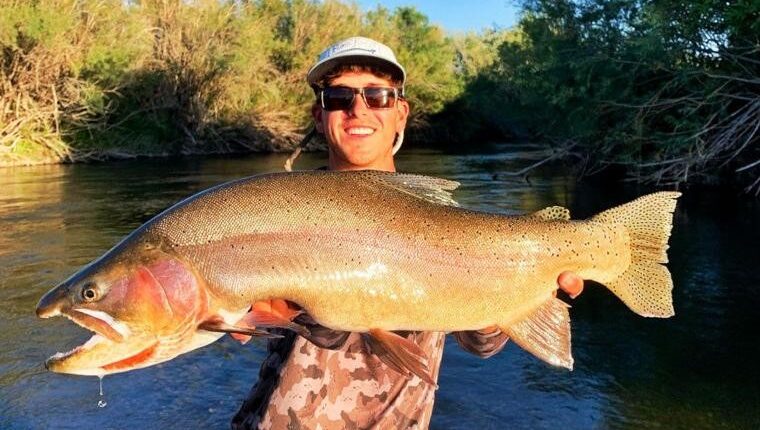
Congratulations to Nate Burr of Rexburg on setting a new state record by landing a remarkable 31-inch Yellowstone cutthroat trout.

Burr and a fellow angler had been fly fishing the Snake River for three days and looking for big trout without much success. As evening set in on the third day of slow fishing, their luck changed as a huge trout smashed Burr’s fly.

Burr grew up in Tetonia and has began his career as a fly-fishing guide at age 18. In recent years, he’s focused more on catching larger trout and less on catching big numbers of fish.

“It was one of those brutally slow days,” Burr said. “Hunting big trout on streamers means a day on the water can go from zero to 100 in a split second. That was exactly the case with this fish.”

After chasing the hooked trout for nearly half a mile downstream in a drift boat, the pair managed to finally scoop the fish with a landing net. After taking a quick photo and reviving the fish, Burr released the huge trout back into the Snake River, securing his name in the record books.

Yellowstone cutthroat trout over 30 inches are exceedingly rare — especially in river systems where they do not grow as quickly as in large lakes. Even more remarkable is that this fish just barely beats the 30.5-inch monster Yellowstone cutthroat trout record set in August by Sam Hix, also from the Snake River.

The catch-and-release record program began in 2016 as a way to recognize anglers that wanted to release the trophy fish they caught.

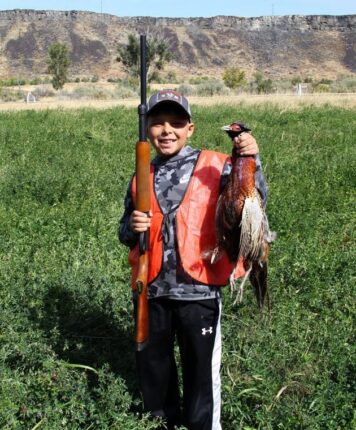
Youth pheasant season runs Oct. 3-9, new stocking areas added this year

The youth pheasant hunting season began Saturday and runs through Oct. 9. Youth ages 17 years and younger with an Idaho hunting license can participate in the youth pheasant hunt so long as they’re accompanied by an Idaho licensed hunter age 18 years or older. Anyone 18 years or older can not hunt during the youth hunt.

For full rules on the hunt, see page 11 of the 2020-21 Idaho Upland Game, Turkey and Furbearer rules booklet.

Fish and Game in 2020 is expanding its pheasant stocking program throughout the state and now includes 22 locations — at least one in each region — most of which will be stocked for the youth hunt.

Pheasant hunting at these locations starts at 10 a.m. daily with one exception in the Clearwater Region.

Youth hunters do not need an Upland Game Bird Permit to hunt where birds are stocked, but they are required to wear hunter orange above the waist during the pheasant season while hunting at those locations. A hunter orange hat meets this requirement.

For a full list of areas where pheasants will be stocked and number of birds to be stocked, go to Pheasant Stocking Program webpage at idfg.idaho.gov/hunt/pheasant/stocking and click on each location.

Young hunters who have never had a hunting license and have not taken hunter education can still participate in the hunt through Idaho’s Hunting Passport Program.

Pheasant hunting for all ages starts Oct. 10 or Oct. 17, depending which part of the state you’re in.

Right place, right time: Grizzly fight captured on video in Yellowstone

Dave Angelescu didn’t know what he’d see when he went down to the Hayden Valley in Yellowstone National Park last Saturday. All he knew is there had been a grizzly bear feeding on an elk next to the Yellowstone River for the past week. You know the one. There was a video of it taking down the elk the Friday before, and there were plenty of photos of it sitting over its kill in the following days.

Angelescu, who works for Xanterra in Gardiner, Montana, couldn’t get away from work until the weekend. Saturday was his first chance. He got to the Hayden Valley around 6:45 a.m. There were already 100 or more people there.

“It was a madhouse,” he said.

He parked north of the bear and hiked about a quarter-mile to get a good spot. A collared bear was sitting over the carcass. It has been identified as No. 881, a 17-year-old male.

That’s not the bear that originally killed the elk. It showed up and took over sometime late last week, after the original bear left. By Saturday, No. 881 had dragged the carcass uphill a bit and reburied it, hoping to conceal its scent.

A tree branch was sort of in the way for Angelescu to get good pictures, but soon that wouldn’t matter. Conflict was brewing.

Another grizzly came out of the forest and got into the water, swimming toward the elk carcass. It circled around a downed tree and toward the shore, looking to get a bite.

No. 881 wasn’t having it. It bolted down the hill once, forcing the other bear to retreat. Then the other bear made one more move toward the meat, and No. 881 bolted back down to the water.

This time, the fight was on. They clawed and bit at each other, splashing around in the river. They roared.

Grizzlies Fighting Over Elk Carcass Yellowstone National Park 9.26.20

Ultimately, No. 881 won and resumed its spot over the carcass. After No. 881 made one more run toward the water and roared again, the other bear grabbed a scrap and retreated for good.

Angelescu got it all on video.

“I was just at the right place at the right time,” he said.

He posted the full 10-minute clip to YouTube. As of Friday morning, it had more than 110,000 views.

It was the second video from that spot in two weeks to circle the world and captivate Yellowstone-lovers. The first was of the initial kill, captured by a part-time Cody, Wyoming, resident early on the morning of Sept. 18, according to the Billings Gazette.

Officials believe the bear shown killing the elk was No. 791, a 9-year-old male.

The drama drew massive crowds to the north end of the Hayden Valley. Saturday afternoon, long after the fight, the crowd of bear-watchers was still huge. They stood on the edge of the road between Canyon Village and Fishing Bridge and gawked across the river at No. 881.

Traffic crawled. A park ranger urged people to keep from stopping in the road. Cars parked at steep angles in the ditch. People tiptoed along the road shoulder to get a glimpse.

Even so, Kerry Gunther, Yellowstone’s top bear biologist, said it was a fairly well-mannered bear jam.

“From all the thousands of bear jams we’ve had over the last 20 years, then parking was actually the best at that jam than I’d ever seen for a jam that large,” Gunther said.

Gunther said Wednesday that the bears had left and the carcass appeared to be completely consumed. But there were still people there hoping they’d see something.

Who can blame them? It’s not often that an elk killing or a fight between two big boars is that visible.

“It probably happens all the time far from a road and we just don’t see it,” Gunther said.

The Hayden Valley has one of the more dense grizzly populations in the park, according to Gunther. He said female and subadult bears are seen near the road more often than males, which tend to be farther off.

Trent Sizemore, a photographer and tour guide based in West Yellowstone, said shots of bears in that area are often from a much longer distance — maybe a half-mile away, not just across the river.

He made a few stops there last week to check out the scene. He caught video of one of the bears dragging the elk carcass farther into the trees and reburying it. But he wasn’t there for the fight.

“Something like that is pretty rare to see in the park,” Sizemore said. “… It just happened to occur in a good spot.”

The identity of the uncollared bear involved in the fight is somewhat in question. Sizemore believes it was No. 791, the original killer of the elk. Angelescu thinks it was likely a third bear.

Without a collar, it’s hard to say. Gunther said a third bear is a definite possibility. It’s not uncommon for there to be multiple bears on one carcass. His staff once documented 23 bears on a single bison carcass.

The question doesn’t diminish the rarity of what Angelescu caught on camera. He moved to Montana in December, and this was his fourth run-in with a grizzly since then.

None of the others were quite as eventful.

“That was definitely a National Geographic moment,” Angelescu said.