2020 Christmas list for the outdoors types

I had COVID-19 in April and didn’t recoup until May 6. For six weeks prior to that I was helping a buddy over in South Dakota. I left there and it was pretty much still winter and by the time I got well, spring was in full swing, crappie fishing was on the tail end slide and the mushroom season was over. When I went to sleep it was winter and when I woke up and it was almost summer. I felt like Rip Van Winkle.

I got to make the most of summer but still, even now I feel a little time disoriented. And suddenly it’s almost Christmas and here I am writing my annual Christmas list. Wow.

Well, here’s a list of some of the cool items that I got to test out this year and some that are old-time favorites. I say something to this effect every year but if you take time to investigate what your little outdoor honey wants/needs, you can really rack up some points. Most of our outdoor endeavors are pretty specific so investigate before you make a purchase.

I’ve never thrown this angle in before, but with the COVID-19 panic ravaging businesses in America try to shop in your community if at all possible and keep the dollars at home. That way your friends and neighbors can maintain their jobs and businesses. If your health is compromised then, yes, you can probably do almost all of your shopping online. I just wanted to remind everyone that local businesses are what supports the community that you live in.

If you buy a unique or much-needed item, you’ll sweep your outdoor lover off their feet. And you don’t always have to spend a lot of money. Well, let’s get started:

HUNTING

  • SneakyHunter BootLamps
  • Smith’s Folding Limb Saw
  • Knives of Alaska Professional Boning Knife
  • Umarex airguns. Check out the Gauntlet, Origin or the Yukon Magnum break barrel.
  • mytopomaps. They will make a map of wherever or however detailed that you want. I use them.
  • Hi Mountain seasoning to make your own jerky and sausage.
  • Chard Pro Former Jerky Gun. I just got one. Can’t wait to use it.
  • .511 cool tactical pants, great for hunting.
  • Spyderco makes a cool little hunting knife called the Bow River knife.
  • Scopes/Binoculars. There’s an up and coming new company called Riton Optics. Check out their offerings.
  • For shooters, Caldwell makes a lot of must-have items. Shooting bags, Hydrosled and their Stable Table. These items help you have a stable rest when sighting in your rifles.
  • Otis Elite Range Box. This is a great help when mounting scopes or cleaning your guns.

BACKPACKING ITEMS

  • Alps Mountaineering Dash chair
  • Alps Chaos 2 tent
  • Alps Nimble pad
  • Camp Chef Stryker 200 stove
  • Aquimira filtered water bottles and straws
  • Adventure Medical Kits duct tape, mole skin
  • Irish Setter Canyons hiking boots
  • Hiking socks — these are worth their weight in gold.
  • Eating utensils, Outdoor Edge Chowpal, Collapsible cooking utensils.
  • Uberleben Stoker Flatpack is a cool little collapsible stove.
  • Smith’s Consumer Products offers I don’t know how many folding knives that are great for backpacking.
  • Backpacking meals

FISHING

  • Heybo makes some cool fishing shirts.
  • Mister Twister plastics. I like their tube jigs for crappie fishing.
  • I’ve been using a Honda BF 2.3 motor to fish with this summer. I like it better than my trolling motor.
  • Sunglasses. Check out the Hobie El Matador model for full eye coverage.
  • Hire a fishing guide to float a river.
  • Fishing rod & reel.
  • Fish filleting knives. Smith’s Consumer Products makes a variety of sizes.

CAMPING

  • Daisy Powerline 51 slingshot, great fun for kids (and Katy) for shooting cans around camp.
  • Grizzly 60 cooler. This is a well-built, stout cooler.
  • Camp Chef Rainer 2X camp stove
  • Smith’s Consumer Products sharpening stones. My favorite is their 8-inch Tri-hone set but I also love their 6-inch fine diamond stone.
  • Lodge Dutch oven with legs
  • Tent
  • Backpack

STOCKING STUFFERS

This is where you can score some points on cheap little knickknacks that they’ll value.

  • Split shots
  • Fishing lures
  • .22 ammo
  • Waterproof matches
  • Flashlight
  • Substitute a day pack for a stocking!
  • Talon Snap Cleaning Kit. This is a cool new kit to clean your pistol.
  • Flies make great stocking stuffers. (Check out flydealflies.com use CLAYCOMB and you can get a discount.)

Tom Claycomb lives in Idaho and has outdoors columns in newspapers in Alaska, Idaho, Utah, Nevada, Colorado and Louisiana. He also writes for various outdoors magazines and teaches outdoors seminars at stores like Cabela’s, Sportsman’s Warehouse and Bass Pro Shop.
New films scale ‘Idaho’s 12ers’ — and explore Gem State history

Two new films from Idaho Public Television’s original productions “Outdoor Idaho” and “Idaho Experience” journey to all nine of Idaho’s 12,000-foot mountain peaks and explore moments from Gem State history. IPT announced in a press release that the films air Sunday, Dec. 6, as part of the final night of IdahoPTV’s fall on-air fundraiser, DecemberFest.

‘Idaho’s 12ers’ on Outdoor Idaho

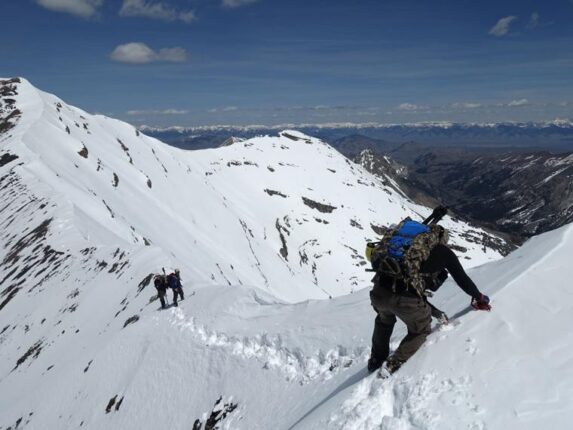
Some seek thrills, some seek records, some push themselves to the edge of physical and mental endurance. But for most Idaho climbers, standing on the top of Idaho’s tallest mountains is reward enough. For the DecemberFest special “Idaho’s 12ers” (Sunday, Dec. 6, at 7 p.m.), the Outdoor Idaho production crew spent time on all nine of the Gem State’s 12,000-foot peaks (and a few 11,000-footers) with 44 intrepid climbers of a variety of ages and experience levels — Idaho natives and newcomers, experts and novices, men and women.

“Our climbing partners ranged from the 7-, 8- and 9-year-old kids who are the youngest people to climb all the 12ers, to the retired Boise State University math professors who have climbed all 123 Idaho peaks 11,000 feet and higher,” said producer Bill Manny. “It was a lot of work, and a lot of fun.”

Outdoor Idaho explores Idaho’s 12ers and gets to know the people who cherish Idaho’s highest places from close-up and from afar.

‘Books, Boats and Embezzlers’ on Idaho Experience

For the DecemberFest special “Books, Boats and Embezzlers” (Sunday, Dec. 6, at 8:30 p.m.), our Idaho Experience team shares a collection of short stories drawn from Idaho’s rich and varied history: a publisher who maintains hands-on printing traditions; how Ernest Hemingway’s time in Idaho influenced him; the steamboats that thrived on Lake Pend Oreille at the turn of the 20th century; New Plymouth’s beginning as an irrigated utopia; an infamous Idaho criminal from a pioneer family; and drive-in theaters that keep movie-watching traditions alive.

For Marcia Franklin, who produced a piece on the Ardingers of Limberlost Press, it was a chance to step back in time and watch as the couple lovingly crafted a chapbook of poems — from printing on a century-old letterpress to sewing each book by hand. It was also an homage to Franklin’s father, who had a similar press in their home on which the two of them would print holiday cards.

“Nostalgic feelings seem to be coming to the fore for many of us these days,” said Franklin. “This edition of Idaho Experience will take viewers on a drive down a country lane of the past, and hopefully help uplift spirits. And like a good story, watch for more! Many of these pieces will be expanded in future seasons into full-length programs.”

An entity of the Idaho State Board of Education, Idaho Public Television is a statewide multimedia broadcast network with transmitters and translator stations that deliver programs to more than 99 percent of Idaho households, and is among the most-watched PBS affiliate networks per capita in the United States. IdahoPTV broadcasts across four digital channels through five full-power transmitters (KAID, Boise; KCDT, Coeur D’Alene; KIPT, Twin Falls; KISU, Pocatello; and KUID, Moscow) and offers streaming content and educational resources through its website: idahoptv.org. The mission of Idaho Public Television is to “harness the power of public media to encourage lifelong learning, connect our communities, and enrich the lives of all Idahoans. We tell Idaho’s stories.”

Idaho Parks and Rec makes campsite reservations easier, increases fees

Idaho Department of Parks and Recreation announced in a press release it will adopt a new fee structure and site-type simplification that will go into effect on Dec. 10. There will also be a $2 increase to the motor vehicle entrance fee, from $5 to $7.

The fee structure and campsite-type simplifications are designed to make the reservation process easier by limiting the amount of site types from which to choose. In effect, the number of campsite options has been reduced to three: Basic, Electric, and Full Hook-Up. For example, the term Serviced Site has been eliminated and replaced with either Electric Site or Full Hook-Up Site, making it easier to identify what the ideal campsite is for all customers.

This also means a fee increase across the board, ranging from 8 to 16 percent per site. It should also be noted that the new fees are now tax inclusive and more transparent to the customer.

“With our improved fee structure, users will know exactly what they are paying for their sites. And additional revenue from the fee increases will be used to improve and maintain campsites, ensuring users have great outdoor experiences for generations to come,” said Susan Buxton, IDPR Interim Director.

Customers can expect to see the new site types and fee increases when the nine-month reservation window reopens on Dec. 10 as well as on self-pay envelopes for both day use and walk-up camping.

Out-of-state residents will also see the standard surcharge of $3 per night for campsites, $5 per night for camper cabins and yurts, and 10 percent per night for houses, cottages, deluxe cabins, and group camps.

And a reminder to all Idaho residents to purchase their Idaho State Passport sticker with their annual motor vehicle registration. The $10 sticker saves time and money by waiving the motor vehicle entrance fee to any of your Idaho state parks.

For more information on fees and the Idaho State Passport, visit parksandrecreation.idaho.gov.

Fall survey of South Fork finds record number of fish per mile

If you’ve thought that fishing has been good for trout on the South Fork of the Snake River this year, a recent survey helps to explain why: The fish numbers are at record levels.

Idaho Fish and Game’s recent fall electrofishing survey estimates trout densities to be 6,302 fish per mile in the upper river.

“The most important take-home message from these surveys is that trout abundance is high in the (South Fork of the Snake River),” said Patrick Kennedy, Fish and Game fisheries research biologist, in a news release. “The total trout estimate is higher than ever estimated at Conant, since 1982.”

The 6,000 fish per mile number puts the South Fork in elite company.

“Other rivers in the Western U.S. also host estimates of trout per mile in the thousands, but few boast estimates higher than 5,000 trout/mile,” Kennedy said. “Within Idaho, the South Fork Boise, Big Lost and Henry’s Fork rivers boast some of our highest abundance estimates, but none have exceeded 6,000 fish per mile.”

What adds to the unusual character is that unlike other rivers with high concentration of trout, the upper South Fork is not supplemented with hatchery trout, he said.

“The exceptional wild trout population in the South Fork highlights the extremely high productivity observed in recent years in the river and the potential this tailwater fishery possesses,” Kennedy said. “For anglers, high abundances of trout should ensure that fishing will remain great into next year and beyond.”

Regional fisheries manager Brett High said “several years of heavy snowpack and good stream flows have been good for fish on the South Fork.”

Fish and Game surveyed two locations along the South Fork — the Conant monitoring reach and near the Lorenzo boat ramp. The Conant section topped 6,000 trout per mile and the Lorenzo location 2,650 trout per mile. The Lorenzo numbers were higher than the 10-year average of 1,889 trout per mile. The 10-year average for the Conant section is 4,710 trout per mile.

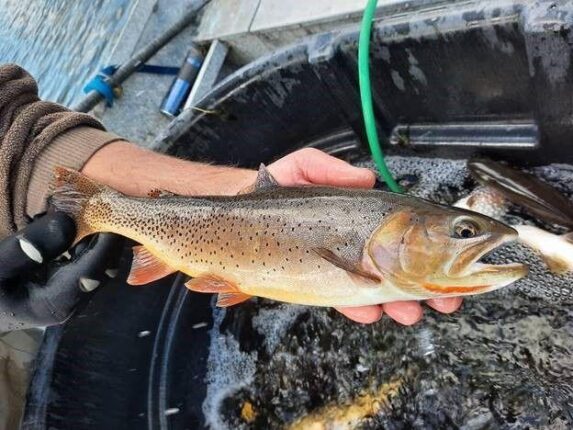
One key purpose of the annual fall survey is to see how well native Yellowstone cutthroat trout are doing, particularly in relation to nonnative rainbow trout.

Fish and Game management goals focus on protecting the “genetic integrity and population” of cutthroat in the river and reducing rainbow trout abundance to less than 10 percent of the trout in the upper river, Kennedy said. The recent survey found that rainbow trout make up 43.1 percent of the trout in the Conant reach.

“Rainbow trout still comprise more of the population in the upper South Fork than called for in the management plan,” Kennedy said. “Rainbow trout, which are the biggest threat to cutthroat trout through competition and hybridization, continue to provide management challenges.”

Fish and Game’s James Brower said the department works to limit rainbows in a few different ways. There is no limit on harvesting rainbows on the South Fork and catching rainbows is encouraged with an angler incentive program. With that program, several hundred rainbows and rainbow hybrids are tagged with money rewards of $50 to $1,000.

“They have done some and will continue to do some mechanical removal with the electrofishing program,” Brower said of other tactics to reduce rainbow numbers. “They scan those fish so they make sure they’re not taking any of the money-tagged fish from the incentive program.”

Rainbows removed from the river are planted in local fishing ponds and elsewhere.

Brower said the South Fork also has an extensive weir program on several of the nursery streams that allows them to exclude rainbow trout from spawning.

The other trout found in the South Fork survey were brown trout, making up more than 1,200 of the total fish per mile. Because brown trout are fall spawners, they don’t pose a hazard of hybridizing with cutthroats.

How to make the best turkey stew

As a grade-school kid, I’d read the Fur-Fish-Game magazine and dream of being a mountain man. No, read probably isn’t the right word. Devour would be the correct word. I’d read the articles about the old trappers up in Canada and of their lifestyles. In summer they’d go out in the woods, build a cabin, pack in supplies, cut a winter’s worth of firewood and then when the winter snows hit, they’d slap on a pair of snowshoes and set a trapline. They’d trap all winter and come out in the spring and sell their hides, which they’d scraped and stretched on the long winter nights in the cabin.

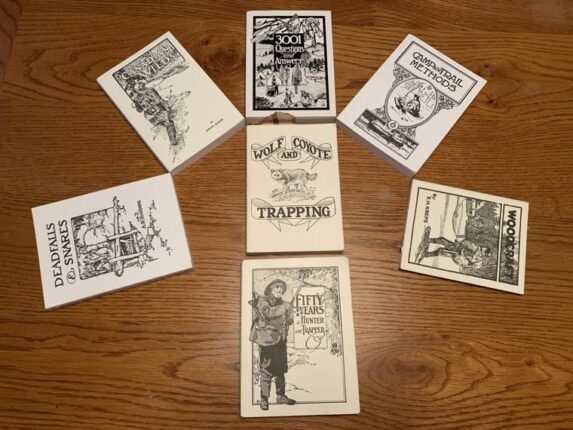
In junior high with my paper route earnings I bought some of the old A.R. Harding books that were advertised in FFG. In some of the books the old timers would talk about processing their moose, which would provide their meat for the upcoming winter. But they also made a big deal out of saving the bones, which they’d boil down to make broths and stews. You can visualize how they made their stew.

At daylight before they took off to run their traplines they’d load up a Dutch oven with moose bones, canned vegetables and snow and put it on the fireplace. After running their trapline all day they’d come home at dusk to a hot pot of stew.

Then nine or 10 years ago, I was helping a store up in Haines, Alaska, during the Canadian Thanksgiving spree. One day a young lady pulled up to the back of the store and asked if we could cut up her moose bones for her to make stew. We shrugged our shoulders and said sure. She opened her van and there was a whole moose carcass in back laying on a tarp. She took all of the cut-up bones back to her cabin to make stews and broths for the winter.

So, I guess these backdrops are what prompted me to save the bones/fat off of our Thanksgiving turkey and try to make a stew. Boy, am I glad that I did. Turkey stew has now come to be almost as enjoyable as eating the actual turkey itself. Plus, it’s super easy to make.

Ever since, I’ve been making turkey stew but I doubt that I’ve ever used the same recipe. I’ll list out a general list of ingredients that I use but feel free to improvise to your family’s liking. I suppose that you can throw in pretty much anything on up to the proverbial kitchen sink.

Here’s how I make it. I’ll throw in the turkey bones/fat, sliced potatoes, squash, tomato, onion and, for sure, cilantro. Cilantro is a key ingredient. I also slice up one to two jalapenos to add a little spice and then garlic, salt and pepper. I go light on the salt and let everyone add what they prefer when served.

There’s nothing sacred about following my exact recipe. Tweak it to what sounds good to you or what ingredients that you have handy. Cook until the vegetables are done. You won’t believe how good it is.

Maybe I’m too much of a mountain man/cowboy but it tastes best when cooked in a Lodge Dutch oven. For cooking at home, I use a Dutch oven without legs. They’re easier to use on the stove top or in the oven without legs.

I know you’re thinking that there has to be more to it than this. Nope, it’s that simple.

So when you carve up a turkey don’t throw away the bones and fat. Bag them up and freeze them so you can later make some turkey stew. Even on a smaller turkey you’ll have enough scraps to make two batches and can stretch it out to three to four batches on a large bird.

Have a Happy Thanksgiving and take a moment to give thanks for all of your many blessings. It always improves my outlook on life when I focus on all the blessings I have instead of the one or two things that I don’t have.

Sidenote: FFG is still going strong. In fact, I have an article in the November issue which is currently on the shelves. If you want to check out some of the old A.R. Harding books contact FFG or look on pages 40 and 44 in the current issue.

Tom Claycomb lives in Idaho and has outdoors columns in newspapers in Alaska, Idaho, Utah, Nevada, Colorado and Louisiana. He also writes for various outdoors magazines and teaches outdoors seminars at stores like Cabela’s, Sportsman’s Warehouse and Bass Pro Shop.
Smoking your turkey for Thanksgiving

Four centuries ago, America was a fledgling country. Her life was in the balance. The pilgrims were on the verge of starving and things didn’t look good. Luckily some friendly Native Americans came out of the woodwork (OK, the woods) and provided a feast for the pilgrims. That shifted the pendulum and gave the starving pilgrims hope.

Tradition has it that they brought in some wild turkeys among an assortment of other foods. The pilgrims were overwhelmed by their kindness and gave thanks for the meal, their new friends and all of their many blessings in general.

Since that time nearly 400 years ago, Americans nationwide have declared Thanksgiving as a national holiday and stopped for a day to acknowledge their many blessings and give thanks for them and our country. Four hundred years later, we still have the best country in the world as evidenced by the thousands of people trying to enter America. Who can blame them?

So with that said, what should your main course be this Thanksgiving? Anything less than a turkey along with maybe a smoked ham and for sure pumpkin pie is obviously a plot designed to end all true American traditions.

One year, I thought I’d do something different. I grilled some ribeyes for a change of pace. They were nice, well-marbled ribeyes. They were probably as good of ribeyes as any that you’ve ever had. But it went against all tradition. It put a big kink in the Claycomb family traditions. The Wampanoag native people would have turned over in their graves. Never again has my family deviated from having a smoked turkey as the main dish. Since then, things have settled down and all is well again in the Claycomb household. Katy and Kolby have not left me.

The last decade or so, Mom has sent us a smoked turkey from Greenburg’s in East Texas but a few weeks ago their plant burned down. So this year we will go back to me smoking the turkey. If you’ve never smoked your own turkey, don’t panic. It is super easy and will turn out delicious.

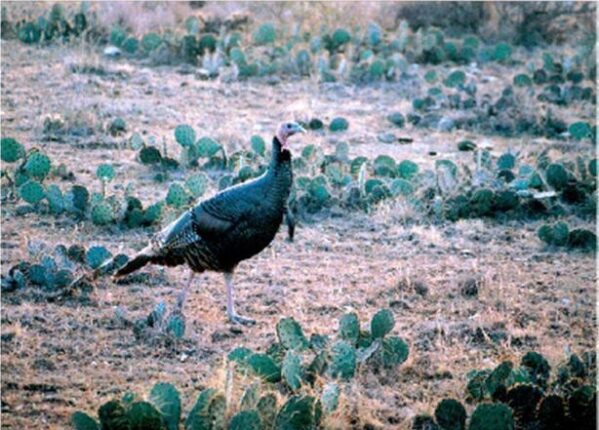
Most likely, you will run to the store to purchase your turkey, but if you’re lucky, you may be smoking a wild turkey that you killed this spring. If so, realize that you will need to baby it a little bit more than if you’re cooking a farm raised fat butterball turkey. A wild gobbler won’t have as much fat as their farm-raised cousin so it won’t be as juicy. Baby it a little more than you would a store-bought turkey.

I learned how easy it was to smoke turkeys over 40 years ago. A buddy at work, her family raised turkeys and she knew that I smoked deer meat, sausage, etc., and asked me to smoke a turkey for her. I told her I didn’t know how. She told me all that she needed was for me to put it on my smoker for three to four hours and then she’d come by that night and grab it and take it home and finish cooking it. I was apprehensive but she told me to just smoke it and quit worrying. (At the time, I had a wood smoker. Now I use my Camp Chef pellet smoker.)

The next day she brought me a sample. Oh my gosh, it was the best turkey that I’d ever had. I have since cooked them as she instructed. Here’s how you do it. If you have a regular smoker, throw it on the smoker at low heat for four hours. Then put it in a black turkey-roasting pan in the oven all night at about 190-200 degrees.

Put a couple of cups of water in it to keep it moist. You don’t want it to dry out. In the middle of the night check it out. If all of the liquid has evaporated add a couple of more cups of water. When you wake up, if it pretty much falls apart with a fork, it’s done. If not, turn up the heat to 325 and cook until done.

When you put it in the oven, sprinkle with spices. I’ve cooked it like this for the past 40 years. But this year, I’m going to deviate and use this recipe that I found on Hi-Mountain Seasoning’s website: Bourbon-glazed Holiday Turkey. It looks good. (himtnjerky.com)

I’ve ordered their Game Bird & Poultry Brine Mix and their Poultry Rub Blend to use. I can’t wait!

Tom Claycomb lives in Idaho and has outdoors columns in newspapers in Alaska, Idaho, Utah, Nevada, Colorado and Louisiana. He also writes for various outdoors magazines and teaches outdoors seminars at stores like Cabela’s, Sportsman’s Warehouse and Bass Pro Shop.
Trumpeter swans released in Yellowstone to bolster population

Eight young trumpeter swans were released in Yellowstone National Park’s Hayden Valley earlier this year as part of an ongoing restoration project to halt the decline of the bird inside the park.

On Sept. 19, staff from the park, the Wyoming Wetlands Society, and Ricketts Conservation Foundation released the swans at Alum Creek in Hayden Valley.

“From a high of over 60 birds and 17 territorial pairs in the early 1960s, to only four birds in 2009 and 2010, the swan population has declined for a variety of reasons,” the park said in a news release. “Researchers are collecting population data such as nest success, number of territorial pairs, and the number of cygnets produced each year. This data may help determine the reasons for the decline.”

The Teton Basin Trumpeter Swan Restoration Project, a collaborative effort in the Driggs-Victor area, recently released six cygnets (young swans) onto a protected wetland in Teton Valley.

“(We) have been monitoring them for a month and have observed them bonding with a wild swan,” the Teton Regional Land Trust said in a recent news release.

The project is a partnership between the land trust, Idaho Fish and Game, U.S. Fish and Wildlife Service, Intermountain Aquatics and others.

The trumpeter swan is named for its musical call and is North America’s largest wild waterfowl with a wingspan of up to 8 feet, according to the park’s trumpeter webpage. The bird once nested from Alaska to northern Missouri but was nearly eliminated in the lower 48 states by 1930. About 70 birds survived in the Greater Yellowstone ecosystem and, after intensive management, recovered in the latter half of the century to about 63,000 today.

Numbers inside Yellowstone National Park show signs of rebounding after recent efforts to restore them. Swans were also released into the park in 2019.

“Recent releases and other restoration efforts have bolstered the population to over 20 birds and five territorial pairs, including natural reproduction in some years,” the park said.

Park biologists say limiting factors for swans in Yellowstone appear to be flooding of nests, predation, possibly effects of drought caused by climate change, and less immigration into the park from outside locations.

There is no hunting season for trumpeter swans in Idaho.

The park said the effort is a public/private partnership between the National Park Service, Wyoming Wetlands Society, Ricketts Conservation Foundation, and Montana State University.

A short video of the release can be seen here: facebook.com/YellowstoneNPS/posts/2948153785199956.

Going into Idaho’s outdoors country? Sometimes you’re gonna get stuck

If you’re going to get into good country, sometimes you’re going to get stuck. It’s not a maybe, it’s only a when. Let me throw out one disclaimer first. When you finally get your first four-wheel-drive truck, you erroneously think that you’re bulletproof. Newsflash — you’re not. Just because you have a four-wheel-drive doesn’t mean that you can’t get stuck so be prudent. I’ve heard it said, drive like you have a two wheel drive, that way you don’t jump all in and get hopelessly stuck.

When you really get in trouble is when you drive too aggressively and get in too far, and then it’s really hard to get you out.

So enough theory. What’s the moral of this article? You’re going to get stuck once in a while, so how do we get out?

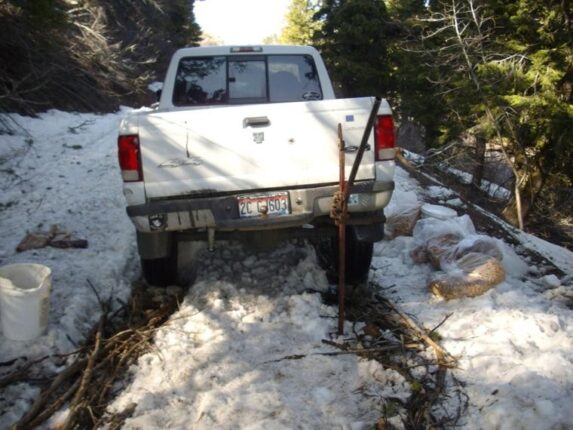
The curse of all curses is when you high center. That’s when the snow or dirt is up against the body of your truck. Not good. What you’ll have to do in this scenario is jack up your rig and put some rocks in the ruts and under the wheels. If no rocks are handy then use sticks and limbs. Anything to get your truck to set up higher.

To be able to do this you need to carry a Handyman jack. A little hydraulic jack usually is nonfunctional. You’re buried in the mud so you can’t get the hydraulic jack slipped in under the truck and even if you can you’re on a soft base. If there is enough clearance you might be able to put a rock under the jack. Just carry a Handyman jack.

With a Handyman jack, you can put the lip under the bumper or whatever is stout enough to lift your truck and lift it up. Don’t get under anything as the ground under the jack will likely be muddy and slippery and it can shoot out and drop the truck.

I always carry a few quarter-inch bolts and nuts because laying in the bed of my truck and bouncing around the bolt holding on the jack handle is always getting lost. Many times the jack gets rusty and won’t function. Keep a quart of oil in your truck which you should do anyway and pour a little on the jack mechanism to lubricate it up so it’s functional.

You also need to keep a shovel in back of your truck. That way you can dig out some of the snow and mud that is causing you to high center. I don’t carry one but I’ve also thought that a hoe would be beneficial in a lot of circumstances. I used to worry about someone stealing the gear out of the back of my truck but most of the kids in town are little yuppies now and don’t even know what a shovel and a Handyman jack are. And the ones that do are farm and ranch kids and are decent enough so they won’t steal them.

Always carry a chain. You’ll need it so someone can pull you out or so you can pull out some other poor soul. You can also pull trees off the trail if one is blocking you in. And while speaking of trees blocking the road, for sure carry an axe and it’s best to have a chain saw.

Think about it a minute. You see a lot of blown over trees while hunting, right? That happens behind you sometimes when you go down a trail, too. Speaking of, one time we had hiked down a trail in the Frank Church River of No Return Wilderness Area while fly fishing. I’d backpacked in and set up a camp back in there a few miles. That morning my nephew Tom and I had hiked downstream fishing. Later when we were fishing back to camp we found a 20-foot log, about 2.5 feet in diameter laying dead center in the trail. It had rolled down the mountain and landed in the trail. Glad we weren’t there when that happened.

Same can happen behind you when you drive in on a trail. One time on a spring bear hunt Ed Sweet and I drove into an area. Going in we noticed a crack down the middle of the road. The downhill side had dropped about 1 inch. Coming out it had now dropped 2 inches. Not good. You don’t want that to sluff off and slide down the mountain. Hate to be a weenie but Mercedes and I got out and let him drive over that spot alone!

A lot of people have winches on their four-wheelers but not too many people do on their trucks. If you do, they can be beneficial. I have a buddy that carries a big spike, he drives it in the ground and then has something to tie off to when stuck out on the prairies.

Then lastly, of course, aggressive tires make a big difference. If your tires are bald you’re not going to get any traction. And nothing to do with getting stuck but go to the junkyard and get an extra tire and wheel. As many flats as I get I always carry two spares. Be careful out there.

Tom Claycomb lives in Idaho and has outdoors columns in newspapers in Alaska, Idaho, Utah, Nevada, Colorado and Louisiana. He also writes for various outdoors magazines and teaches outdoors seminars at stores like Cabela’s, Sportsman’s Warehouse and Bass Pro Shop.
Forest Service, BLM offers Christmas tree cutting permits

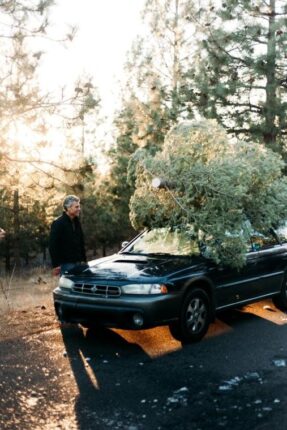
The National Forest and Bureau of Land Management are offering Christmas tree cutting permits starting this month for families to march around in the backcountry and find that perfect holiday tree.

If you have a fourth-grader in your house, the Every Kid Outdoors program provides one free Christmas tree cutting permit for every valid Every Kid Outdoor pass.

“We are super stoked about being able to do online permits,” said Caribou-Targhee National Forest spokeswoman Sarah Wheeler via text.

Permits to cut Christmas trees up to 20 feet high cost $15 — one per household — and can be found online at fs.usda.gov/detail/ctnf/passes-permits/forestproducts or by going to recreation.gov.

“We are excited to offer online purchasing this year,” said Tom Silvey, timber program manager at Caribou-Targhee. “We decided to offer online sales as an added convenience for visitors and because it provides an attractive alternative to in-person transactions at offices that remain closed to walk-in business due to the COVID-19 pandemic.”

The Forest Service website also includes safety information, maps on where it’s permissible to cut trees and how to care for your tree.

Permits and maps are also available through local ranger district offices and participating vendor locations. District offices include Dubois (208-374-5422), Ashton (208-652-7443), Teton Basin (208-354-2312), Palisades Idaho Falls (208-523-1412), Soda Springs (208-547-4356), and West Side Pocatello (208-236-7500).

Bureau of Land Management information can be found by calling the Idaho Falls office at 208-524-7500 or the Pocatello office at 208-478-6340.

“Households that purchase a Christmas tree permit are encouraged to harvest their trees as soon as possible due to weather conditions,” Wheeler said in a news release. “Mountain snowstorms and subsequent road conditions can limit access to cutting areas. The earlier folks cut their trees, the greater the chances of getting into areas where previous year cuttings have limited the number and selection of trees.”

The Every Kid Outdoors offer can only be validated through the local Forest Service or recreation.gov site. The Every Kid in a Park initiative allows fourth-graders to go to the Every Kid in the Park website and obtain a pass for free entry for them and their families to more than 2,000 federally managed lands and waters for an entire year starting Sept. 1, 2020.

New to the outdoors? I’ve got you covered

Katy and I were talking and she said her principal said he’d heard that I liked hunting. She asked him if he liked the outdoors and he said he used to but hadn’t been in 12 to 15 years, that he didn’t know where to go.

Which prompted her to say I ought to write an article about how to get into hunting.

I’m super blessed. I had the best mom and dad in the world. Dad took us hunting and fishing with him since we were born. We got BB guns when we were 6 years old, pellet guns at 9 years old and shotguns at 10. When I started dove hunting, I couldn’t even reach the trigger. I had to hold the butt under my arm like granny on the Beverly Hillbillies.

But what if you didn’t come from a hunting family? How could you get into it? It’s almost like a family inheritance or something — if you don’t have a dad or uncles that take you as a kid it can be almost impossible to get into.

I think we have to break newbies into two groups. Group one hasn’t ever hunted/fished and group two has but they’ve just moved to Idaho, or maybe just moved to a new locale and lost their old hunting/fishing spots.

GROUP ONE: I’M A HUNTING NEWBIE

There are a million/trillion Californians moving into Idaho. Many of them would like to get into the Idaho lifestyle but don’t know how to start. They’re not against hunting/fishing/camping — they just don’t know how to get into it. I’ve had a lot of them tell me this. This may be you.

So how do you become the next Kit Carson? It’s tough but not impossible. Let’s speed up your learning curve. I meet most of my hunting buddies at church or work.

Have patience. There’s so much to learn so it will take a minute. First thing, guns are a lot of fun but if someone gets shot it sucks all the fun out of it. You’re going to be shooting/hunting with people you love. It would screw up your life if someone you love got shot. I’m not known as Captain Safety. This year I’ve broken a rib twice, cracked my patella, torn a meniscus, gotten stabbed and I can’t remember what else but on gun safety, I take it super serious. While hunting, make it a standing rule that everyone has the freedom to point out unsafe acts. This is serious stuff.

The good news is, now it is easier than ever to get into the outdoors. As a kid, I only remember a couple of outdoor shows. There were no YouTubes, podcast, blogs, etc. Now there’s a million videos on calling, etc.

When I first started elk hunting, I just grabbed a bugle and went hunting. In those days, there were no tubes. We cut a vacuum cleaner hose and blew into it. There’s no reason you can’t have a sharper learning curve than we had in the old days due to all of the helps.

Seminars: I’d recommend hitting all of the outdoor seminars you can. I never heard of an outdoor seminar until I was in my 30s. Now I conduct 50 to 60 seminars a year. The first of the year I’ll be conducting two seminars at the Dallas Safari Club Convention & Expo, five at the SHOT Show in Vegas, and four at the 2021 Safari Club International (SCI) Convention also in Las Vegas, plus at multiple retail stores. But I still attend as many seminars as I can to keep on top and learn new tricks.

Publications: The Idaho Press has the best outdoor page of any newspaper. One disclaimer though. Used to all articles had to get approved and edited by an editor. Now, anyone can start a website/blog with no reality filters But there are a few good ones. I write a weekly Product Review for Ammoland ShootingSports News (ammoland.com), which is the largest outdoor website in America. Also, check out gunpowdermagazine.com.

Join local clubs, the gun range, archery clubs, shooting range events, local Ducks Unlimited club, the National Rifle Association and so forth. You’ll meet people there.

GROUP TWO: I USED TO HUNT BUT …

I’ve had to move a bit and that’s always a major pain. In some ways it’s like starting all over again. You have to discover new hunting/fishing spots. That can be a major pain but it can also be exciting. You’ll meet new hunting partners at work, Church or in your neighborhood.

If you’re a girl, it can be really tough to get into the outdoors. Of course, ALL of the guys will want to teach you the ropes but that can get weird. There’s getting to be more women groups. My wife and daughters go shooting with their buddies.

So yes, it’s tough getting into the outdoor world if you weren’t raised in it but it is not impossible.

Imagine you just moved to a new country and don’t know the customs or the language? That’s almost how drastic it is. Have the attitude of a 2-year-old and jump in with both feet.

Tom Claycomb lives in Idaho and has outdoors columns in newspapers in Alaska, Idaho, Utah, Nevada, Colorado and Louisiana. He also writes for various outdoors magazines and teaches outdoors seminars at stores like Cabela’s, Sportsman’s Warehouse and Bass Pro Shop.